The Architect of Light: Defining Sargent's Impressionistic Realism
To step into the world of John Singer Sargent is to enter a realm where light does not merely illuminate a subject but breathes life into it. As an American master who navigated the sophisticated circles of both Europe and America, Sargent possessed a singular ability to marry the rigorous precision of Realism with the fleeting, ethereal qualities of Impressionism. His work serves as a bridge between eras, capturing the tangible weight of silk and the subtle warmth of skin while simultaneously celebrating the spontaneous dance of sunlight across a landscape.
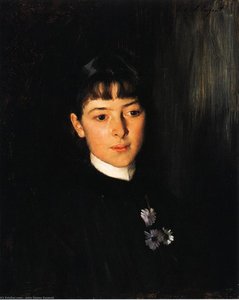
This mastery is perhaps most evident in his command over tonal range. Sargent did not rely on heavy outlines to define form; instead, he utilized the interplay of shadow and brilliance to sculpt his subjects upon the canvas. In works such as Emily Sargent, one observes how light functions as a structural element, carving out depth and presence with an almost architectural certainty. His palette, though often grounded in the classical traditions of the Old Masters, was infused with a modern vitality, using unexpected highlights to suggest movement and atmosphere.
Ultimately, his approach redefined the boundaries of portraiture. By treating light as a living protagonist, he moved beyond mere documentation, offering instead a sensory experience that remains as potent today as it was during the Gilded Age. He taught us that to truly see a subject, one must first understand how the light chooses to touch it.
Gilded Age Grandeur: The Art of Portraiture and Social Elegance
The era in which Sargent flourished was one of unparalleled opulence, a period defined by the rise of industrial titans and a social hierarchy draped in velvet and lace. He became the preeminent chronicler of this Gilded Age, capturing the psychological depth and outward splendor of the era's most influential figures. His portraits are far more than social records; they are profound studies of identity, status, and the quiet tensions hidden beneath a veneer of aristocratic poise.
In his celebrated portrait Violet Sargent and Flora Priestley, we witness an intimate glimpse into a private moment, where the grandeur of setting is balanced by a remarkable sense of human connection. Sargent had an uncanny ability to navigate the duality of his subjects—capturing the public persona of wealth and prestige while simultaneously revealing the introspective, often vulnerable, gaze of the individual. His brush could render the stiff, formal collars of high society with equal ease to the soft, flowing drapery that suggested a more romanticized, effortless elegance.
Through these works, Sargent immortalized an age of transition. He captured the very essence of prestige, ensuring that the grace and gravity of his sitters would endure long after the era of candlelight and carriage had faded into history. To view his portraits is to walk through the halls of a vanished world, feeling the weight of its history and the shimmer of its splendor.
Brushwork and Bravura: Analyzing the Technical Mastery of the Master
Beyond the subject matter lies the true marvel of Sargent’s genius: his technique. Often described as having a "bravura" style, Sargent utilized bold, confident brushstrokes that could appear almost impressionistic upon close inspection, yet resolved into breathtakingly realistic textures when viewed from a distance. This economy of means—the ability to suggest complex details with a single, decisive stroke—is the hallmark of a true virtuoso.
His use of impasto, the thick application of paint, allowed him to create physical texture that caught actual light on the canvas surface. This technique was particularly effective in rendering the tactile qualities of fabrics, from the heavy sheen of satin to the delicate transparency of lace. There is a rhythmic energy in his hand; one can almost trace the movement of the brush as it sweeps across the canvas, leaving behind traces of white lead and oil that pulse with vitality.
This technical prowess was not merely for show; it was essential to his storytelling. The fluidity of his strokes allowed him to capture the ephemeral—the shimmer of a reflection in water or the sudden glint of light on jewelry. It is this marriage of technical discipline and expressive freedom that prevents his work from ever feeling static, imbuing every canvas with a sense of immediate, living presence.
Intimacy in Oil: Exploring Personal Subjects and Landscapes
While much of Sargent's fame rests upon his grand social portraits, there exists a deeply moving dimension to his oeuvre found in his more personal explorations. Away from the demanding commissions of the elite, Sargent turned his gaze toward the intimate and the elemental. His self-portraits, such as the 1906 Self Portrait, offer a rare window into the artist's own psyche, showcasing an introspective gaze that is both haunting and profoundly human.
In these more private works, the bravado of his social portraiture gives way to a quiet, contemplative strength. He explored the landscape not just as a backdrop for human drama, but as a subject capable of profound emotional resonance. His landscapes often mirror the same light-drenched philosophy found in his portraits, using the shifting weather and the play of shadows to evoke moods ranging from serene tranquility to melancholic solitude.
These works remind us that Sargent was, at his core, an observer of life in all its forms. Whether capturing the grandeur of a ballroom or the quietude of a coastal afternoon, his commitment to the truth of perception remained unwavering. It is in these smaller, more personal moments that we find the heartbeat of his artistry.
Preserving the Legacy: Bringing Sargent’s Brilliance into the Modern Home
The enduring appeal of John Singer Sargent lies in his ability to transcend time. His works do not feel like relics of a bygone era; rather, they possess a contemporary energy that continues to inspire collectors and art enthusiasts globally. The elegance he captured is timeless, offering a sense of sophistication and historical depth that can transform any modern interior into a space of profound beauty.
For those seeking to honor this legacy, the pursuit of high-quality reproductions offers a way to invite this brilliance into one's personal sanctuary. At ArtsDot.com, we specialize in preserving this human creativity through meticulous, hand-painted oil reproductions. Our master artists, holding degrees from prestigious academies, utilize the same dedication to texture and light that Sargent himself embodied. Each piece is a labor of passion, painted on 100% cotton canvas with visible brushstrokes that capture the true soul of the original.
Whether you are drawn to the sweeping landscapes of his travels or the commanding presence of his Gilded Age portraits, our collection allows you to curate a space defined by classical excellence. We believe that fine art should be accessible, providing a bridge between the masterpieces of the past and the homes of the present, ensuring that the luminous brilliance of Sargent continues to shine for generations to come.