

Introduction
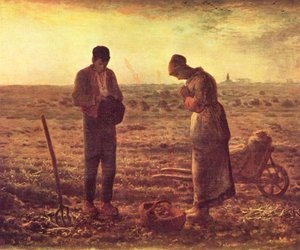
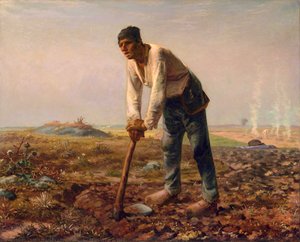
To step into the world of Realism is to strip away the gilded illusions of myth and the dramatic escapism of Romanticism, choosing instead to confront the unvarnably beautiful truth of the human condition. It was a movement born from a profound desire to witness life as it truly unfolded—not through the lens of heroic legends or idealized landscapes, but through the grit of the earth, the weight of labor, and the quiet dignity of the everyday.
Emerging in the mid-19th century, particularly within the vibrant, turbulent heart of France, Realism acted as a courageous rebellion. It demanded that the artist’s gaze remain fixed upon the tangible: the weathered hands of a peasant, the somber light of a rural workshop, and the raw, unpolished textures of the working class. These masters rejected the polished perfection of Neoclassicism to find poetry in the mundane, proving that there is an inherent majesty in the honest depiction of our shared reality.
Today, as we navigate an era often dominated by digital artifice and curated perfection, these masterpieces resonate with a renewed, haunting relevance. They serve as a vital reminder that authenticity possesses its own profound depth and that true beauty does not require embellishment to command our respect. As we prepare to explore these ten definitive works, we invite you to look closer—to feel the texture of the canvas and the pulse of history—as we rediscover the era that taught us how to truly see.
Olympia - Édouard Manet
 Olympia - Édouard Manet
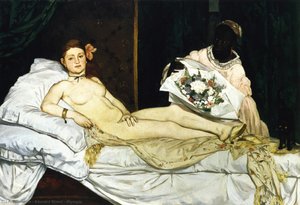
In Édouard Manet’s Olympia , one is immediately met by a gaze that refuses to look away—a piercing, unapologetic stare that confronts the viewer with startling intimacy. As a cornerstone of the Realism art movement , this work stripped away the idealized veils of mythology to reveal the raw, unvarnished truth of modern life. There is a profound psychological depth in her defiance; she is not a distant goddess, but a contemporary woman asserting her presence. The stark contrast of light against the crumpled linens and the symbolic weight of the black cat create a tension that remains palpable centuries later. To display such a revolutionary masterpiece within your home is to invite a dialogue between history and modernity. Whether placed in a quiet library or a grand salon, this painting transforms a personal sanctuary into a space for profound reflection, challenging the boundaries of perception and anchoring your collection with an undeniable sense of historical importance.
The Fog Warning - Winslow Homer
 The Fog Warning - Winslow Homer
In Winslow Homer’s 1885 masterpiece, The Fog Warning , one feels the immediate, chilling weight of the encroaching mist. The painting captures a moment of breathless tension, where the solitary fisherman’s struggle against the turbulent, slate-gray waves becomes a universal symbol of human endurance. As a cornerstone of the Realism movement , Homer eschews romanticized beauty for an unflinching look at life's precariousness, using thick, textured brushstrokes to render the heavy Atlantic swells and the looming threat of the fog.
There is a profound psychological depth here; it is a meditation on vulnerability and the indomitable spirit. Integrating such a powerful work into your home—perhaps as a focal point in a study or a quiet corner of a library—transforms a personal sanctuary into a space for deep reflection. It serves as a constant, silent reminder of the strength found within the storm, anchoring your interior with historical gravity and emotional resonance.
Man at the Window - Gustave Caillebotte
 Man at the Window - Gustave Caillebotte
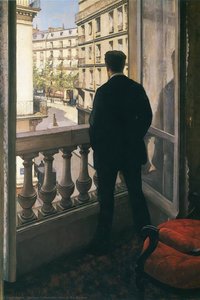
What story does the sprawling, Haussmann-era cityscape through the window of Man at the Window tell? It whispers of profound urban isolation amidst the rapid modernization of 19th-century Paris. Gustave Caillebotte’s 1875 masterpiece is a cornerstone among the top 10 masterpieces that defined the Realism art movement , capturing the unvarnished truth of the human condition within an evolving metropolis. While his brushwork hints at the dawn of Impressionism, the painting remains anchored in the meticulous detail and structural precision characteristic of Realism. The viewer is captivated by the striking contrast of a vibrant red chair against the muted, somber tones of the urban architecture, creating a palpable sense of quiet contemplation. For the sophisticated homeowner, this work serves as more than an acquisition; it offers a curated escape, inviting a sense of historical depth and a window into a lost era to grace the walls of a modern, thoughtfully designed interior.
The origin of the world - Gustave Courbet
 The origin of the world - Gustave Courbet
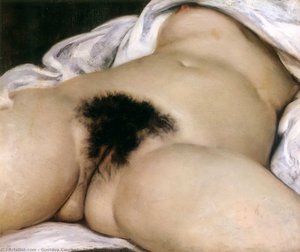
What story does the intimate, unadorned landscape of The origin of the world by Gustave Courbet tell? It is a narrative of profound rebellion, stripping away the polished, mythological veneers of the Academy to reveal the raw, anatomical truth of existence. As a cornerstone of the Realism movement , this 1866 masterpiece stands as one of the top masterpieces that defined Realism because it dared to replace idealized beauty with unapologetic naturalism. Through masterful chiaroscuro, Courbet uses deep shadows and earthy ochre tones to create a sculptural, tactile presence that commands attention. The tight composition forces an intimate confrontation, making the viewer a witness to art history's most provocative anatomical study. For the modern interior, such a piece serves as a sophisticated historical escape; it brings a sense of weight, texture, and daring authenticity to a curated collection, transforming a contemporary space into a window onto art’s most revolutionary era.
The Stone Breakers - Gustave Courbet
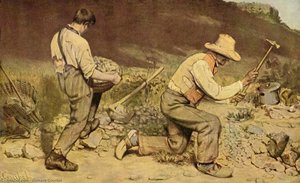 The Stone Breakers - Gustave Courbet
In The Stone Breakers by Gustave Courbet, the composition is a masterclass in structural tension and geometric weight. The painting utilizes strong diagonal lines of the quarry face to guide the eye through the arduous task of the laborers, while the heavy, rectangular shapes of the stones create a grounded, almost architectural stability. This careful balance between the rugged foreground figures and the soft, distant landscape achieves a sense of timeless perfection, securing its place among the most significant masterpieces of the Realism art movement .
There is a profound internal harmony here; the way Courbet anchors the composition with earthy ochres and muted browns mirrors the principles of modern minimalist design. Much like a contemporary clean aesthetic, the painting’s focus on essential forms and unadorned truth provides a grounding element for any sophisticated interior. It is not merely a depiction of toil, but a rhythmic arrangement of light and shadow that captures the raw, enduring soul of the working class.
Lane with poplars near Nuenen - vincent willem van gogh
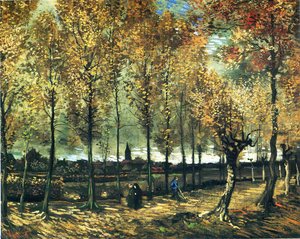 Lane with poplars near Nuenen - vincent willem van gogh
Before the vibrant yellows of Arles ever touched a canvas, there was a profound, somber truth to be found in the Dutch soil. In Lane with poplars near Nuenen by Vincent van Gogh , we witness a master in the making, capturing the quiet gravity of the 1885 landscape. This work earns its place among the defining masterpieces of the Realism movement because it does not merely depict a path; it anchors the viewer to the earth.
The composition is commanded by the vertical strength of towering populating trees, their forms rendered with an emerging, expressive weight. Through a palette of deep greens and muted, earthy ochres, Van Gogh captures the atmospheric haze of the countryside, using heavy, deliberate brushstrokes that hint at the emotional intensity to come. It is a pivotal moment where academic precision begins to yield to raw feeling. Today, such works remind us that true art does not just decorate a room—it breathes life and historical soul into our most cherished spaces.
Woman with a Parrot - Gustave Courbet
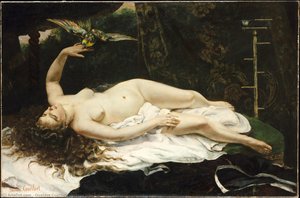 Woman with a Parrot - Gustave Courbet
In Woman with a Parrot by Gustave Courbet, the composition is anchored by a masterful diagonal line formed by the reclining figure, cutting through the organic, irregular shapes of the dark forest backdrop. This structural harmony—the delicate balance between the soft, rounded forms of the subject and the textured, shadowed foliage—creates a sense of timeless perfection that defines the very essence of the Realism movement . There is a profound parallel here to the principles of modern minimalist design; just as a single, intentional element can ground a contemporary space, Courbet’s internal equilibrium provides a sophisticated focal point for a clean, modern aesthetic. The palette, rich with earthy greens and luminous flesh tones, is punctuated by the vibrant presence of the parrot, evoking an atmosphere of serene intimacy. Through dramatic lighting and meticulous brushwork, Courbet captures a moment where raw authenticity meets eternal grace, making this masterpiece an enduring icon of art history.
Harvesters Resting - Jean-François Millet
 Harvesters Resting - Jean-François Millet
What if I told you that Harvesters Resting by Jean-François Millet was born from a moment of rebellion—a stroke of defiance against the ordinary? This is not merely a painting; it is a manifesto . Its place among the top masterpieces of the Realism movement is not just earned; it is demanded by history.
Millet stripped away the polished, idealized illusions of his era to reveal the profound dignity found in the raw, unvarnished truth of rural life. Through a palette of sun-drenched ochres, muted greens, and deep earth tones, he captures the heavy, rhythmic pulse of labor and the quiet strength of community. The soft, diffused light illuminates the weary yet resilient figures, turning a simple moment of respite into a timeless study of human endurance and the beauty of the natural world.
At ArtsDot, we believe such soul-stirring works should transcend museum archives to become living decor for your most refined spaces. Imagine this textured, hand-painted oil reproduction anchoring your home or office—transforming every glance into a reminder that your space is not just a room, but a profound statement of heritage and elegance.
Honoré Daumier Nous voulons Barabbas (Ecce Homo) We want Barabbas (Ecce Homo) - Honoré Daumier
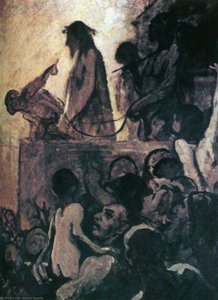 Honoré Daumier Nous voulons Barabbas (Ecce Homo) We want Barabbas (Ecce Homo) - Honoré Daumier
Before he was celebrated as a master of oil, Honoré Daumier was a notorious provocateur, often risking censorship through his biting political caricatures. In 1852, this subversive spirit reached a fever pitch in Nous voulons Barabbas (Ecce Homo) , a work that stands as one of the Top 10 Masterpieces That Defined the 'Realism' Art Movement . Daumier eschews classical beauty for a raw, visceral truth, utilizing a somber palette of deep ochres and heavy blacks to sculpt faces out of shadow. Through dramatic chiaroscuro and vigorous, impasto-like brushstrokes, he captures the terrifying moment of collective moral failure. The painting’s heavy atmosphere and textured depth do more than recount a biblical tragedy; they command presence. For the discerning professional, placing such a profound work in a modern home office or study fosters an environment of gravity and intellectual rigor, inviting a space for deep reflection and the pursuit of truth.
The Flute Concert at Sanssouci (sketch) - Adolph von Menzel
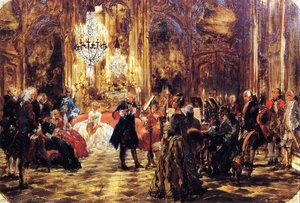 The Flute Concert at Sanssouci (sketch) - Adolph von Menzel
Close your eyes. Can you feel the flickering candlelight in The Flute Concert at Sanssouci (sketch) by Adolph von Menzel? It is not merely illumination; it is a language . Menzel did not simply paint light—he composed it, much like a musician crafting a delicate sonata. This work stands as a definitive masterpiece of the Realism movement because it does more than reflect light; it invents it .
As you gaze upon the poised figure in her flowing white dress, Menzel’s energetic, gestural brushwork breathes life into the gilded shadows and warm ochre tones of the palace interior. The scene captures the fleeting essence of 19th-century social elegance and human connection through a masterful interplay of texture and atmosphere. Now, open your eyes. That luminous, historical glow is waiting to spill into your home, turning your walls into portals of inspiration.
Conclusion
As the light fades on our journey through the profound depths of the Realism movement, we are left with more than just a collection of historical artifacts; we carry with us a renewed recognition of the beauty found in unadorned truth. These masterpieces do not merely exist as relics of a bygone era preserved behind museum glass; they act as living presences, breathing life into our most intimate spaces and anchoring our modern lives to the raw, honest textures of human experience.
To invite such gravity into your home is to participate in an eternal dialogue between the past and the present. Whether it is through the heavy, tactile impasto of a landscape or the quiet dignity captured in a portrait, these works transform a house into a sanctuary, turning walls into windows through which we view the enduring strength of the human spirit. They remind us that art is not an escape from life, but a deeper immersion into it. We invite you to continue this exploration and find your own connection to this legacy within our full collection , where the pulse of history meets the elegance of your personal surroundings.