


Introduction
To step into the world of Neoclassicism is to enter a realm of profound order, where the chaotic emotions of an era are distilled into the sublime clarity of antiquity. Imagine walking through a gallery where every brushstroke serves a higher purpose: to evoke the stoic dignity of ancient Greece and the disciplined grandeur of Rome. This movement did not merely seek to imitate the past; it sought to resurrect its virtues—honor, duty, and structural perfection—at a time when the world was undergoing the seismic shifts of revolution and enlightenment.
Born in the mid-1erm century, Neoclassicism emerged as a sophisticated rebellion against the ornate excesses of the Rococo. It was an era defined by the archaeological rediscoveries of Pompeii and Herculaneum, which breathed new life into the classical imagination. Artists began to trade whimsical flourishes for sharp contours, a muted yet powerful palette, and compositions that feel as permanent as marble. Through their canvases, painters captured the tension between individual passion and civic responsibility, creating a visual language that spoke of stability amidst political upheaval.
Even in our modern, fast-paced digital age, these masterpieces retain an arresting relevance. They remind us of the enduring power of balance and the beauty found in restraint. The dramatic lighting and sculptural precision found in these works continue to inspire contemporary designers and collectors alike, offering a sense of timelessness that transcends the fleeting trends of fashion. There is a quiet authority in these paintings that commands the room, providing an anchor of elegance for any curated space.
In the following curation, we invite you to journey through ten pivotal works that embody this spirit of classical revival. From the heroic narratives of Jacques-Louis David to the luminous, structured landscapes that define the era, each piece serves as a window into a period where art was used to shape the very soul of civilization. Prepare to encounter the textures, the shadows, and the monumental legacies that continue to define the pinnacle of Western art history.
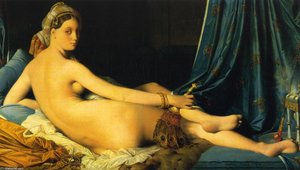
The Grande Odalisque - Jean-Auguste-Dominique Ingres
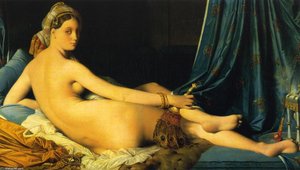 The Grande Odalisque - Jean-Auguste-Dominique Ingres
In 1814, Jean-Auguste-Dominique Ingres unveiled The Grande Odalisque , a work that serves as a breathtaking bridge between the disciplined precision of Neoclassicism and the emotive pulse of Romanticism. This masterpiece is not merely a painting; it is an inheritance of elegance . Through his legendary technical virtuosity, Ingres employs a smooth, luminous surface—achieved via meticulous oil glazes—to render the soft contours of a reclining figure. While he adheres to classical academic standards, he famously defies anatomical rigidity, introducing deliberate elongations that lend the subject a dreamlike, ethereal grace.
The composition invites us into an Orientalist fantasy, where rich textures of silk, ornate drapery, and delicate feathers evoke a sense of exotic luxury. The warm palette of flesh tones, contrasted against deep blues and shadows, creates a profound atmosphere of quietude and mystery. To possess such a work is to embrace a lineage of taste ; it is a nod to the masters that transforms a private space into a curated gallery. With ArtsDot, this monumental legacy moves from the museum walls directly to yours, allowing you to live amidst the timeless beauty of art history.
The Oath of the Horatii (detail) - Jacques-Louis David
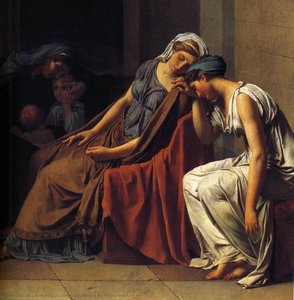 The Oath of the Horatii (detail) - Jacques-Louis David
In this poignant detail from Jacques-Louis David’s 1784 masterpiece, the rigid geometry of Neoclassicism meets the raw vulnerability of human grief. The composition is anchored by a profound structural harmony; David employs a pyramidal arrangement that directs our gaze toward the central figures, where the weight of the drapery and the solidity of the forms create a sense of timeless perfection. Through precise, sculptural lines and a masterful use of chiaroscuro , the artist sculpts light and shadow to heighten the emotional tension between the resolute masculine strength and the soft, tragic curves of the mourning women.
The palette, rich with warm ochres, deep reds, and somber earth tones, evokes an atmosphere of solemnity that remains as impactful today as it was during the French Revolution. There is a striking parallel to be found between this classical balance and the principles of modern minimalist design; the way David strips away Rococo frivolity to focus on essential forms and clear silhouettes allows this work to ground a clean, contemporary aesthetic in any sophisticated interior. It is a breathtaking study of how order can contain chaos, making it an indispensable pillar of the Neoclassical movement.
Plate one, from A Rake's Progress - William Hogarth
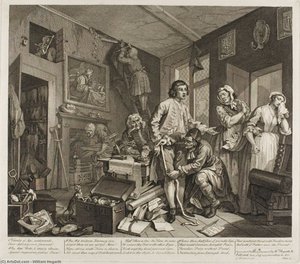 Plate one, from A Rake's Progress - William Hogarth
Step into the shadows of an 18th-century London interior with Plate one, from A Rake's Progress by William Hogarth. The air feels heavy with the scent of old parchment and the frantic energy of social climbing. In this masterful engraving, Hogarth captures a world of beautiful decay, where every meticulously etched line serves as a sharp, satirical needle. Through intricate cross-hatching and dramatic tonal contrasts, he reveals a scene teeming with reckless gambling, scattered documents, and the hollow pursuit of vanity.
While the movement of Neoclassicism often sought order and restraint, Hogarth’s work provides a profound, cautionary counterpoint through its complex narrative layers. The monochromatic depth and textured surfaces—from the heavy fabrics of fine attire to the chaotic clutter of the room—create a sense of historical gravity. For the discerning collector, integrating such a storied piece into a modern study or library offers more than mere decoration; it introduces a layer of intellectual depth and a conversation about the enduring human condition, bringing a sophisticated, reflective atmosphere to any curated space.
Self Portrait with Her Daughter, Julie - Louise Élisabeth Vigée Le Brun
 Self Portrait with Her Daughter, Julie - Louise Élisabeth Vigée Le Brun
A tender embrace captured in time, Self Portrait with Her Daughter, Julie by Louise Élisabeth Vigée Le Brun transcends mere portraiture to become a profound meditation on maternal devotion. At ArtsDot.com, our mission has always been to democratize such profound beauty, ensuring the emotional depth of the Old Masters is accessible to all. This masterpiece earns its place among the top Neoclassical works through its exquisite ability to blend the refined grace of the Rococo with the structured, emotional sincerity of the Neoclassical movement.
Vigée Le Brun utilizes a muted, earthy palette and dramatic, directional lighting to sculpt the figures, creating a sense of three-dimensional intimacy that feels remarkably modern. The soft textures of skin and fabric, set against a dark, indistinct background, draw the viewer into a private moment of protection and unconditional love. This painting does more than document a family bond; it sets a standard for emotional resonance in visual culture. Today, this timeless elegance serves as a cornerstone for sophisticated interiors, allowing collectors to bring its transformative presence and serene, nurturing atmosphere into any home, office, or personal gallery through our museum-quality hand-painted reproductions.
Watson and the Shark - John Singleton Copley
 Watson and the Shark - John Singleton Copley
Acquiring Watson and the Shark by John Singleton Copley is more than a mere purchase; it is an investment in a profound legacy of dramatic storytelling and refined taste. As one of the definitive masterpieces of the Neoclassicism movement, this 1778 work commands immense market prestige due to its unparalleled emotional intensity and historical weight. Copley masterfully captures the harrowing struggle in Havana Harbor, utilizing a palette of deep oceanic blues, earthy browns, and sudden, brilliant highlights that evoke the spray of turbulent salt water.
The composition breathes with life, where the tension of diagonal lines and the visceral texture of the churning waves draw the viewer into a moment of pure survival. The play of light against the dark, looming presence of the shark creates a chiaroscuro effect that resonates with timeless authority. For the discerning collector, a high-quality hand-painted oil reproduction of this scale brings an incomparable aesthetic gravity to modern luxury interiors, offering a focal point of quiet prestige and historical grandeur that elevates any sophisticated architectural space.
Basket of Peaches - Jean-Baptiste-Siméon Chardin
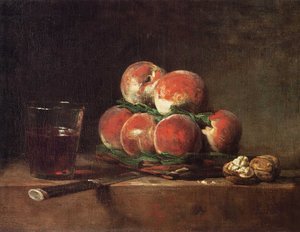 Basket of Peaches - Jean-Baptiste-Siméon Chardin
In Basket of Peaches by Jean-Baptiste-Siméon Chardin, a deep, resonant ochre anchors the composition, casting a mood of profound warmth and grounded tranquility. This masterpiece stands among the top 10 masterpieces that defined the Neoclassicism art movement because it eschews Rococo frivolity for a disciplined, soulful realism. Chardin’s mastery lies in his palette of muted earth tones—rich browns, velvety reds, and soft creams—which breathe life into the tactile impasto textures of the fruit. The light does not merely strike the objects; it caresses them, creating a sense of quiet permanence.
For the discerning interior designer or homeowner, integrating this work into a modern dining room offers an unparalleled opportunity to curate an atmosphere of sophisticated intimacy. The painting’s somber yet rich color scheme serves as a perfect anchor for spaces featuring natural wood, stone, or linen textures. By placing such a piece in a curated collection, one introduces a sense of historical weight and emotional depth, transforming a contemporary room into a sanctuary of quiet contemplation and timeless elegance.
A Bay Hunter With Two Spaniels - George Stubbs
 A Bay Hunter With Two Spaniels - George Stubbs
Imagine standing in a quiet, dew-kissed meadow at the first light of dawn, where the only sound is the soft breathing of loyal companions and the rustle of grass. George Stubbs’ 1777 masterpiece, A Bay Hunter With Two Spaniels , captures this exact moment of profound tranquility. This work stands as a cornerstone of the Neoclassical era's pursuit of order and natural truth. Through his unparalleled anatomical precision—born from a deep study of equine structure—Stubbs elevates a simple hunting scene into a grand study of harmony between animal and earth.
The painting earns its place among the top masterpieces of the movement through its balanced composition and the luminous, earthy palette that breathes life into the bay hunter’s muscular form. The soft, pastel hues of the morning sky evoke a sense of timelessness, reminding us of a world governed by grace rather than chaos. Bringing such a piece into a modern interior does more than decorate a wall; it invites a curated sense of serenity and classical dignity into the home, anchoring our fast-paced lives with the enduring beauty of the natural world.
The Lictors Returning to Brutus the Bodies of his Sons - Jacques-Louis David
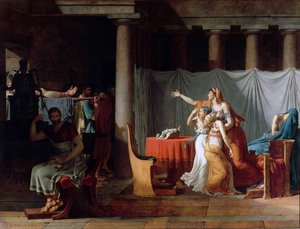 The Lictors Returning to Brutus the Bodies of his Sons - Jacques-Louis David
To stand before a masterpiece is to witness the heavy weight of history rendered in pigment and light. In 1789, as the winds of revolution began to stir across France, Jacques-Louis David captured a moment of unparalleled moral gravity in The Lictors Returning to Brutus the Bodies of his Sons . This work stands as a cornerstone of the Neoclassicism movement, embodying the era's obsession with civic virtue and the harrowing cost of patriotism.
David employs a masterful, restrained palette of earthy tones and muted hues, utilizing a sharp chiaroscuro to illuminate the tragic tableau. The precision of his brushwork brings a tactile reality to the scene—from the cold, imposing stone columns to the somber, heavy folds of drapery. The composition directs our gaze toward the profound emotional conflict of Brutus, whose stoic resolve contrasts painfully with the raw grief surrounding him. Through meticulous detail and dramatic lighting, David transforms a Roman legend into a timeless meditation on duty. Today, such a painting does more than decorate a room; it anchors a space with an aura of quiet prestige and enduring intellectual depth.
Napoleon at the St. Bernard Pass - Jacques-Louis David
 Napoleon at the St. Bernard Pass - Jacques-Louis David
In Napoleon at the St. Bernard Pass by Jacques-Louis David, one is immediately arrested by the resolute, commanding gaze of the First Consul, a look that transcends mere portraiture to embody the very essence of indomitable will. This masterpiece does not simply document a military maneuver; it captures the psychological intensity of a man destined to reshape Europe. Through the lens of Neoclassicism, David utilizes a dramatic interplay of light and shadow—chiaroscuro—to sculpt Napoleon’s figure against a turbulent, lightning-streaked sky, creating a sense of heroic grandeur that feels both mythic and profoundly human.
The painting serves as a universal mirror of ambition, where the rhythmic movement of the white charger and the billowing crimson cloak evoke a visceral sense of momentum. For the discerning collector, integrating such a powerful work into a private study or grand salon transforms the space into an arena for profound reflection. It invites a dialogue between the viewer and history, turning a personal sanctuary into a sophisticated gallery of strength and enduring legacy.
The Loves of Paris and Helen - Jacques-Louis David
 The Loves of Paris and Helen - Jacques-Louis David
In the quiet, opulent corridors of history, few moments capture the tension between desire and destiny as exquisitely as Jacques-Louis David’s 1788 masterpiece, The Loves of Paris and Helen . This work earns its place among the top 10 masterpieces of Neoclassicism by pivoting away from the era's typical battlefield violence, choosing instead to explore the intimate psychological drama of two souls. Within a richly detailed interior, David utilizes a commanding linear perspective and directional lighting to sculpt the porcelain skin of the lovers against heavy, luxurious drapery.
The painting is a masterclass in 18th-century French technique, where every meticulous brushstroke serves a narrative of profound stillness and impending consequence. As you contemplate the symbolic lyre and classical caryatids, you are not merely viewing a myth; you are witnessing the very essence of Neoclassical grandeur. At ArtsDot.com, we believe such transformative energy should not be confined to museum halls. By commissioning a hand-painted oil reproduction, you can invite this sophisticated, classical energy into your own sanctuary, turning a private room into a curated statement of timeless elegance and historical reverence.
Conclusion
As the light fades on our journey through the Neoclassical era, we are left with more than just a collection of historical images; we carry with us the enduring echoes of order, virtue, and profound human emotion. These masterpieces do not belong solely to the silent halls of museums or the dusty pages of textbooks. They remain living presences, breathing life into our modern spaces and continuing to shape the aesthetic soul of our homes and interiors. To gaze upon these works is to reconnect with a timeless pursuit of beauty and clarity that transcends the centuries.
At ArtsDot.com , we believe that such profound legacies should be felt, not just observed from afar. We strive to bridge the gap between the distant past and your personal sanctuary by ensuring every masterpiece can be reborn as a hand-painted reproduction. Our skilled artists, trained in the rigorous traditions of fine arts academies, approach each commission with a reverence for the original's soul, meticulously recreating the precise brushstrokes, tonal depth, and dramatic light that define these legendary works. Whether you are seeking to anchor a grand hall with a sweeping historical epic or add a touch of classical grace to a contemporary study, we invite you to explore our full collection and bring the eternal elegance of Neoclassicism into your own world.