

Introduction
To step into a room adorned with true masterpieces is to enter a silent dialogue with the souls of the past. There is a profound, almost sacred weight to an oil on canvas —a medium where the slow drying of pigment allows for a physical depth that no digital screen can ever truly replicate. When we speak of the legendary works that changed art forever, we are not merely discussing historical artifacts; we are tracing the very evolution of human emotion, captured through the deliberate movement of a brush and the rich, tactile layering of oils.
Throughout the centuries, from the dramatic chiaroscuro of the Baroque era to the light-drenched revolutions of Impressionism, certain paintings emerged as more than just images. They became cultural seismic shifts. These works broke the boundaries of their time, challenging religious iconography, redefining perspective, and forcing the world to see light, shadow, and human suffering through a new lens. They were born from moments of intense creative struggle, often painted on heavy cotton canvases that have survived wars, revolutions, and the relentless passage of time.
Today, these masterpieces remain deeply meaningful because they touch upon the universal. Whether it is the haunting gaze of a portrait or the turbulent energy of a landscape, they resonate with our modern sensibilities, offering a sense of continuity in an ever-changing world. They remind us that while technology evolves, the human impulse to capture beauty and truth remains constant.
In the following curation, we invite you to wander through a gallery of giants. We have selected ten pivotal works—each a cornerstone of art history—that did not merely follow trends but shattered them, leaving an indelible mark on the canvas of human civilization. Prepare to encounter the textures, the colors, and the stories that continue to breathe life into the halls of our collective memory.
Starry Night (New York, MoMA) - vincent willem van gogh
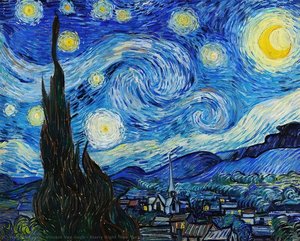 Starry Night (New York, MoMA) - vincent willem van gogh
In Starry Night , Vincent van Gogh achieves a breathtaking structural harmony that transcends mere landscape painting. The composition is anchored by the dark, vertical silhouette of the cypress tree, which provides a profound sense of balance against the rhythmic, swirling celestial bodies above. These undulating lines and organic shapes create a dynamic geometry, where the turbulent energy of the cobalt sky is perfectly offset by the quiet, grounded stability of the sleeping village below.
This masterful interplay of movement and stillness creates a timeless perfection that remains a cornerstone of our collection of Top 10 Legendary 'Oil On Canvas' Masterpieces That Changed Art Forever . For the discerning collector or interior designer, the painting’s internal equilibrium offers a striking parallel to modern minimalist design; its bold, expressive textures and deep tonal range provide a soulful focal point that grounds a clean, contemporary aesthetic with quiet prestige and emotional depth.
The Disintegration of Persistence of Memory, 1952-54 - Salvador Dalí
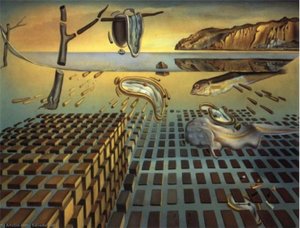 The Disintegration of Persistence of Memory, 1952-54 - Salvador Dalí
In The Disintegration of the Persistence of Memory , Salvador Dalí does not merely revisit his most famous motif; he performs a profound deconstruction of reality itself. Created between 1952 and 1954, this masterpiece stands as a pivotal moment in the history of Surrealism, marking a transition from the dreamscapes of the early 20th century to a more complex, atomic-age meditation on decay and fragmentation. Dalí’s technical mastery is breathtaking, utilizing meticulous oil brushwork to render melting clocks and skeletal structures with a photographic precision that feels both hyper-real and hauntingly impossible.
This work earns its place among the top legendary oil on canvas masterpieces through its philosophical depth, challenging our very perception of time and stability. The earthy ochres and muted shadows evoke a sense of existential solitude, inviting viewers to contemplate the fragility of memory in an ever-changing universe. For the discerning collector or interior designer, integrating such a profound piece into a curated space creates a timeless dialogue between historical gravity and modern aesthetic sophistication, turning a room into a sanctuary for deep reflection.
Guernica - Pablo Picasso
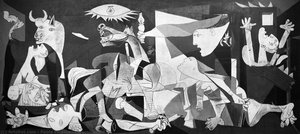 Guernica - Pablo Picasso
To stand before Pablo Picasso’s Guernica is to witness a silent, monochromatic scream. Created in 1937, this monumental oil on canvas transcends mere paint and pigment; it is a visceral, cinematic descent into the heart of human suffering. The palette—a stark, journalistic arrangement of blacks, whites, and greys—strips away the comfort of color, forcing us to confront the raw, fragmented geometry of chaos. Through the lens of Cubism, Picasso deconstructs the agony of the Spanish Civil War, presenting a landscape of distorted limbs, a grieving mother, and a wounded horse that seem to vibrate with an unsettling energy.
The texture of this masterpiece lies in its emotional depth, where sharp, angular lines and overlapping planes create a claustrophobic atmosphere of profound loss. While its subject is heavy with history, the sheer power of its composition offers a transformative presence for any serious collector. Integrating such a legendary work into a modern space serves as a powerful focal point for reflection, inviting a deep, intellectual dialogue between historical tragedy and contemporary architectural elegance.
The Scream - Edvard Munch
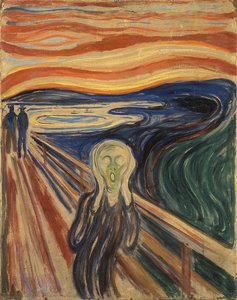 The Scream - Edvard Munch
To stand before a masterpiece is to encounter a mirror of the human soul, and few works reflect our deepest vulnerabilities as piercingly as The Scream by Edvard Munch . Created in 1893, this seminal work serves as a cornerstone of the Expressionist movement, marking a definitive departure from representational accuracy toward the raw, visceral depiction of internal psychological states. As we traverse the history of the Top 10 Legendary 'Oil On Canvas' Masterpieces That Changed Art Forever , Munch’s achievement stands unparalleled for its ability to translate existential dread into visual form.
The canvas vibrates with an unsettling energy; swirling, turbulent skies of fiery orange and blood-red clash against the cold, deep blues of the fjord, creating a chromatic dissonance that mirrors the protagonist's inner turmoil. Through thick, expressive brushstrokes and a distorted, flattened perspective, Munch captures a moment where the boundary between the external landscape and internal agony dissolves. The central figure, clutching a skull-like face, becomes a universal symbol of modern anxiety. Today, this iconic imagery continues to transform spaces, offering a profound, contemplative depth that reminds us of our shared human experience.
Night Watch - Rembrandt van Rijn
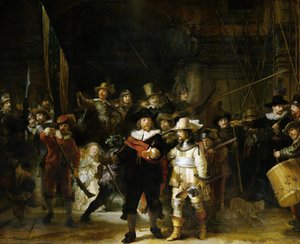 Night Watch - Rembrandt van Rijn
Rembrandt van Rijn’s The Night Watch stands as a monumental pillar of the Dutch Golden Age, a work that transcends the traditional boundaries of group portraiture to offer a visceral, theatrical experience. It earns its place among the world's greatest oil on canvas masterpieces through its revolutionary use of chiaroscuro —that masterful, dramatic interplay of light and shadow that breathes life into the chaotic assembly of the Kloveniers militia. As you stand before this scale of artistry, the spotlighting effect directs your gaze through a labyrinth of earthy ochres, deep blacks, and sudden, brilliant highlights, creating an illusion of profound depth and movement.
Beyond its technical brilliance, the painting serves as a timeless study of civic pride and human energy. The symbolic presence of the enigmatic young girl and the dynamic, asymmetrical composition invite us to reflect on the beauty found within organized chaos. For the discerning collector or interior designer, integrating the essence of such Baroque drama into a curated space creates a powerful conversation between historical heritage and modern sophistication, bringing an enduring sense of prestige and narrative soul to any environment.
Three Musicians - Pablo Picasso
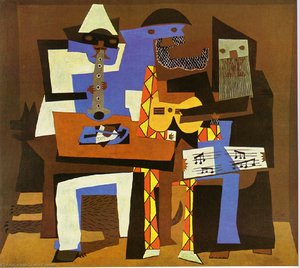 Three Musicians - Pablo Picasso
In Three Musicians by Pablo Picasso, one does not simply observe a scene; one enters a rhythmic, fractured dreamscape where the boundaries between melody and matter dissolve. There is a profound, silent tension held within the gaze of these figures—Harlequin, Pierrot, and the monk—as they exist in a state of perpetual, geometric performance. As a cornerstone of our selection of the top 10 legendary oil on canvas masterpieces that changed art forever , this 1921 work captures the very soul of Synthetic Cubism through its vibrant, flattened planes and the masterful interplay of blues, ochres, and earthy browns.
Picasso deconstructs the Commedia dell'arte characters into a mosaic of angular shapes, inviting us to find harmony within fragmentation. To possess such a piece is to invite a sophisticated intellectual energy into your home; displaying this powerful emotional resonance can transform a personal sanctuary into a space for profound reflection or calm. It serves as a visual symphony, reminding the viewer that even in a broken world, there is an enduring, beautiful order to be found.
The Girl with a Pearl Earring - Johannes Vermeer
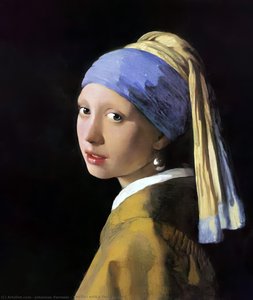 The Girl with a Pearl Earring - Johannes Vermeer
In The Girl with a Pearl Earring by Johannes Vermeer, the composition achieves a profound structural harmony that transcends its 1665 origins. The artwork is anchored by a masterful triangular arrangement, where the soft curves of the subject’s face and the exotic folds of her blue turban create a stable yet dynamic balance. This geometric precision is punctuated by the singular, luminous focal point: the pearl itself, which catches the light with an almost ethereal brilliance. Vermeer utilizes a dark, undefined void to push the figure forward, creating an intimate, shallow perspective that forces a direct, soulful connection with the viewer.
This meticulous use of negative space and restrained color palette—rich ultramarine against deep ochre—mirrors the principles of modern minimalist design . Much like a contemporary curated space, the painting’s internal equilibrium provides a sense of calm and clarity, making it an essential pillar in our exploration of the Top 10 Legendary 'Oil On Canvas' Masterpieces That Changed Art Forever . It is this seamless blend of classical Dutch realism and structural simplicity that allows Vermeer’s work to ground a clean, sophisticated aesthetic in any modern collection.
Olympia - Édouard Manet
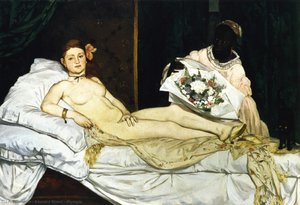 Olympia - Édouard Manet
What story does the defiant atmosphere within Olympia by Édouard Manet tell us about the dawn of modernity? Created in 1863, this masterpiece emerged from a period of intense social upheaval, where the rigid boundaries of the Paris Salon were being pushed to their breaking point. Unlike the idealized, mythological nudes of the past, Manet presents a contemporary woman—a courtesan—whose unapologetic, direct gaze confronts the viewer with startling realism. The composition is a masterclass in tension: the stark contrast between the crumpled white linens, the vibrant bouquet of flowers, and the shadowy presence of the Black servant creates a narrative of class, race, and commerce.
Manet’s rejection of traditional chiaroscuro in favor of flattened forms and visible, textured brushstrokes foreshadowed the Impressionist revolution. For the modern collector, integrating such a provocative piece into a curated interior offers more than mere decoration; it provides a sophisticated escape into a moment of historical rebellion. This painting does not just occupy a wall; it commands the room, inviting an era of bold, intellectual engagement into the home.
American Gothic - Grant Wood
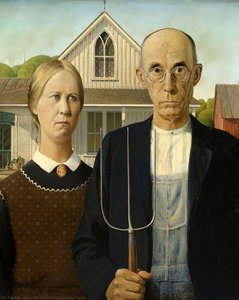 American Gothic - Grant Wood
Standing before Grant Wood’s 1930 masterpiece, American Gothic , one is immediately met by the piercing, stoic gaze of a farmer and his daughter. There is a profound, cinematic stillness in this scene; the muted earth tones of browns, greens, and grays evoke the somber resilience of the American Midwest during the Great Depression. The air feels heavy with tradition, captured through Wood’s meticulous, almost photographic technique inspired by the Flemish masters.
Every element is a deliberate stroke of symbolism: the sharp, geometric precision of the pitchfork, the delicate Carpenter Gothic window, and the rigid, upright postures that command respect. The light is diffused and soft, casting subtle shadows that reveal the textures of linen and weathered skin, inviting a deep, reflective contemplation on heritage and endurance. In a modern interior, this legendary oil on canvas serves as more than mere decor; it acts as an anchor of historical gravity. Its presence brings a sense of quiet dignity and architectural strength to a room, inspiring a space of profound reflection and timeless character.
The Calling of Saint Matthew - Caravaggio
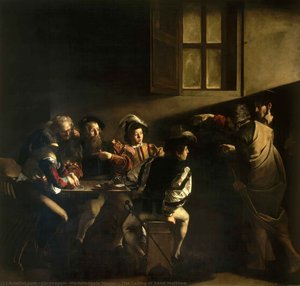 The Calling of Saint Matthew - Caravaggio
In the profound silence of a darkened room, a single, piercing beam of light cuts through the shadows to reveal a moment of divine transformation. The Calling of Saint Matthew by Caravaggio is not merely a painting; it is a masterclass in tenebrism , where the stark interplay of light and deep, velvety darkness creates an unparalleled emotional gravity. As one of our most revered selections in this collection of legendary oil on canvas masterpieces, this work redefined the Baroque era by replacing idealized divinity with raw, unflinching human realism.
Caravaggio’s genius lies in his ability to ground the sacred within the mundane, using contemporary textures and dramatic chiaroscuro to make the spiritual call feel immediate and visceral. The way light dances across the faces of tax collectors and saints alike offers a timeless meditation on revelation and grace. At ArtsDot.com, we believe such transformative beauty should not be confined to Roman chapels. Through our meticulous, hand-painted oil reproductions, you can invite this same dramatic presence and historical soul into your own home, office, or private gallery, allowing the master's light to illuminate your personal space forever.
Conclusion
As the light fades on our journey through these legendary canvases, we are reminded that these masterpieces are far more than mere relics of a bygone era or static subjects in a museum archive. They are living, breathing presences that continue to pulse with the same raw emotion and technical brilliance that first captivated the world centuries ago. Each brushstroke—from the swirling celestial energy of a nocturnal sky to the delicate, light-drenched petals of a summer garden—servates as an eternal dialogue between the artist's soul and our own contemporary experience.
To bring these works into one’s private sanctuary is to invite history to reside within your walls. Whether it is the quiet dignity of a Renaissance portrait or the bold, textured rebellion of an Impressionist landscape, these paintings do more than decorate a room; they shape the very atmosphere of a home, anchoring our modern lives to a lineage of profound human expression. They offer us moments of stillness in a frantic world, transforming a simple living space into a gallery of reflection and wonder.
We invite you to continue this exploration and find the piece that speaks to your own story within our full collection . Let the timeless textures of oil on canvas remind you daily that beauty, once captured by a master's hand, remains an inexhaustible source of inspiration for generations to come.