The Painter of Tranquil Shores: The Life and Legacy of Albert Savery
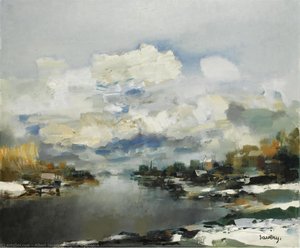
Albert Savery (1736 – 1809) stands as a singular figure in the twilight of the Dutch Golden Age, a master who found profound beauty not in the grand, sweeping dramas of history or mythology, but in the quiet, rhythmic pulse of the coastline. While many of his contemporaries sought to captivate audiences with heroic narratives and turbulent allegories, Savery cultivated a deliberate aesthetic of serenity. His work serves as a window into a world where time slows down, inviting the viewer to witness the subtle, ephemeral dance between light, water, and sky. Born in Amsterdam, Savery’s artistic journey was nurtured by his father, a linen draper who recognized his son's innate sensitivity to the natural world. This early support led him to the tutelage of Johann Christian Feyens, a prominent Haarlem landscape painter, from whom Savery inherited a foundational mastery of tonal painting and the delicate art of atmospheric perspective.
A Mastery of Light and Atmosphere
As Savery established his own workshop in Amsterdam around 1760, his artistic language began to deepen, absorbing the dramatic legacies of masters like Rembrandt and Caravaggio. He possessed a unique ability to marry the intense chiaroscuro—the profound interplay of light and shadow—of the earlier Dutch masters with a new, more tranquil sensibility. His technique was one of immense patience and precision; he utilized the painstaking process of layering thin glazes of oil paint to create surfaces that possess an unparalleled luminosity. This method allowed him to capture the shimmering, translucent quality of water as it meets the shore, the muted, earthy hues of wind-swept sand dunes, and the heavy, silvered atmosphere characteristic of a misty winter morning. To look upon a Savery seascape is to experience the very texture of the coast, where the boundary between the salt spray and the heavens seems to dissolve into a single, breathing entity.
The Enduring Resonance of the Maritime Soul
The historical significance of Albert Savery lies in his ability to transform the maritime landscape from a mere topographical record into a meditative retreat. His oeuvre, though focused on the coastal environment, transcends simple realism to touch upon the emotional depth of the human spirit. Through his eyes, we see the sea not just as a body of water, but as a source of profound stillness and rhythmic peace. His workshop became a crucible for experimentation, attracting pupils who helped refine the approach to color and brushwork that would define his era. Even today, Savery’s works remain vital, offering a sanctuary of calm in an increasingly turbulent world. He remains a master of the coastal soul, leaving behind a legacy of paintings that act as eternal windows to the tranquil shores of the Dutch coast, reminding us of the timeless beauty found in the simplest movements of the tide.