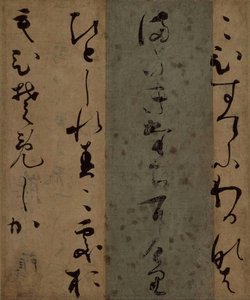
Top 3 works: Poem (Waka) Written on Shikishi Paper, known as Ogura-shikishi
Развернуть подробности
Born: 1162, Kyoto, Japan
Nationality: Japan
Lifespan: 79 years
Died: 1241
Also known as: fujiwara teika
The Architect of Poetic Elegance
In the twilight of the Heian era and the burgeoning dawn of the Kamakura period, a figure emerged from the heart of Kyoto whose creative spirit would forever define the Japanese aesthetic. Born in 1162, Fujiwara no Teika—often known by his name Fujiwara no Sadaie—was far more than a mere scholar; he was a weaver of emotions and a master of the ephemeral. Descended from a prestigious lineage of poets, he was the son of the celebrated Fujiwara no Shunzei, and this heritage provided the fertile soil in which his genius would bloom. His early life was steeped in the rhythmic beauty of classical traditions, yet it was his unique ability to breathe new vitality into the waka form that set him apart from the masters who preceded him.
The Convergence of Verse and Calligraphy
Teika’s artistry resided in a delicate, almost transcendent balance between the written word and the visual grace of calligraphy. As a profound critic and theorist, he developed influential ideas on the composition of poetry that would remain the standard for scholars well into the Meiji era. His approach was characterized by an exquisite sensitivity to traditional Japanese motifs and a deep, spiritual connection to the natural world. Yet, his contribution extended far beyond the structural perfection of verse; as a calligrapher, his hand moved with an expressive fluidity that transformed ink on paper into a living, breathing entity. To witness his calligraphy is to see the very essence of Japanese elegance—a dance of shadows and light captured in the deliberate yet flowing movement of the brush, where every stroke carries the weight of profound sentiment.
An Enduring Literary Legacy
The life of Fujiwara no Teika was as dramatic and turbulent as the poetry he composed. His relationship with the imperial court, particularly his complex bond with the Retired Emperor Go-Toba, was a saga of high artistic commissions followed by the sting of political banishment. Despite these shifts in power, his literary output remained monumental and unyielding. Through landmark works such as the Hyakushi, a curated collection of one hundred poems, he captured the very heartbeat of Japanese sentiment for future generations. His influence rippled through centuries, shaping the work of countless poets and calligraphers who sought to emulate his depth and precision. Even today, the echoes of his creative spirit resonate across the globe, proving that true mastery is a flame that never truly fades.
Explore the profound beauty of Japanese Ukiyo-e. Discover the history, masters like Hokusai, and the enduring legacy of the 'Floating World' through an expert art-historical lens.
Погрузитесь в мир гения Кацусики Хокусая! 25 легендарных гравюр укиё-э, включая "Великую волну". История искусства Японии и вдохновение для вашего интерьера. Репродукции высокого качества на ArtsDot.com.
Explore the captivating world of Utagawa Kuniyoshi, a master of Japanese ukiyo-e woodblock prints. Discover his innovative warrior scenes, vibrant landscapes & lasting legacy in 19th-century art history.