The Luminous Vision of James Augustus Suydam
In the golden age of American landscape painting, few artists captured the profound stillness of the natural world as masterfully as James Augustus Suydam. A pivotal figure within the Hudson River School and a premier practitioner of Luminism, Suydam possessed a rare ability to translate the ephemeral qualities of light and atmosphere into enduring canvases. Born on March 27, 1819, into an established New York Dutch merchant family, his life was far from a singular pursuit of the arts. He was a man of multifaceted intellect, navigating the worlds of law, architecture, and commerce with the same precision he applied to his brushstrokes. This disciplined background provided him with a unique structural understanding of the landscapes he sought to immortalize, allowing him to balance the ethereal glow of light with a grounded, architectural sense of composition.
Suydam’s artistic evolution was deeply influenced by his early training under Minor C. Kellogg, a renowned portrait painter. From Kellogg, Suydam inherited a devotion to meticulous observation and an acute sensitivity to tonal subtleties. However, it was his transition from the commercial spheres of business and law toward a dedicated life of painting that truly ignited his creative spirit. Following a transformative Grand Tour of Europe in the early 1840s, Suydam returned to America with a broadened aesthetic horizon. He soon became a central figure in the Conway School of Art, collaborating with luminaries such as Sanford Robinson Gifford. Together, they sought to capture the serene, almost spiritual beauty of the White Mountains in New Hampshire, a pursuit that would become a cornerstone of his legacy.
The Mastery of Light and Atmosphere
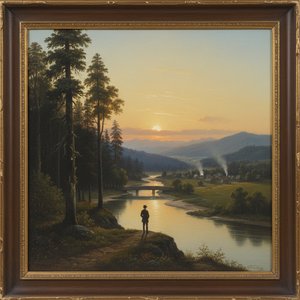
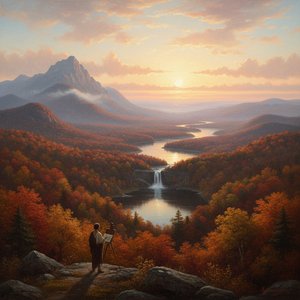
What distinguishes Suydam’s work from the more dramatic, turbulent landscapes of his Hudson River School contemporaries is his commitment to Luminism. While earlier pioneers like Thomas Cole often focused on the sublime terror of untamed wilderness, Suydam turned his gaze toward a profound and meditative quietude. His technique centered on the mastery of aerial perspective and the subtle manipulation of light to create a sense of infinite space. In his hands, the landscape became a vessel for the divine, where the clarity of the air and the soft radiance of the sun suggested an eternal, peaceful order.
His most celebrated works often feature:
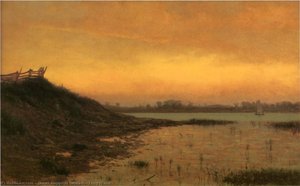
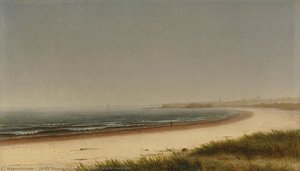
- Atmospheric Tranquility: A focus on the stillness of water and the hazy, glowing horizons that define the Luminist aesthetic.
- Tonal Subtlety: The use of delicate gradations of color to evoke the changing moods of the sky and earth.
- The Conway Meadows: His acclaimed depictions of New Hampshire landscapes, which showcased his ability to find grandeur in peaceful, pastoral settings.
This dedication to light was not merely a stylistic choice but a philosophical one. Through his canvases, Suydam invited viewers into a state of contemplation, reflecting the mid-nineteenth-century American desire to find spiritual meaning within the expanding natural frontier.
Legacy and Professional Eminence
Suydam’s professional ascent was marked by significant recognition from the most prestigious institutions of his era. His election to the Century Association at the young age of thirty signaled his rising status among the New York intelligentsia. In 1858, he established a studio in the famed Tenth Street Studio Building, a hub for the nation's most talented artists, further cementing his place within the artistic community. His talent was formally honored by the National Academy of Design, where he earned honorary professional membership in 1859 and full membership in 1861.
Despite his rapid rise and profound impact, Suydam’s life was tragically short. He passed away suddenly in North Conway at the age of forty-six, leaving behind a body of work that remains a cornerstone of American art history. His ability to bridge the gap between the rugged Romanticism of the early Hudson River School and the serene, light-drenched precision of Luminism ensures his place as a visionary. Today, his paintings serve as windows into a vanished era, reminding us of a time when the American landscape was viewed not just as territory to be conquered, but as a sacred space of light, peace, and infinite beauty.