The Quiet Mastery of Jan Joost van Goyen
Jan Joost van Goyen, born in Leiden in 1596 and passing away in 1656, occupies a unique position within the Dutch Golden Age. While contemporaries like Rembrandt van Rijn captured drama with chiaroscuro and Frans Hals immortalized boisterous gatherings, Van Goyen cultivated a quieter, more contemplative vision of the world. He wasn’t concerned with grand narratives or psychological depth; instead, he dedicated his life to meticulously rendering the vast skies and expansive landscapes of Holland, becoming arguably the most prolific landscape painter of his time – credited with over 1,200 surviving works. His paintings aren't filled with bustling activity but rather evoke a sense of stillness, a profound connection between humanity and the natural world.Early Life and Formation
Van Goyen’s early training remains somewhat obscure, though it is believed he initially apprenticed with landscape painter Jacob van Swanenburg in Leiden. This foundation instilled in him a respect for topographical accuracy, but Van Goyen quickly moved beyond mere replication. He travelled extensively throughout Holland and Friesland during the 1620s and 30s, sketching directly from nature – an unusual practice at the time when studio work was more common. These sketches weren’t intended as finished pieces but served as studies for larger compositions. His early works demonstrate a clear influence of Pieter Bruegel the Elder's panoramic views, though Van Goyen soon developed his own distinctive style characterized by low horizons and a restrained palette dominated by shades of grey, brown, and ochre. He married at least twice, and financial records suggest he was often involved in property speculation alongside his artistic pursuits – a testament to the practical concerns of an artist supporting a family in 17th-century Holland.A Monochromatic Vision: Style and Technique
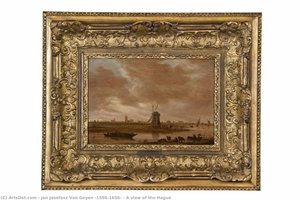
Van Goyen’s most recognizable characteristic is his limited color range, earning him the nickname “the grey master.” This wasn't due to a lack of skill but rather a deliberate aesthetic choice. He believed that the subtle nuances of light and atmosphere were more important than vibrant hues. His technique involved building up layers of thin, translucent glazes over a carefully prepared ground, creating a remarkable sense of depth and luminosity. The low horizon lines in his paintings emphasize the immensity of the sky, often filled with dramatic cloud formations – a subject he rendered with astonishing precision. He frequently included small figures engaged in everyday activities—peasants working in fields, boats navigating waterways—but these are secondary elements, serving to anchor the landscape and provide a sense of scale. His focus was always on capturing the essence of the Dutch countryside, its vastness, tranquility, and ever-changing light conditions.Themes and Historical Context
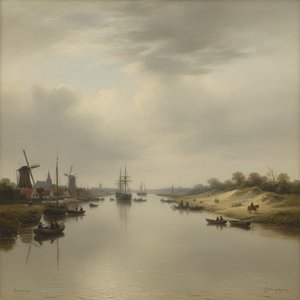
Van Goyen’s work reflects the burgeoning national consciousness of the Dutch Republic in the 17th century. The Eighty Years' War had recently concluded, and Holland was experiencing a period of unprecedented economic prosperity and cultural flourishing. His landscapes can be seen as celebrations of Dutch land ownership and industriousness. The paintings depict scenes of reclamation projects—draining marshes, building dikes—symbolizing the Dutch people’s mastery over their environment. He also produced numerous “water views,” depicting rivers, canals, and harbors, reflecting Holland's importance as a maritime power. Unlike many other artists of his time who focused on religious or mythological subjects, Van Goyen found beauty and meaning in the everyday world around him—a testament to the growing secularism of Dutch society. He also pioneered the practice of selling his paintings directly to collectors through auction catalogs, bypassing traditional art dealers and increasing his reach.Legacy and Influence
While Van Goyen didn’t found a formal “school” in the same way as Rembrandt or Hals, his influence on subsequent generations of Dutch landscape painters was profound. Artists like Jan van de Cappelle and Pieter de Molyn adopted his monochromatic palette and emphasis on atmospheric effects. His meticulous technique and dedication to topographical accuracy set a new standard for landscape painting in Holland.- His paintings continue to be admired today for their quiet beauty, technical mastery, and evocative depiction of 17th-century Dutch life.
- Van Goyen’s work offers a unique window into the social, economic, and cultural context of the Dutch Golden Age.
- He remains a pivotal figure in the development of landscape painting, demonstrating that profound artistic expression can be found not only in dramatic narratives but also in the subtle nuances of the natural world.