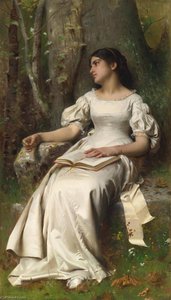
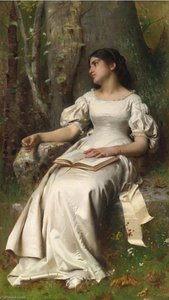
The Serene Mastery of Léon Jean Basile Perrault
Léon Jean Basile Perrault emerged as a luminous figure in the French art scene during the Second Empire, a period defined by a delicate tension between rigorous academic tradition and the burgeoning whispers of Symbolism. Born on June 20, 1832, in the modest surroundings of Poitiers, France, Perrault’s early life was shaped by a profound determination to transcend the hardships of poverty. This drive led him from local drawing courses at the age of fourteen to the prestigious studios of Paris in 1853. His journey was guided by the hands of masters such as François-Édouard Picot and the legendary William-Adolphe Bouguereau, whose influence is etched into every meticulously rendered figure and soft, ethereal light found within Perrault’s oeuvre. Under their tutelage, he mastered the art of anatomical precision and tonal gradation, developing a style that could breathe life into both the mythological and the mundane.
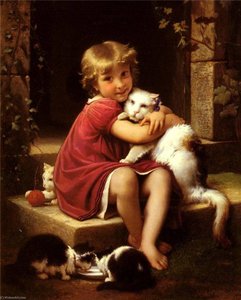
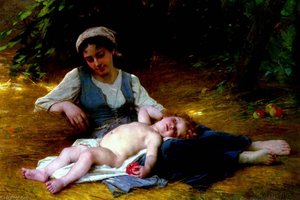
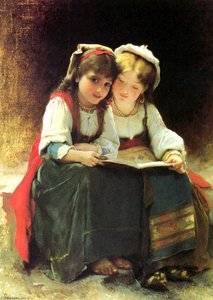
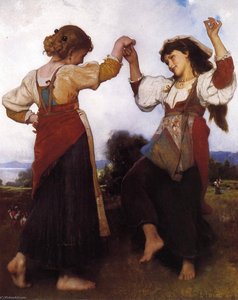
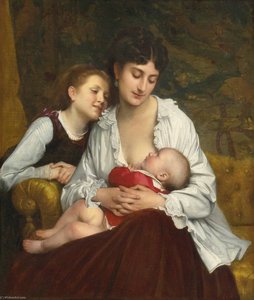
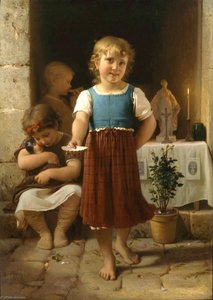
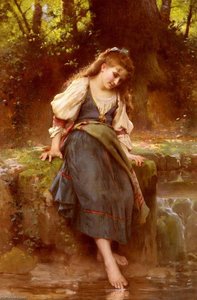
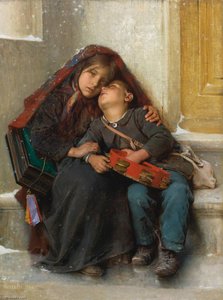
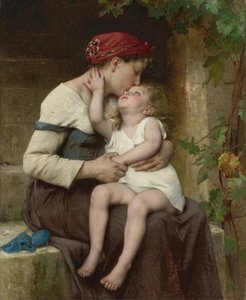
The essence of Perrault’s artistry lies in his ability to bridge the gap between the structured discipline of the Academy and the evocative, dreamlike qualities of Symbolism. While he was deeply rooted in the classical tradition—celebrating idealized beauty and the grace of human forms—his work often transcended mere representation to touch upon psychological depth and spiritual resonance. His paintings frequently feature scenes of profound innocence or mythological grandeur, rendered with a texture and color palette that invite the viewer into a state of quiet contemplation. Whether depicting the poignant vulnerability of The Little Shipwrecked Boy or the classical elegance of Venus à la colombe, Perrault possessed a unique gift for capturing a sense of timelessness, making his subjects feel both intimately present and mythically distant.
A Legacy of Accolades and Artistic Evolution
Perrault’s ascent within the Parisian art world was marked by consistent recognition from the most prestigious institutions of his era. His debut at the Salon of 1861, featuring Le Vieillard et les Trois Jeunes Hommes, immediately established him as a formidable talent. This early success was followed by a series of significant honors that validated his technical prowess and thematic depth. Throughout his career, he earned honorable mentions and second-class medals, notably in 1864 for La Frayeur and in 1876 for works such as St. Jean le Précurseur. His ability to navigate various genres—ranging from religious and historical scenes to intimate genre paintings—allowed him to capture the diverse interests of the affluent bourgeoisie, who found great beauty in his idealized depictions of classical myths.
Beyond the walls of the Paris Salon, Perrault’s influence extended across borders. During the tumultuous years of the Franco-Prussian War and the Paris Commune, he sought refuge in England, where he continued to exhibit at the Royal Academy, showcasing works like Cache Cache. His international standing was further solidified when he represented France at the Vienna International Exhibition, earning a diploma of honor. The late stages of his life were marked by high distinction, including being knighted as a Chevalier in the Legion of Honor in 1887, and receiving silver and bronze medals at the Universal Expositions of 1889 and 1900. As he passed away in Royan in 1908, Perrault left behind a legacy of paintings that remain celebrated for their ability to marry the technical perfection of the French Academic style with the soulful, evocative spirit of a changing artistic era.