The Enigma of the Flemish Canvas
In the twilight of the fifteenth century, within the bustling artistic hubs of Brussels and Antwerp, a painter emerged whose identity remains shrouded in the mists of history. Known to scholars only as the Master of the Story of Joseph, this enigmatic figure stands as a pivotal architect of the early Flemish Renaissance. While his true name has eluded centuries of investigation—with debates occasionally swirling around figures such as Lucas van Leyden or even the legendary Pieter Bruegel the Elder—his hand is unmistakable. His work represents a profound moment in art history where the sacred and the secular began to dance in a seamless, breathtaking embrace, marking him as a true pioneer of genre painting.
The Master’s life, much like his paintings, is a tapestry of fragments. Though precise biographical details are scarce, we can discern the vibrant atmosphere of his training. It is widely believed that he operated within the rich tradition of Netherlandish panel painting, likely honing his craft under masters who specialized in monumental altarpieces. This formative period instilled in him a reverence for meticulous detail and a capacity to render the physical world with startling clarity. His era was one of great transition, where the spiritual weight of the Middle Ages began to meet the observational curiosity of a new age, and the Master stood at the very heart of this evolution.
A Symphony of Realism and Symbolism
To gaze upon a work by the Master is to enter a world where every thread of fabric and every glint of light carries a dual purpose. His technique was characterized by an astonishingly precise observation of contemporary life, yet he never allowed the material world to overshadow the divine. He possessed a singular ability to ground biblical narratives in the tangible reality of his own time. In his hands, a scene from the Old Testament is not merely a distant myth but a living event occurring amidst the recognizable textures of fifteenth-century Flanders.
His mastery is perhaps most evident in his use of symbolic realism. Consider his approach to composition and detail:
- Texture and Materiality: He rendered the heavy folds of velvet, the sheen of polished metal, and the intricate patterns of striped hose with such accuracy that the viewer can almost feel the weight of the objects.
- The Sacred in the Mundane: By placing biblical figures within settings filled with everyday items—cups, bowls, and ritualistic implements—he bridged the gap between the heavenly and the earthly.
- A Muted Palette: His preference for harmonious, earthy tones, such as deep ochres and somber browns, created a contemplative atmosphere that invited the viewer to linger on the deeper theological truths hidden within the scene.
The Legacy of Divine Interpretation
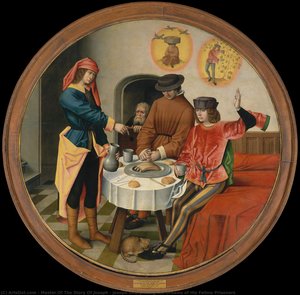
One of his most profound achievements lies in his ability to capture human vulnerability through the lens of prophecy. In celebrated works such as Joseph Interpreting the Dreams of His Fellow Prisoners, the Master demonstrates a remarkable command of psychological depth. The scene is charged with an intimate drama; the hushed tension of the prisoners awaiting their fate is palpable. Here, the artist uses the physical presence of figures gathered around a table to anchor the miraculous interpretation of dreams within a relatable human struggle.
The historical significance of the Master of the Story of Joseph cannot be overstated. By weaving high religious narrative with the minutiae of daily life—often including subtle, unexpected details like a resting animal or a specific piece of period fashion—he laid the groundwork for the genre painting movement that would flourish in the centuries to follow. He taught subsequent generations that the divine could be found in the smallest corner of a room and that the most profound spiritual truths are often reflected in the very textures of our everyday existence. His legacy remains a testament to the power of art to make the eternal feel immediate, tactile, and profoundly human.