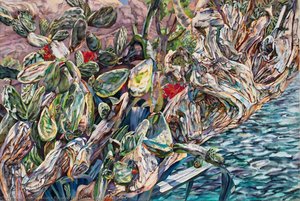
Patricia Tobacco Forrester: A Watercolorist of Lush Landscapes
Patricia Tobacco Forrester (September 17, 1940 – March 16, 2011) was a profoundly influential American watercolorist whose vibrant and expansive works captured the essence of nature with an almost sensual intensity. Born in Northampton, Massachusetts, into a family rooted in agriculture—her grandfather’s surname, Tobczynski, ultimately evolving to “Tobacco”—Forrester’s artistic journey began amidst the rhythms of rural life, deeply shaping her connection to the natural world and informing her distinctive style. Her career spanned over five decades, marked by consistent innovation, critical acclaim, and a growing recognition for her unique approach to watercolor painting.
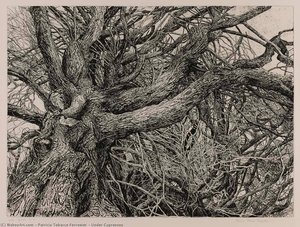
Early influences were diverse and formative. She graduated from Smith College in 1962 with a B.A., Phi Beta Kappa, where she initially explored printmaking and sculpture under the guidance of Leonard Baskin, a renowned sculptor known for his evocative woodcuts. This early exposure to reductive techniques instilled a deep appreciation for line, texture, and the inherent beauty of materials. Subsequently, Forrester pursued her artistic education at Yale University, earning a Master of Fine Arts in 1965, studying under the luminaries Chuck Close and Janet Fish. These mentors exposed her to Photo-Realism and gestural abstraction, broadening her artistic vocabulary while simultaneously reinforcing her core interest in observation and representation.
The Evolution of Style: From Printmaking to Grand Scale
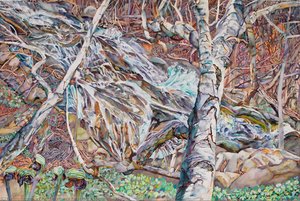
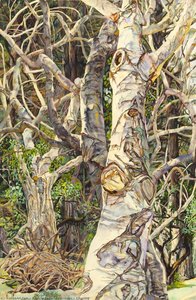
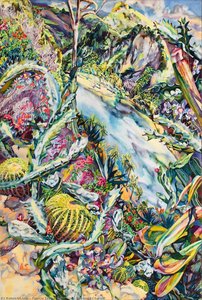
Forrester’s artistic trajectory shifted dramatically after receiving a prestigious Guggenheim Fellowship in 1967. This pivotal moment marked a decisive move towards large-scale watercolor painting, a medium she would master with unparalleled skill and vision. Rejecting the traditional constraints of smaller formats, Forrester embraced expansive canvases—often measuring over four feet by six feet—allowing her to capture the grandeur and complexity of natural landscapes with breathtaking detail. Her paintings weren’t mere depictions; they were immersive experiences, inviting viewers into a world teeming with life, light, and color.
Her technique was characterized by an intuitive approach, often working *en plein air* – directly on location—and embracing the unpredictable nature of watercolor itself. She eschewed meticulous planning and preparatory sketches, preferring to respond spontaneously to the shifting conditions of light and atmosphere. Forrester famously described her process as “painting things that grow,” reflecting a deep reverence for the cyclical rhythms of nature and an understanding of how color, texture, and form could be used to evoke a sense of vitality and growth. The accidental qualities inherent in watercolor—the way pigments bleed and mingle, creating unexpected patterns and textures—were not seen as flaws but rather as integral elements of her artistic vision.
Subjects and Influences: Nature’s Embrace
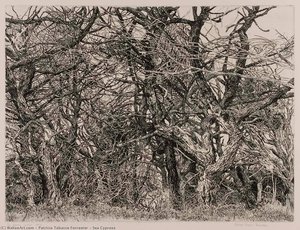
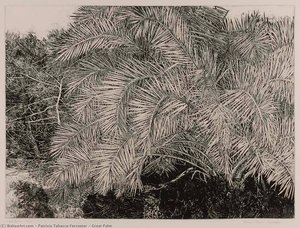
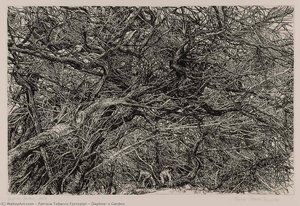
Forrester's primary subject matter revolved around the natural world – trees, flowers, landscapes, and the interplay between light and shadow. Her paintings frequently depicted scenes from diverse environments, including forests, gardens, coastlines, and tropical regions. She traveled extensively throughout her career, seeking inspiration in places as varied as Guatemala, Mexico, Costa Rica, and Southeast Asia. These journeys enriched her artistic perspective, exposing her to a kaleidoscope of colors, textures, and forms.
Beyond the natural world, Forrester was influenced by several key figures. Leonard Baskin’s emphasis on line and texture resonated deeply with her own approach to watercolor painting. The work of Chuck Close and Janet Fish—both prominent Photo-Realists—provided a framework for understanding how to render complex forms with remarkable accuracy. However, Forrester ultimately forged her own distinctive style, characterized by an expressive use of color, a loose and gestural brushstroke, and a profound sense of atmosphere.
Legacy and Recognition
Patricia Tobacco Forrester’s work has been exhibited extensively in museums and galleries across the United States and abroad. Her paintings are held in prestigious collections including the Smithsonian American Art Museum, the Brooklyn Museum, the Corcoran Gallery of Art (now part of the National Gallery of Art), the British Museum, and numerous private collections. She was elected into the National Academy of Design as an Associate member in 1992 and a full Academician in 1994 – honors recognizing her significant contributions to American art.
Forrester’s legacy extends beyond her individual achievements. Her pioneering use of large-scale watercolor painting helped to elevate the medium's status as a serious artistic practice. She demonstrated that watercolor could be used to create works of immense scale and complexity, capable of capturing the grandeur and beauty of the natural world with remarkable detail and emotional resonance. Her commitment to working *en plein air* and embracing the inherent qualities of her chosen medium continues to inspire artists today. Patricia Tobacco Forrester’s paintings remain a testament to the power of observation, intuition, and a deep connection to the earth.