The Luminous Legacy of Pieter Cornelis Dommersen
In the grand tapestry of nineteenth-century maritime art, few threads shine with as much atmospheric brilliance as those woven by Pieter Cornelis Dommersen. Born as Pieter Dommershuisen on December 6, 1833, in the historic city of Utrecht, his life was a journey through the very landscapes he sought to immortalize. While his roots were firmly planted in the Dutch tradition, his spirit was nomadic, traveling through Belgium, France, and America before eventually finding a settled home in England. This movement across Europe allowed him to absorb a diverse array of coastal aesthetics, yet it was his foundational training under the legendary Anton Mauve that truly defined his artistic soul. Under Mauve’s tutelage, Dommersen learned to look beyond mere topography, seeking instead the ephemeral dance of light upon water and the fleeting moods of the North Sea.
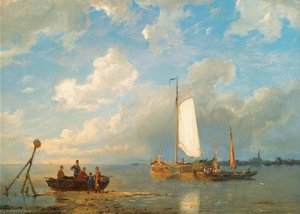
Dommersen’s technique was a masterful marriage of Dutch precision and Impressionist fluidity. He possessed a rare ability to manipulate pigments with a wet-on-wet approach, layering translucent washes that breathed life into his canvases. To gaze upon one of his works is to witness the ebb and flow of the tide; he utilized loose, expressive brushstrokes to soften the edges of reality, prioritizing tonal harmony over rigid anatomical or structural accuracy. This stylistic choice allowed him to capture the sublime—that specific, breathtaking moment when a storm breaks or when the low tide reveals the glistening, mud-slicked secrets of a Dutch estuary. His work often features bustling harbors and salt-sprayed vessels, where the energy of seafaring life is felt through the rhythmic movement of his brush.
A Family of Maritime Visionaries
The art of Dommersen was not merely a solitary pursuit but part of a profound familial legacy. The maritime genre became a shared language for his kin, creating a cohesive school of marine painting that resonated throughout the late nineteenth century. His brother, Cornelis Christiaan Dommersen, and his son, William Raymond Dommersen, both followed in his footsteps, each contributing their own nuances to the depiction of sea, land, and river-scapes. This shared devotion to the maritime theme ensured that the family name became synonymous with the romantic revival of seascape painting during an era when the industrial revolution was rapidly altering the natural world.
Beyond the canvas, Dommersen’s life was marked by a deep connection to the social fabric of his time. His marriage to Anna Petronella Synja in 1859 anchored him within the community of Marylebone, even as his professional travels took him far afield. His achievements were recognized by the most prestigious institutions of the age; his works were frequently exhibited at the Royal Academy and the Royal Society of British Artists, earning him a place among the elite painters of the Victorian era. He did not merely paint the sea; he translated its very essence into a visual language that spoke to the nostalgia and wonder of a generation witnessing the twilight of the great age of sail.
As we reflect on his contributions today, Dommersen stands as a pivotal figure who bridged the gap between traditional Dutch realism and the burgeoning Impressionist movement. His ability to capture the transient—the spray of a wave, the mist over a harbor, or the golden light of a setting sun—remains his greatest gift to the art world. Through his eyes, we continue to experience the timeless, rhythmic beauty of the coastlines he so dearly loved.