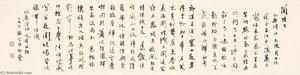
A Legacy of Calligraphy and Cultural Reverence
Rao Zongyi, known to the world as Jao Tsung-I, was far more than a mere practitioner of the brush; he was a titan of humanities whose life served as a living bridge between China's ancient soul and the modern era. Born on August 9, 1917, in the culturally rich landscape of Chaozhou, Guangdong Province, his journey began amidst the profound echoes of tradition. Growing up surrounded by a vast family library that had been meticulously amassed over generations, Rao was immersed in the classics from his earliest years. This early exposure to classical texts did not merely educate him; it ignited an intellectual curiosity and a deep-seated passion for calligraphy that would define his entire existence. His scholarly path led him through the prestigious halls of Guangdong University and eventually to postgraduate studies at Peking University, where he studied under the legendary Ji Xianlin. This mentorship was pivotal, instilling in him a rigorous academic discipline and a reverence for the nuanced beauty found within historical manuscripts.
As his career unfolded, Rao Zongyi emerged as a polymath of unparalleled breadth. While many recognize him primarily as a master calligrapher, his intellect spanned the vast territories of sinology, history, archaeology, epigraphy, and folklore. He was a man who could navigate the complexities of ancient paleography with the same grace that he applied to the fluid strokes of a poem. His scholarly contributions were not merely academic exercises but were driven by a profound mission: the preservation and dissemination of traditional Chinese culture. Throughout decades of significant political and social transformations in China, Rao remained an unwavering guardian of heritage, ensuring that the delicate threads of historical identity were not lost to the tides of change.
The Artistry of the Brush: Fluidity and Expression
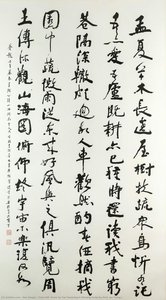
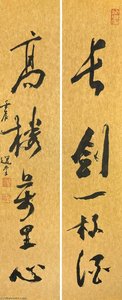
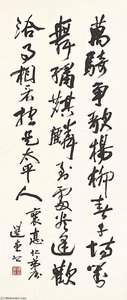
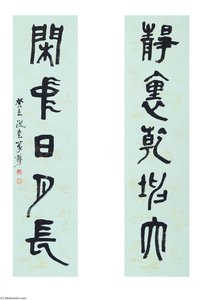
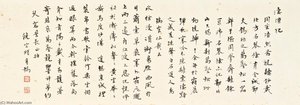
The true essence of Rao Zongyi’s artistic genius lies in his mastery of various calligraphic scripts, most notably Zhuanshu (seal script) and Xingshu (running script). In his hands, calligraphy ceased to be mere writing and became a dynamic dance of ink and energy. His work in Zhuanshu was characterized by an extraordinary balance of controlled elegance and spontaneous vitality. Drawing inspiration from historical masters such as Wang Duo, he embraced the flowing, rhythmic lines that define this ancient script, yet he infused them with a personal expressive power that felt remarkably alive. Every stroke was a testament to his disciplined study of the stylistic nuances of renowned calligraphers like Zhao Mengfu, allowing him to achieve a level of technical perfection that commanded respect across the globe.
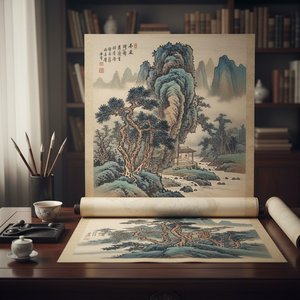
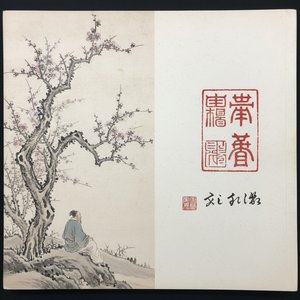
Beyond the structured beauty of seal scripts, Rao’s explorations into Xingshu and running scripts revealed a more lyrical side of his artistry. In these works, one can witness a breathtaking fluidity where characters seem to breathe and move across the paper. His landscapes, often rendered through calligraphic gestures, evoke a sense of serene movement, blending the boundaries between text and image. Whether he was composing poetic verses or executing bold, sweeping strokes in a couplet, his work always maintained a profound sense of balance and harmony. The interplay of thick and thin lines, of heavy ink saturation and delicate, dry-brush textures, created compositions that were as much about the emotional resonance of the artist as they were about the legibility of the characters.
A Global Scholar and Enduring Influence
The historical significance of Rao Zongyi extends far beyond the borders of China. As a professor at prestigious institutions such as the University of Hong Kong, Yale University, and the Chinese University of Hong Kong, he shared his vast knowledge with a global audience, shaping the minds of new generations of scholars and artists. His accolades, including the Grand Bauhinia Medal and various life achievement awards, reflect the immense respect he garnered from both the academic community and the arts. He was a figure who commanded authority in the study of ancient inscriptions and folk religion, yet he remained deeply connected to the aesthetic beauty of the painterly tradition.
Rao Zongyi passed away on February 6, 2018, at the age of 100, leaving behind a legacy that is as enduring as the ink on his scrolls. His life was a masterclass in how to honor the past while contributing meaningfully to the present. To study his work is to engage with the very heartbeat of Chinese civilization—a journey through:
- The precision of ancient scripts, which preserved the linguistic roots of a culture.
- The elegance of calligraphic landscapes, which captured the spiritual essence of nature.
- The rigor of sinological research, which illuminated the forgotten corners of history.