The Alchemist of Siena: The Life and Legacy of Ugolino di Vieri
In the golden twilight of the fourteenth century, within the vibrant, walled splendor of Siena, there lived a creator whose hands moved between the worlds of metal, stone, and verse. Ugolino di Vieri, often remembered by the evocative moniker Verino, was far more than a mere craftsman; he was a true Renaissance polymath. Born into a noble Florentine lineage steeped in the rigors of law and administration, Ugolino’s spirit was shaped by the intellectual ferment of an era transitioning from the medieval to the humanistic. His life was a tapestry woven from the disparate threads of goldsmithing, sculpture, and classical poetry, making him a singular figure in the artistic landscape of Italy.
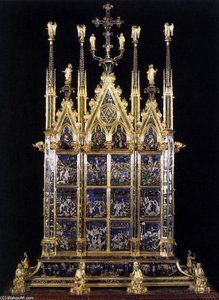
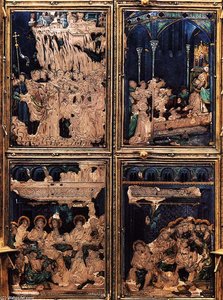
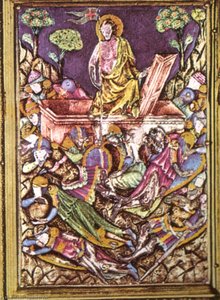
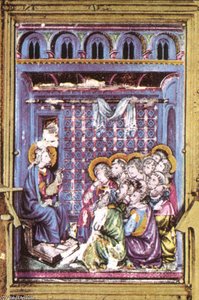
The essence of Ugolino’s artistry lay in his mastery of smalt—a translucent enamel technique that allowed light to dance through layers of colored glass. This skill reached its zenith in his most celebrated achievement, the Reliquary of the Santo Corporale. Housed within the majestic Orvieto Cathedral, this monumental work serves as a testament to his technical virtuosity. Through intricate enamel panels, Ugolino breathed life into the sacred narrative of the Miracle of Bolsena. Each panel was not merely a depiction but a window into the divine, where meticulous craftsmanship met profound theological symbolism, capturing the very essence of Sienese spiritual devotion.
A Symphony of Metal and Verse
While his hands shaped the physical splendor of reliquaries and sculptures, Ugolino’s mind wandered through the classical landscapes of antiquity. As a humanist, he was deeply influenced by the revival of Latin learning, a movement that sought to bridge the gap between Christian piety and the elegance of the ancient world. This duality is perhaps most evident in his literary contributions. His poetic works, such as Flametta and Carlias, demonstrate a profound command of Latin hexameter, echoing the rhythmic beauty of Virgil and Homer. In these verses, he found a medium to express the same precision and grace that defined his work in gold and enamel.
His intellectual journey was marked by significant connections to the power players of the Italian Renaissance. Trained under the renowned humanist scholar Cristoforo Landino, Ugolino absorbed the spirit of inquiry that would define his generation. His life saw him navigating the complex political and religious currents of Florence and Siena, earning the patronage of figures ranging from the Medici family to the influential preacher Girolamo Savonarola. This ability to traverse both the secular courts of Lorenzo de' Medici and the ascetic circles of the Piagnoni speaks to a man whose talent was as versatile as it was deeply rooted in the cultural soil of his time.
The Enduring Radiance of a Master
The historical significance of Ugolino di Vieri extends far beyond the physical objects he left behind. He represents a pivotal moment in art history where the artisan’s workshop began to merge with the scholar’s study. His legacy is found not only in the shimmering surfaces of the Orvieto reliquary but in the very concept of the artist as an intellectual force. To look upon his work is to witness the birth of a new era, one where technical brilliance was inseparable from philosophical depth.
Today, the memory of the Maestro of Siena Smalt persists through:
- The Reliquary of the Santo Corporale: A pinnacle of Renaissance enamelwork that continues to inspire awe in the Orvieto Cathedral.
- Humanist Poetry: His Latin compositions which helped sustain the classical tradition during a period of profound religious transition.
- The Synthesis of Arts: His role in bridging the gap between the decorative arts of the goldsmith and the high intellectualism of the humanist movement.
Ugolino di Vieri remains a luminous figure, a creator who could capture the light of heaven in a drop of enamel and the weight of history in a line of Latin verse. His life stands as a brilliant testament to the boundless potential of the human spirit when guided by both passion and intellect.