The Visionary of the Changing Tide
In the twilight of the Edo period, as the isolationist veil of Japan began to fray under the pressure of encroaching Western influence, one artist stood poised to document the seismic shifts of a nation in transition. Utagawa Sadahide, born Hashimoto Kenjirō in 1807 within the Shimosa Province, was far more than a mere chronicler; he was a visual pioneer who captured the collision of two worlds. Emerging from the prestigious Utagawa school as a dedicated pupil of the master Kunisada, Sadahide initially honed his craft through the delicate medium of book illustrations and the traditional subjects of bijin-ga (pictures of beautiful women) and yakusha-e (actor prints). Yet, beneath this classical training lay an insatiable curiosity for the unknown, a fascination with the frontiers that would eventually define his legacy.
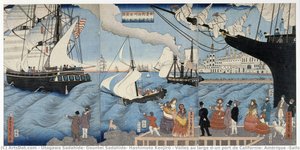
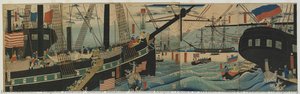
As the mid-1s century approached, the winds of change blew from across the seas, bringing with them the presence of foreign traders, naval vessels, and entirely new cultural aesthetics. While many of his contemporaries remained tethered to the established motifs of Japanese tradition, Sadahide turned his gaze toward the horizon. He became a master of Yokohama-e, a specialized genre of ukiyo-e prints that focused on the burgeoning international enclave of Yokohama. His work during the 1860s serves as a vibrant, breathing window into a period of profound upheaval, where the sight of Westerners in their distinct attire and the presence of foreign technology became the new reality for the Japanese populace.
A Master of Perspective and Panorama
What truly distinguished Sadahide from his peers was his daring technical experimentation. He possessed a remarkable ability to integrate Western-inspired linear perspective and bird's-eye views into the traditional woodblock medium, creating a sense of depth and scale that was revolutionary for the time. His compositions often utilized wide, panoramic angles—sometimes spanning multiple sheets of paper—to encapsulate the sprawling energy of bustling ports and maritime trade. This sweeping approach allowed him to present not just individual figures, but entire ecosystems of cultural exchange, where Japanese merchants and Western sailors occupied the same meticulously detailed space.
His artistic development was marked by a restless pursuit of the "border zones" of his country. Before the formal opening of Yokohama, Sadahide was already exploring the edges of the known world through works like Kaigai shinwa, which illustrated the Opium Wars in China, and detailed accounts of Japan's northern frontier in Hokkaido. This preoccupation with the periphery—the places where Japan met the rest of the globe—gave his work an unparalleled historical weight. Whether he was depicting the intricate details of silk dyeing in a Yokohama shop or the dramatic silhouettes of foreign warships on the horizon, his prints functioned as both art and news, providing a visual vocabulary for a society grappling with its new identity.
Legacy Amidst the Meiji Dawn
The significance of Sadahide’s oeuvre extends far beyond the aesthetic beauty of his woodblock prints; he was an essential architect of Japan's visual memory during the transition from the Edo to the Meiji era. His work was so highly regarded that it was chosen by the Tokugawa shogunate's delegation to represent Japanese artistry at the International Exposition of 1867 in Paris, signaling to the world that Japanese art was capable of engaging with global themes and modern perspectives. Even as he moved his focus toward Nagasaki and collaborated on grand series like the Fifty-three Stations of the Tokaido, his ability to blend the old with the new remained his defining characteristic.
Ultimately, the life of Utagawa Sadahide reflects the very essence of the era he depicted: a period of profound transformation, characterized by both the loss of tradition and the exhilarating birth of modernity. Through his masterful use of:
- Panoramic compositions that captured the vastness of maritime landscapes;
- Hybrid perspectives that bridged Japanese and Western artistic traditions;
- Documentary precision in depicting the arrival of foreign influence;
He ensured that the fleeting moments of the 19th century were etched permanently into the cultural consciousness. Today, his prints remain indispensable treasures, offering a kaleidoscopic view of a nation finding its footing in an increasingly interconnected world.