The Quiet Mastery of Willem Hekking
In the golden age of Dutch realism, few artists captured the delicate intersection of nature and stillness quite like Willem Hekking. A painter whose life spanned the transformative decades of the nineteenth century, Hekking emerged from the rich artistic traditions of the Netherlands to carve out a niche defined by profound observation and technical grace. Born in 1796, his journey through the art world was one of meticulous devotion to the tangible beauty of the physical world. His work does not merely represent objects; it breathes life into them, inviting the viewer into a silent, contemplative space where every petal and every drop of dew holds a weight of its own.
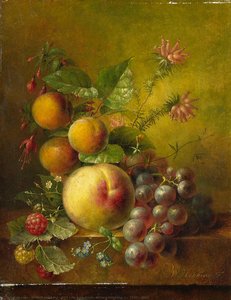
Hekking’s artistic soul was deeply rooted in the Dutch tradition of still life, a genre that demands an almost scientific precision paired with poetic sensibility. His canvases often serve as intimate portraits of the ephemeral—the fleeting bloom of a peony, the lush texture of a peach, or the somber elegance of game birds. Through his brush, the mundane becomes monumental. He possessed a rare ability to manipulate light, allowing it to dance across the surfaces of fruit and flora, creating a sense of volume and tactile reality that feels almost within reach. This mastery of light and shadow allowed him to navigate the complexities of texture, from the velvety skin of an apricot to the translucent fragility of a flower petal.
A Legacy of Light and Texture
The development of Hekking’s style reveals an artist constantly refining his dialogue with nature. His compositions are rarely chaotic; instead, they possess a structured harmony that guides the eye through a carefully curated landscape of objects. Whether he was depicting a bountiful harvest or a somber hunting trophy, there is an underlying rhythm to his work that speaks to the balance of life and decay. This thematic preoccupation with the cycle of nature adds a layer of symbolic depth to his paintings, transforming a simple arrangement of flowers into a memento mori—a gentle reminder of the passage of time.
Throughout his career, Hekking’s achievements were marked by his ability to maintain a standard of excellence that resonated within the European art market. His works, characterized by their incredible detail, found their way into prestigious collections and auctions, securing his place among the notable Dutch masters of his era. The historical significance of his oeuvre lies in its preservation of a specific aesthetic moment—a period where the rigorous discipline of classical technique met a burgeoning interest in the naturalistic beauty of the everyday.
To look upon a Hekking original is to experience a moment of profound stillness. His legacy continues to inspire those who seek beauty in the details, reminding us that true artistry lies in the ability to see the extraordinary within the ordinary. His contributions to the genre of still life remain a testament to the enduring power of observation and the timeless allure of the natural world.