The Enigmatic Master of the Vienna Adoration
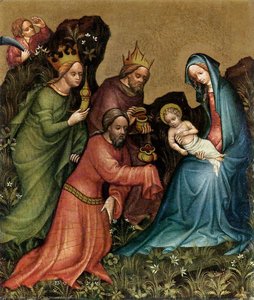
The identity of the artist known as “Master of the Vienna Adoration” remains elusive, a frustrating puzzle for art historians who admire his remarkable contribution to Flemish painting during the early fifteenth century. Despite speculation and scholarly debate, definitive biographical details remain scarce—hence the moniker derived solely from one of his most celebrated works: an exquisite depiction of the Adoration of Christ housed in the Kunsthistorisches Museum, Vienna. This single masterpiece serves as a beacon guiding researchers toward understanding his artistic style and placing him firmly within the broader context of European art at the time.
### Vienna’s Silent Witness: The Artwork That Defined Him
The “Adoration” panel—a tempera on oak—is considered to be one of the finest examples of Soft Style, or Beautiful Style, a distinctive aesthetic that emerged in Flanders around 1410. Characterized by subtle modelling and luminous colours, it exemplifies the artistic ideals championed by Pieter Bruegel the Elder and embodies the humanist spirit of the period. Unlike earlier Gothic art, which prioritized stylized representations and symbolic grandeur, Soft Style embraced naturalism—albeit filtered through a refined aesthetic sensibility—capturing fleeting moments of human emotion with unprecedented sensitivity. The scene portrays Mary, Joseph, angels, and kneeling donors gazing upon the infant Jesus, bathed in ethereal light. Precise detail is evident throughout the composition: the drapery folds ripple realistically, conveying movement and texture; the faces are rendered with remarkable accuracy, capturing expressions of reverence and humility. It’s a testament to his skill that he achieved this level of realism without resorting to perspective—a technique that would become dominant in Renaissance art. The artist's meticulous attention to detail – particularly in rendering fabrics and facial expressions – speaks volumes about his profound understanding of anatomy and observation, foreshadowing developments that would soon characterize the artistic achievements of the coming centuries.
### A Style Shaped by Gothic Tradition & Emerging Humanism
The Master’s artistic vision was undeniably rooted in the traditions of Gothic art, particularly the influence of Jean Fouquet and Simone Martini. However, he skillfully adapted these stylistic conventions to incorporate elements of burgeoning humanism—a philosophical movement emphasizing reason and observation—reflecting a growing interest in portraying the natural world with greater fidelity. This fusion resulted in an unparalleled blend of elegance and realism, distinguishing him from his contemporaries and establishing him as a pioneer of a new artistic idiom. The artist drew inspiration from Bohemian artists active in Vienna at the end of the fourteenth century, especially the Master of Wittingau (active c.1375-1400), whose work demonstrated a similar preoccupation with naturalistic detail and luminous colour palettes. He was one of the earliest Viennese exponents of Soft Style, marking him as a crucial figure in shaping the artistic landscape of his era. The artist’s meticulous attention to detail – particularly in rendering fabrics and facial expressions – speaks volumes about his profound understanding of anatomy and observation, foreshadowing developments that would soon characterize the artistic achievements of the coming centuries.
### Beyond the Vienna Adoration: Scattered Fragments of Genius
Although the “Adoration” remains his undisputed masterpiece—a breathtaking achievement of Soft Style—surviving fragments of other paintings attributed to him offer tantalizing glimpses into his artistic output. These include altarpiece panels depicting saints and biblical scenes—primarily found in churches throughout Flanders—demonstrating a consistent stylistic approach. Analysis of pigment composition confirms that he utilized ultramarine blue imported from Persia—a costly pigment reserved for the most important commissions—underscoring the prestige associated with his work and highlighting his mastery of technique. The artist’s dedication to capturing subtle nuances of emotion and texture is evident in every piece, cementing his reputation as a visionary artist who anticipated the stylistic innovations of the Renaissance.
### Legacy: An Artist Ahead of His Time
The Master of the Vienna Adoration’s contribution to art history transcends mere stylistic innovation; he represents a pivotal moment in the transition from medieval to Renaissance aesthetics. By synthesizing Gothic grandeur with humanist observation, he established a precedent for portraying human experience with profound psychological depth—a hallmark of the artistic achievements that would soon follow. His enduring influence can be seen in subsequent Flemish painters who sought to emulate his luminous palette and meticulous realism, securing his place as one of the most important figures in fifteenth-century art and cementing his legacy as an artist whose vision anticipated the glories of the Renaissance.