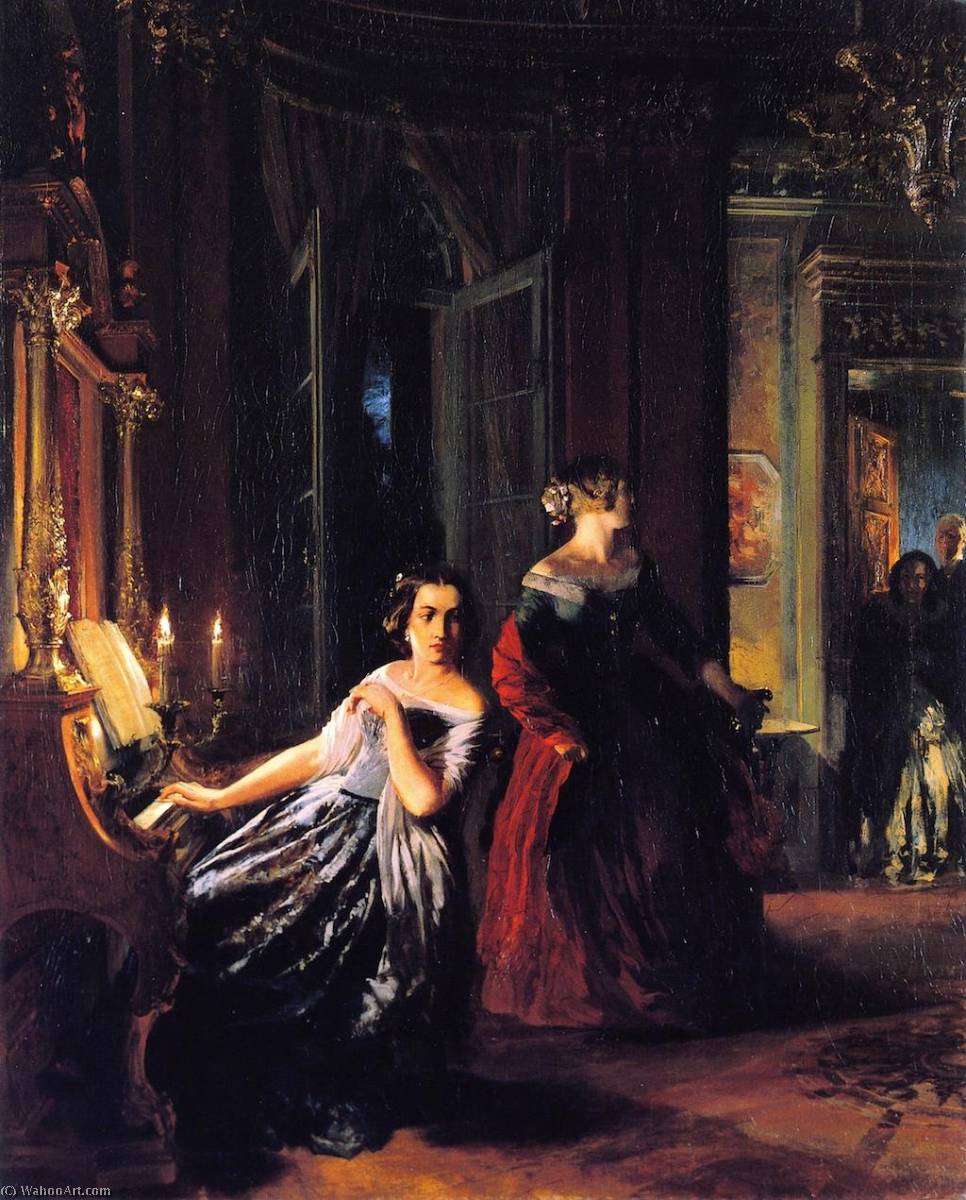
Adolph von Menzel’s “The Interruption”: A Window Into Romantic Elegance
Adolph Friedrich Erdmann von Menzel stands as one of Germany's foremost Realists, yet his artistic vision soared beyond mere observation—he possessed an extraordinary ability to distill the very soul of his era into visual form. Born in Wrocław (then Breslau) in 1815, Menzel’s formative years were spent immersed in the practical world of his father’s lithographic workshop, a circumstance that instilled within him a meticulous attention to detail and a profound appreciation for reproduction—skills which would prove invaluable throughout his prolific career. Though initially destined for academic pursuits, artistic inclination swiftly overruled scholarly ambition, propelling him toward self-directed study and establishing him as a master of diverse mediums, notably oil painting and etching.
- Subject Matter: “The Interruption,” formally titled “Die Unterbrechung,” captures a quintessential moment of aristocratic society—a salon scene depicting two women engaged in conversation amidst opulent surroundings. The composition prioritizes the seated woman’s commanding presence, reflecting her dominance within the frame and embodying an idealized portrait of feminine grace.
- Style: Menzel's work firmly anchors itself within Romanticism, a movement characterized by emotional intensity and fascination with imagination. However, unlike many Romantic artists who prioritized expressive brushstrokes and dramatic color palettes, Menzel meticulously adhered to academic conventions—a deliberate choice that underscores the importance of precision and realism.
Technique & Material Considerations
Menzel’s mastery extended beyond stylistic adherence; he achieved breathtaking visual fidelity through masterful technique. Executed in oil paint on canvas, “The Interruption” exemplifies the meticulous craftsmanship demanded by Romantic art. The artist employed smooth brushwork to render textures—particularly those of fabrics and wall surfaces—creating a palpable sense of materiality. Careful layering of pigments ensured depth and luminosity, capturing the ethereal quality of candlelight illuminating the central figures and casting dramatic shadows across the room. This deliberate manipulation of light contributes significantly to the artwork’s emotional impact.
Historical Context & Symbolism
Painted in 1846, “The Interruption” reflects the anxieties and aspirations of mid-Victorian Germany. The scene portrays a refined domestic interior—a deliberate counterpoint to the turbulent political landscape of the time—suggesting an idealized vision of aristocratic life focused on intellectual discourse and social decorum. The ornate furnishings and drapery serve as symbols of wealth and status, reinforcing the artwork’s portrayal of upper-class society. Furthermore, the subtle tension between the two women hints at unspoken emotions and complexities within interpersonal relationships – a recurring motif in Romantic art.
Emotional Impact & Artistic Legacy
“The Interruption” transcends mere depiction; it evokes profound feelings of elegance, contemplation, and perhaps melancholy. Menzel’s ability to convey atmosphere—the hushed intimacy of the salon, the dramatic interplay of light and shadow—solidifies his reputation as a visionary artist who captured not just what he saw but also what he felt. Today, reproductions of this masterpiece continue to inspire interior designers and art enthusiasts alike, offering a glimpse into the artistic sensibilities of a bygone era and demonstrating Menzel’s enduring contribution to German Romanticism.