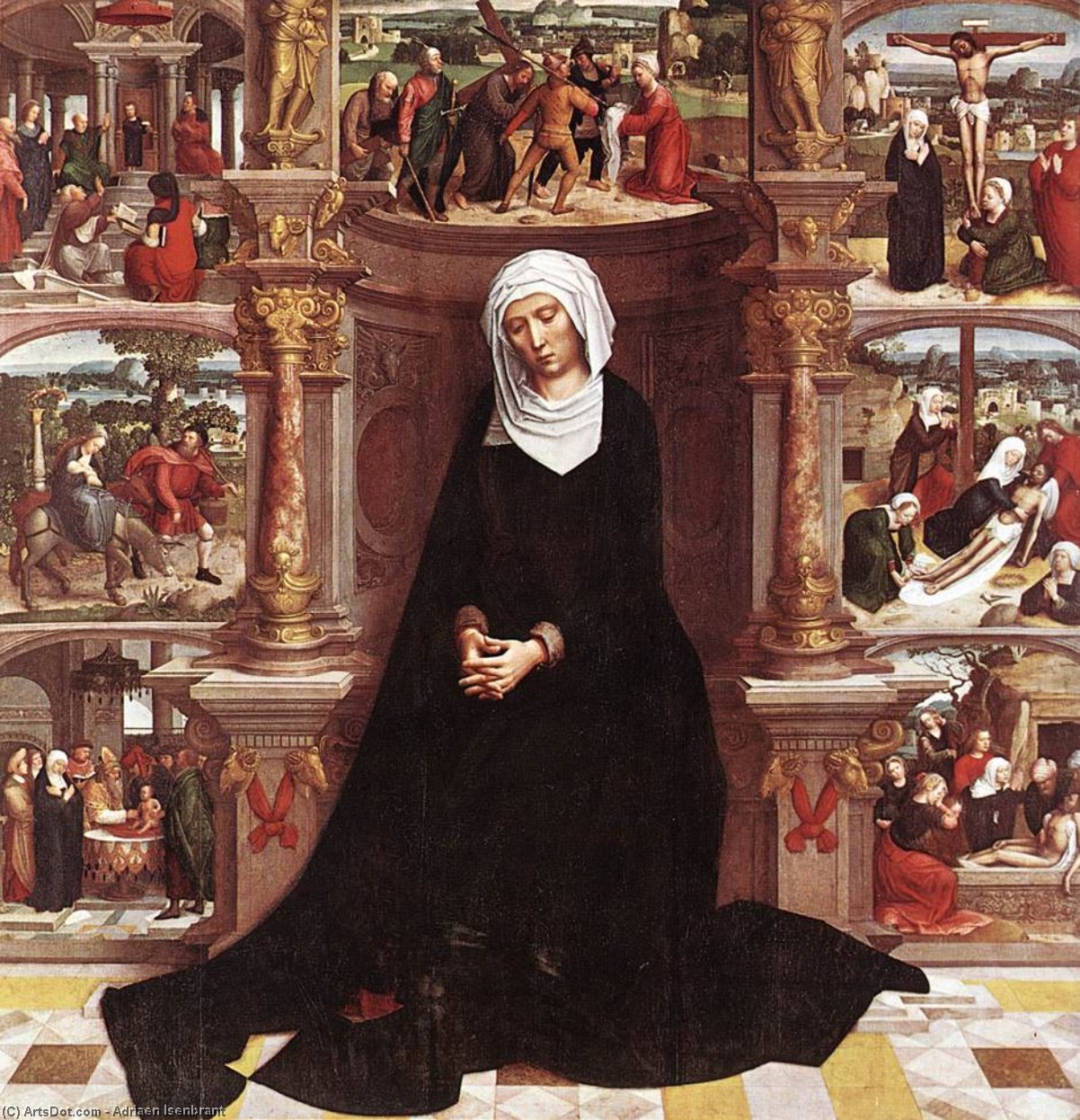
Magnificent Bruges masterpiece! Adriaen Isenbrant’s "Our Lady of the Seven Sorrows" portrays Mary's profound grief with masterful detail and Renaissance influence—a poignant exploration of faith and suffering.
Adrijen Isenbrant (oko 1490–1551) bio je ključni slikar severne renesanse u Brudžu koji je vodio plodnu radionicu. Poznat po religioznim scenama koje spajaju rane nederlandske i rane renesansne stilove.
Otkrijte čarobni grad Brugge! Posetite crkvu Gospe Marije, uživajte u gotičkoj arhitekturi i istražite istorijske znamenitosti Belgije.
Our Lady of the Seven Sorrows: A Bruges Masterpiece Revisited
The Church of Our Lady in Bruges houses one of Adriaen Isenbrant’s most poignant creations, “Our Lady of the Seven Sorrows,” a monumental panel painting completed around 1535. This artwork stands as a testament to the burgeoning Renaissance spirit infiltrating Northern European artistic traditions and exemplifies Isenbrant's masterful blending of Early Netherlandish iconography with emerging stylistic innovations. Its enduring appeal lies not only in its exquisite visual beauty but also in its profound exploration of Marian devotion and human suffering—themes that resonate powerfully across centuries.
A Synthesis of Styles: Bruges’ Artistic Landscape
Isenbrant, operating within the vibrant artistic milieu of Bruges during a period marked by significant cultural exchange between Italy and Flanders, skillfully navigated stylistic currents. While rooted in the established conventions of Early Netherlandish painting – notably evident in the meticulous depiction of drapery folds and the solemn gaze of Mary – “Our Lady of the Seven Sorrows” incorporates elements characteristic of the Renaissance Mannerist style. The architectural setting—a semicircular niche adorned with classical motifs like rams’ heads and garlands—reflects Bruges' engagement with humanist ideals and artistic influences originating from Rome, where the Domus Aurea had captivated artists with its opulent ceiling frescoes. This fusion underscores Isenbrant’s ambition to elevate his work beyond mere representation, striving for a heightened emotional impact and conveying complex theological concepts.
Iconography and Symbolism: Narratives of Sorrow
The painting's narrative unfolds through seven distinct scenes depicting Mary’s sorrows—a deliberate choice reflecting the medieval tradition of commemorating these tribulations as part of the liturgical year. Each episode is meticulously rendered, capturing key moments from Mary’s life marked by grief and anguish: Simeon’s prophetic utterance at the Temple foreshadowing Jesus’ suffering; the arduous journey to Egypt fleeing Herod’s persecution; the discovery of Jesus abandoned in the Temple after his circumcision; Mary receiving news of John the Baptist's birth; Mary witnessing Herod’s massacre of infants; Mary observing Jesus crucified; and finally, Mary mourning over Jesus’ body at the Tomb. These scenes are imbued with symbolic significance—the doves representing divine grace, the thorns symbolizing Christ’s sacrifice, and the weeping Mary embodying compassion and maternal sorrow—creating a visual tapestry that speaks to universal human experience.
Technique and Material: Craftsmanship Elevated
Isenbrant's technique demonstrates remarkable precision and sensitivity to material qualities. Executed on a poplar panel treated with gesso and primed with oil paint, he achieved luminous color palettes using pigments derived from minerals and organic sources—a hallmark of Northern Renaissance painting. The artist’s meticulous brushwork captures the textures of fabric and flesh with astonishing realism, conveying both visual splendor and emotional depth. Furthermore, Isenbrant skillfully employed chiaroscuro—the dramatic interplay between light and shadow—to sculpt form and heighten the expressive power of each scene, mirroring the artistic innovations championed by Michelangelo and Raphael during the High Renaissance.
Legacy and Resonance: An Enduring Image of Faith
“Our Lady of the Seven Sorrows” continues to inspire admiration for its artistic merit and theological profundity. Its presence within the Church of Our Lady—a pilgrimage site attracting visitors from across Europe—underscores its enduring significance as a symbol of Marian devotion and Christian compassion. Today, reproductions crafted by skilled artisans like Ocean’s Bridge allow enthusiasts worldwide to experience the beauty and emotional resonance of Isenbrant's masterpiece, preserving its legacy for future generations.