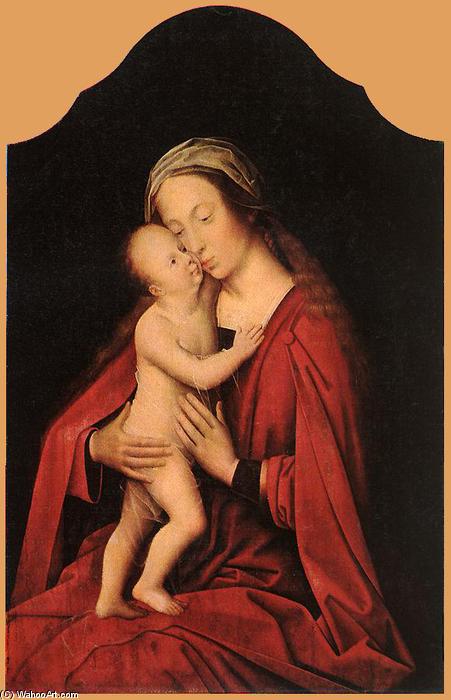
A Divine Encounter in Pigment and Light
In the quiet, hallowed atmosphere of the Szépművészeti Múzeum in Budapest, there exists a window into the soul of the Northern Renaissance. Adriaen Isenbrant’s “Virgin and Child,” painted around 1520, is far more than a mere religious icon; it is a profound meditation on the intersection of the human and the divine. As one gazes upon this oil on oak panel, the initial sensation is one of profound stillness. The composition, centered around the tender embrace of the Virgin Mary and the infant Jesus, draws the viewer into a sacred space where time seems to suspend itself. Isenbrant, a master whose very name evokes the mysterious workshops of Bruges, utilizes a masterful command of chiaroscuro to breathe life into his subjects, allowing light to emerge from a deep, velvety darkness to illuminate the soft contours of holy faces.
The emotional resonance of the piece lies in its delicate balance between maternal tenderness and spiritual gravity. There is an intimacy in the way Mary cradles her son, yet the presence of Saint Anne—Mary’s mother—adds a layer of generational piety and divine lineage that elevates the scene from a domestic moment to a cosmic event. For the collector or the lover of fine art, this painting offers a rare glimpse into the Early Netherlandish tradition, where every brushstroke serves a dual purpose: to replicate the physical world with startling realism and to encode deep theological truths within the very fabric of the image.
The Mastery of Northern Renaissance Technique
To appreciate “Virgin and Child” is to admire the painstaking discipline of the 16th-century Flemish tradition. Isenbrant’s technique is characterized by a deliberate, controlled application of pigment, layered with such precision that the surface appears to glow from within. The artist employs an earthy, sophisticated palette dominated by ochre, umber, and ivory, which grounds the celestial subject matter in a palpable, naturalistic reality. This subdued tonality is brilliantly interrupted by the vibrant red of Mary’s cloak—a color that serves not only as a visual anchor for the composition but also as a potent symbol of her passion and her exalted status as the Mother of Christ.
The interplay of light and shadow is where Isenbrant truly excels. By casting the background into an indistinct, dark void, he forces the viewer’s eye to focus entirely on the luminosity of the central figures. This technique creates a three-dimensional presence that makes the infant Jesus appear almost tangible, his skin catching the light with a soft, pearlescent quality. For interior designers seeking to introduce a sense of historical depth and quiet luxury into a space, the subtle gradations of color and the masterful use of light in this work provide an unparalleled sense of sophistication and calm.
A Legacy of Faith and Humanism
Historically, this masterpiece stands at a fascinating crossroads. Created during the waning years of the High Renaissance, it embodies the burgeoning humanist ideals that were sweeping through Europe. While the subject remains deeply rooted in traditional Catholic devotion, there is an unmistakable emphasis on human dignity and the beauty of the natural world—values championed by contemporary thinkers like Erasmus. Isenbrant captures this tension between the miraculous and the mundane, presenting the divine not as a distant, unreachable force, but as something that exists within the warmth of human connection.
Owning or displaying a high-quality reproduction of such a significant work allows one to bring this atmosphere of reverence into the modern home. It is an invitation to slow down, to contemplate, and to find beauty in the meticulous details of the past. Whether viewed as a piece of historical documentation or a profound work of art, “Virgin and Child” remains an enduring testament to the power of the brush to capture the eternal within the ephemeral.