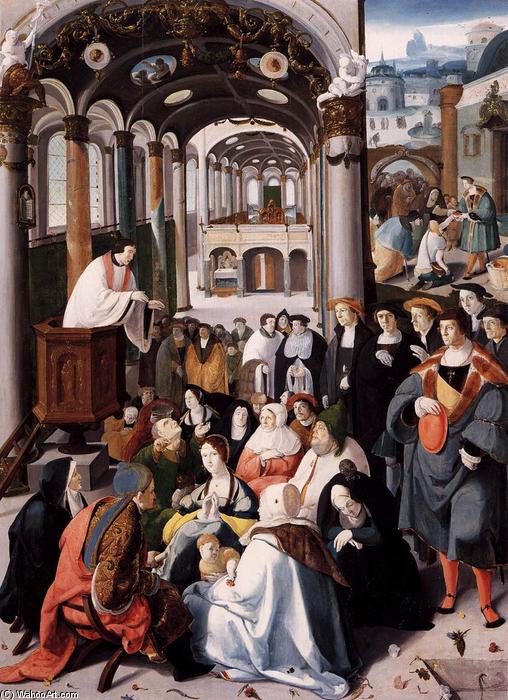
Уметничко репродукција црквеног говора Аертгена Клаеза ван Лејдена из периода Ренесансе, познатог по својој прецизној реалистичности и детаљима. Истражите утицајну религиозу уметност и архитектуру ренесансне Еуропе.
Explore the works of Aertgen Claesz van Leyden (1498-1564), a Leiden master known for religious scenes & intricate detail. Discover his art, including 'The Raising of Lazarus' & more!
Rijksmuseum
(Amsterdam, Netherlands)
Istražite holandske umetnosti i istoriju u Rijksmuseumu Amsterdam! Oduševite se remek-delima Rendvrika, Vermeer i Van Goga u ikoničnoj zgradi – putovanje kroz 800 godina kulture.
Aertgen Claesz van Leyden’s Church Sermon: A Window into Renaissance Faith and Detail
Aertgen Claesz van Leyden (c. 1498 – c. 1564), a name perhaps less resonant than those of his contemporaries like Rembrandt or Rubens, nevertheless occupies a crucial position within the artistic landscape of early Netherlandish painting—a realm characterized by profound spiritual contemplation and breathtaking visual precision. His oeuvre, though comparatively modest in quantity, possesses an exceptional quality that distinguishes it as a cornerstone of Leiden’s artistic heritage and a testament to the enduring power of meticulous observation. This particular artwork, “Church Sermon,” exemplifies Van Leyden's signature style: a captivating blend of realism and illusionism achieved through masterful oil painting technique—a medium he championed with unwavering dedication.
The Scene Captured: Faith Illuminated
“Church Sermon” transports us directly into the heart of Renaissance piety. The painting depicts an interior church space bathed in diffused light, meticulously rendered to convey both grandeur and intimacy. Dominating the composition is a priest delivering his sermon before a congregation—a scene rife with symbolic significance reflecting the pervasive influence of Christianity on daily life during this period. The artist’s keen eye captures not merely the physical appearance of the building but also the palpable atmosphere of devotion, inviting viewers to contemplate the spiritual essence of the moment. As evidenced by the Rijksmuseum's detailed analysis of “The Calling of Saint Anthony,” Van Leyden’s approach prioritized conveying emotion and narrative depth alongside accurate representation.
Technique and Material: Mastery of Oil Paint
Van Leyden’s skill lies principally in his command of oil paint—a revolutionary medium that allowed for unprecedented levels of tonal gradation and textural nuance compared to tempera, the dominant pigment of earlier centuries. The artist skillfully employs glazing techniques, layering thin translucent washes over underlying pigments to achieve luminous effects and subtle color harmonies. This meticulous process is particularly evident in the depiction of drapery folds and architectural surfaces—elements rendered with astonishing realism that contribute significantly to the painting’s overall impression of solidity and depth. Like “Church Sermon,” Van Leyden's work demonstrates a dedication to capturing light and shadow, creating an illusionistic space that transcends mere visual representation.
Historical Context: Leiden’s Artistic Crucible
“Church Sermon” emerged during a period of fervent religious fervor in Leiden—a city renowned for its intellectual vibrancy and burgeoning artistic community. The Reformation had profoundly impacted Dutch society, fostering a renewed interest in biblical narratives and prompting artists to explore themes of faith, morality, and divine grace. Van Leyden’s work reflects this cultural milieu, aligning with the broader stylistic trends prevalent throughout Northern Europe during the Renaissance—characterized by an emphasis on clarity, balance, and idealized beauty. The influence of Flemish art is palpable, mirroring the artistic conventions established by masters like Jan van Eyck and Rogier van der Weyden.
Symbolism: Layers of Meaning Beyond Appearance
Beyond its visual splendor, “Church Sermon” communicates profound symbolic ideas. The priest’s sermon represents the dissemination of Christian doctrine—a cornerstone of Renaissance education and social life. Furthermore, the depiction of the congregation underscores the importance of communal worship and spiritual fellowship. Even seemingly minor details—such as the fly on the priest's robe—serve as visual puns intended to engage the viewer’s intellect and heighten the painting’s emotional impact. As highlighted in WGA’s analysis, Van Leyden skillfully employs illusionistic techniques to enrich the narrative experience.
Emotional Resonance: A Moment Frozen in Time
Ultimately, “Church Sermon” succeeds in capturing a powerful emotion—the solemn reverence of faith. The artist's meticulous attention to detail—from the folds of the priest’s robe to the expressions on the faces of the worshippers—creates an immersive experience that transports viewers back to Renaissance Leiden. This artwork serves as a poignant reminder of humanity’s enduring quest for spiritual understanding and artistic excellence—a legacy that continues to inspire admiration and contemplation centuries later.