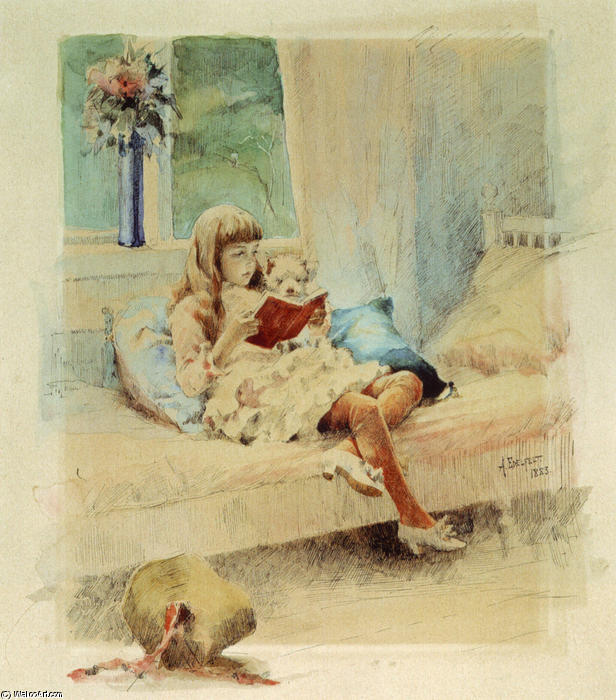
Good Friends III (Berta and Capi) by Albert Edelfelt depicts a young girl reading with her dog, bathed in natural light within a cozy bedroom setting adorned with vases, plants, and a chair. This heartwarming portrait captures the affectionate companionship between human and animal.
Istražite realističke slike Alberta Edelfelta (1854-1905), pionira finskog slikarstva poznatog po portretima, pejzažima i uticaju na finsku umetnost. Otkrijte dela kao što su 'Portret Luja Pasteura' i 'Pod brezama'.
A Portrait of Innocence: Albert Edelfelt’s Girl with Dog
Albert Edelfelt's "Girl with Dog," painted in 1893, stands as a quintessential example of Finnish Impressionism and embodies a profound exploration of childhood innocence intertwined with the enduring bond between humans and animals. This captivating artwork resides within the Helsinki Art Museum’s collection, offering visitors an intimate glimpse into Edelfelt’s masterful artistic vision.
Style and Technique: Embracing Light and Atmosphere
Edelfelt skillfully employed Impressionistic techniques—characterized by loose brushstrokes, vibrant color palettes, and a focus on capturing fleeting moments of light—to depict this serene scene. Unlike the rigid academic conventions prevalent at the time, Edelfelt prioritized conveying atmosphere and emotion over meticulous detail. The artist meticulously blended pigments to achieve subtle tonal variations, creating an ethereal luminescence that envelops the girl and her canine companion. Notice how the dappled sunlight filtering through the window illuminates the girl’s face and casts delicate shadows across the bed linen—a testament to Edelfelt's dedication to capturing the nuances of natural light.
Historical Context: Finland’s Artistic Renaissance
“Girl with Dog” emerged during Finland’s burgeoning artistic renaissance, a period marked by increasing national pride and a desire to establish Finnish identity on an international stage. Following Sweden’s relinquishment of its dominion over Finland in 1809, artists like Edelfelt championed Finnish themes and traditions within the broader European art landscape. Impressionism itself was gaining momentum across Europe, influencing artists to experiment with new approaches to painting—a movement that Edelfelt wholeheartedly embraced, propelling him to prominence as a leading figure of his generation.
Symbolism: The Language of Emotion
Beyond its aesthetic beauty, “Girl with Dog” resonates with symbolic significance. The girl represents purity and vulnerability, qualities cherished within Finnish culture. Her gaze directs upwards towards the window—a visual metaphor for aspiration and contemplation—suggesting an inner life brimming with curiosity and wonder. Simultaneously, the dog embodies loyalty and companionship, reflecting the importance of animal relationships in Finnish folklore and daily life. Together, they symbolize a harmonious connection between humanity and nature—a theme frequently explored by Edelfelt throughout his oeuvre.
Emotional Impact: A Moment Frozen in Time
Ultimately, “Girl with Dog” evokes a powerful emotional response—one of warmth, tenderness, and nostalgia. The painting’s tranquil composition invites viewers to pause and appreciate the simple joys of childhood—the comfort of a beloved pet, the beauty of natural light, and the profound connection between individuals. Edelfelt's masterful execution ensures that this idyllic scene remains eternally preserved in time, continuing to inspire admiration and contemplation for generations to come. It’s a painting that speaks volumes about human compassion and the enduring power of artistic expression.