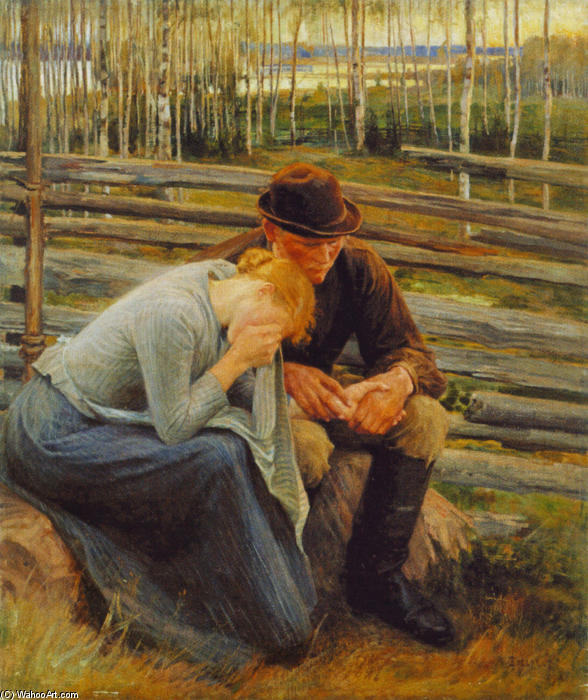
Albert Edelfelt’s “Suru,” An Ode to Finnish Landscape and Human Connection
- Subject Matter: Albert Edelfelt's "Suru," translating to "To Do," depicts a poignant scene of a man and woman seated on a weathered fence overlooking a tranquil Finnish woodland. The composition centers around their figures, subtly conveying intimacy amidst the grandeur of nature.
- Style: The painting embodies Finnish Landscape Romanticism—a movement characterized by idealized depictions of rural Finland infused with emotional depth and spiritual contemplation. Edelfelt skillfully blends realism with expressive brushstrokes to capture both the tangible beauty of the environment and the inner lives of his subjects.
- Technique: Employing oil paints on canvas, Edelfelt utilizes a layering technique—glazes applied over underpaintings—to achieve luminous color palettes and subtle tonal gradations. His meticulous attention to detail is evident in the rendering of textures – from the rough bark of the trees to the worn planks of the fence – contributing to the painting’s immersive quality.
- Historical Context: Created in 1893, “Suru” emerged during a period of fervent artistic revival in Finland. The Finnish Art Society championed landscapes as vehicles for conveying national identity and spiritual aspiration. Edelfelt's work reflects the broader cultural ethos of his time—a yearning for connection with the natural world and an exploration of human emotion.
- Symbolism: The fence itself serves as a powerful symbol—representing boundaries, yet simultaneously facilitating communication and fostering closeness between individuals. The woman’s clasped hands suggest introspection and vulnerability, while the man's gaze directs attention outward, symbolizing contemplation and engagement with the surrounding landscape. Ultimately, “Suru” speaks to the universal desire for harmony between humanity and nature.
Color Palette and Light Rendering – Capturing Finnish Atmosphere
Edelfelt’s masterful use of color contributes significantly to the painting's emotional resonance. Dominant hues—greens, browns, and blues—mirror the palette of Finnish forests—creating a visual echo that reinforces the scene’s tranquil ambiance. The artist skillfully manipulates light—casting dappled shadows across the fence and illuminating the figures—enhancing depth and conveying a sense of ethereal beauty. These techniques align perfectly with the Romantic tradition's emphasis on capturing sublime experiences.
Brushwork and Texture – A Dialogue Between Artist and Canvas
Edelfelt’s brushstrokes are characterized by fluidity and spontaneity—yet underpinned by careful observation and technical precision. Loose, expressive strokes delineate the contours of the trees and fence—capturing their organic forms with remarkable accuracy. Conversely, smoother brushstrokes render the figures—suggesting a subtle blend of realism and idealized representation. The resulting textural interplay enhances the painting’s visual richness—inviting viewers to appreciate the materiality of the artwork itself.
Emotional Impact – Reflections on Solitude and Connection
“Suru” transcends mere depiction—it evokes profound feelings of melancholy, serenity, and contemplation. The figures' posture conveys a quiet stillness—suggesting an awareness of solitude yet simultaneously fostering a sense of shared experience. The painting’s luminous color palette and evocative light rendering amplify these emotional dimensions—transporting viewers to the Finnish woodland depicted within.
Conclusion – An Enduring Legacy of Finnish Romanticism
Albert Edelfelt's “Suru” stands as a testament to the enduring legacy of Finnish Landscape Romanticism. Its masterful composition, refined technique, and symbolic depth continue to inspire admiration—solidifying Edelfelt’s place among Finland’s most celebrated artists. Reproductions of this iconic artwork offer collectors and interior designers alike an opportunity to experience firsthand the beauty and emotional power of a timeless masterpiece.