A Study in Suffering: Albrecht Dürer’s ‘Christ Crowned with Thorns’
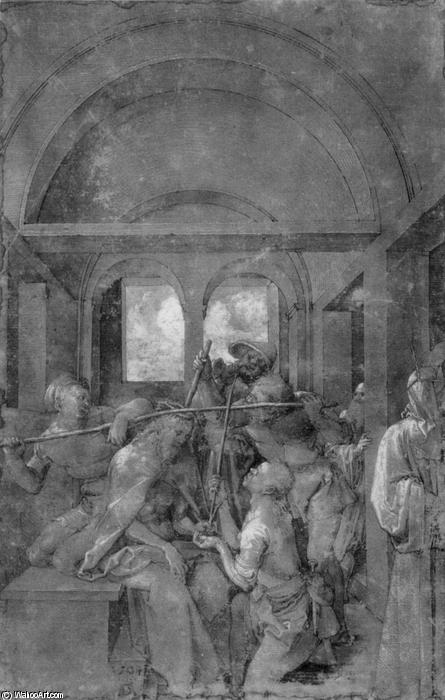
Albrecht Dürer's 'Christ Crowned with Thorns,' a monochromatic study rendered in silverpoint or charcoal, offers a profoundly moving glimpse into the artist’s meticulous process and his deep engagement with one of Christianity’s most poignant narratives. Executed around 1505, this preparatory drawing transcends mere documentation; it is a concentrated distillation of sorrow, compassion, and the weight of sacrifice – hallmarks of Dürer's artistic vision. The image immediately commands attention through its stark grayscale palette, a deliberate choice that amplifies the scene’s solemnity and evokes a sense of timelessness. The subtle gradations achieved through masterful hatching and cross-hatching transform the surface of the paper into a landscape of light and shadow, imbuing the figures with an almost palpable physicality.
Renaissance Precision and Emotional Resonance
Dürer’s mastery is evident in every carefully rendered line. The work firmly establishes itself within the context of Renaissance drawing, a period defined by an intense focus on anatomical accuracy and realistic representation – qualities Dürer honed to extraordinary levels. Yet, this isn't simply a technical exercise; it’s infused with a deeply felt emotional response. The composition, centered around Christ but subtly offset, creates a dynamic tension, mirroring the turmoil of the event itself. The surrounding figures, depicted in a somewhat chaotic arrangement within an architectural setting reminiscent of Roman arches, contribute to this sense of urgency and participation – as if witnessing a moment of profound significance.
Technique and Materials: A Window into Dürer’s Studio
- Medium: Likely silverpoint or charcoal on paper. The choice of medium itself speaks volumes about Dürer's approach – the luminous quality of silverpoint, for instance, lends a unique etherealness to the depiction, while charcoal offers a darker, more expressive potential.
- Line Work: Meticulous sketching with fine lines, combined with extensive hatching and cross-hatching, is central to the artwork’s impact. This technique isn't merely about outlining forms; it’s about building up tonal values, creating an illusion of depth, and suggesting textures – from the rough linen of Christ’s crown to the smooth stone of the arches.
- Perspective & Detail: Linear perspective is skillfully employed in the architectural elements, converging towards a vanishing point that draws the viewer into the scene. The artist's attention to detail—the individual thorns, the expressions of anguish on the surrounding figures—demonstrates an unwavering commitment to realism and psychological depth.
Symbolism and the Weight of Faith
'Christ Crowned with Thorns’ is more than just a depiction of a biblical event; it's a meditation on suffering, redemption, and humanity’s relationship with divinity. The grayscale palette deliberately removes any distractions of color, forcing the viewer to confront the raw emotion at the heart of the scene. The architectural setting, evoking both grandeur and confinement, reinforces the themes of sacrifice and oppression. This work resonates deeply with Christian iconography, reminding us of Christ's willingness to endure pain for humanity’s salvation – a central tenet of faith that continues to inspire awe and reflection centuries later.