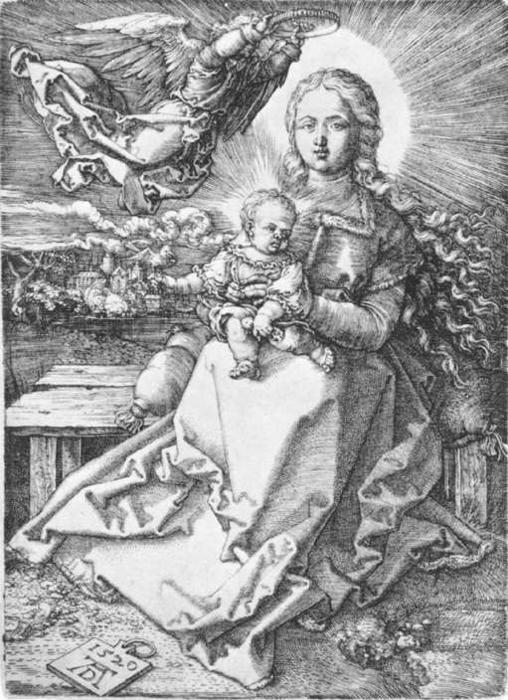
This engraving, created by Albrecht Dürer in 1520, exemplifies the Northern Renaissance style with meticulous detail and realistic portrayal. Utilizing burin technique, Dürer achieved subtle gradations of light and shadow through cross-hatching, capturing the essence of religious iconography—the coronation of Mary by an angel—and reflecting his profound artistic vision.
A Celestial Coronation in Line and Light
In the quiet, meticulous world of Albrecht Dürer’s 1520 engraving, Madonna Crowned by an Angel, time seems to suspend itself in a moment of eternal grace. This masterpiece of the Northern Renaissance does not merely depict a religious event; it invites the viewer into a sacred dialogue between the earthly and the divine. Through the masterful use of monochrome printmaking, Dürer captures the profound tenderness of the Virgin Mary as she cradles the Christ Child, while an ethereal angel descends from the heavens to bestow upon her a celestial crown. The artwork is a breathtaking study in devotion, where every fine line serves as a prayer, and every shadow whispers of the spiritual mysteries held within the heart of Christendom.
The visual impact of this piece lies in its extraordinary technical precision. Dürer, a titan of the German Renaissance, utilized the burin tool to carve intricate patterns into a metal plate with an almost superhuman control over density and direction. By employing sophisticated hatching and cross-hatching, he achieved a miraculous illusion of three-dimensionality on a flat surface. One can almost feel the weight of the Madonna’s heavy, draped garments and the soft, downy texture of the angel's wings. The light does not simply illuminate the scene; it radiates from behind the angelic figure, creating a dramatic, directional glow that carves the figures out of the darkness, lending the composition a sculptural presence that remains strikingly modern despite its age.
Symbolism and the Renaissance Spirit
Beyond its technical brilliance, the engraving is a rich tapestry of theological symbolism. The act of coronation is a powerful visual declaration of Mary’s sanctity and her role as the Queen of Heaven. The angel acts as the vital bridge between realms, a messenger of God's benevolence, while the subtle landscape in the background suggests the vastness of the created world, all revolving around this central moment of divine grace. Dürer’s ability to blend humanist realism with deep spiritual iconography allows the viewer to connect with the figures on both an intellectual and emotional level. The composition is balanced yet dynamic, drawing the eye upward in a rhythmic movement from the grounded simplicity of the bench toward the radiant halo of the heavens.
For the discerning collector or interior designer, a high-quality reproduction of this work offers more than mere decoration; it provides a focal point of profound serenity and intellectual depth. The monochromatic palette of grays and blacks allows it to integrate seamlessly into diverse aesthetic environments, from the sophisticated minimalism of a modern gallery-style room to the rich, textured warmth of a classical study. To possess such a piece is to bring a fragment of the Northern Renaissance into the contemporary home—a constant reminder of the beauty found in precision, the power of light, and the enduring allure of the divine.