A Silent Communion in Monochrome
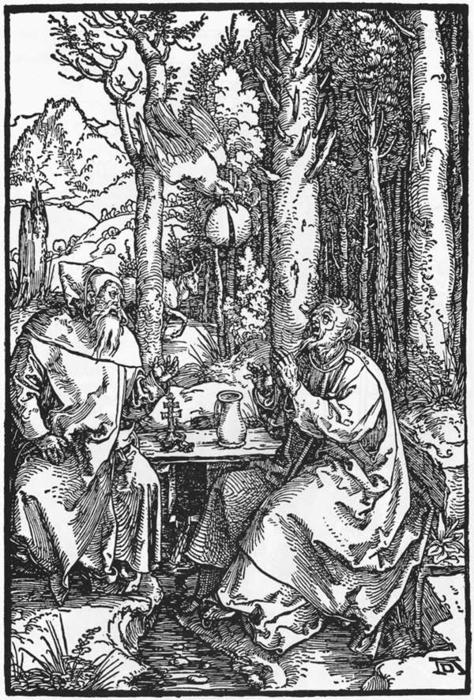
In the quietude of a sun-dappled woodland, two figures sit in profound stillness, their presence bridging the gap between the earthly and the divine. Albrecht Dürer’s The Hermits St Anthony and St Paul is not merely an engraving; it is a window into the soul of the Northern Renaissance. Completed around 1504, this masterpiece captures a moment of sacred intimacy between two of Christianity's most revered ascetics. As they sit beside a humble wooden table, the simplicity of their surroundings—a few ceramic cups and the rugged textures of nature—serves to amplify the spiritual weight of their encounter. For the discerning collector or designer, this piece offers more than just visual interest; it provides a focal point of meditative calm, inviting anyone who gazes upon it to pause and reflect amidst the chaos of modern life.
The brilliance of Dürer’s execution lies in his unparalleled command over the medium of engraving. Eschewing the distraction of color, he utilizes a sophisticated monochromatic palette that relies entirely on the interplay of light and shadow. Through the meticulous application of cross-hatching and fine, rhythmic lines, Dürer breathes life into the inanimate. One can almost feel the rough, weathered bark of the towering tree that frames the composition, or the heavy, coarse folds of the saints' monastic robes. This technical virtuosity creates a tactile experience, where the depth of the forest is rendered through varying line densities, guiding the eye from the sharp detail of the foreground into the soft, receding shadows of the background.
Symbolism and the Renaissance Spirit
Beyond its technical prowess, the artwork is steeped in the rich symbolic language of the 16th century. The central tree, a dominant force in the composition, acts as a pillar of resilience and spiritual growth, its branches reaching upward like prayers toward the heavens. Even the smallest details, such as a solitary bird perched upon a branch, carry weight, perhaps representing divine guidance or the fleeting nature of life. This era of art was defined by a tension between humanism and deep-seated piety, and Dürer captures this perfectly. The saints are portrayed with a psychological depth that feels remarkably modern; they are not distant icons, but palpable beings engaged in a shared moment of quiet devotion.
For those looking to integrate fine art into a curated interior, this engraving offers a timeless elegance. Its vertical orientation and balanced composition make it an ideal candidate for a gallery wall or as a standalone statement piece in a study or library. The monochromatic tones allow it to harmonize seamlessly with a variety of decor styles, from the stark minimalism of contemporary spaces to the rich, textured warmth of classical traditionalism. Owning a high-quality reproduction of this work means bringing a piece of history into the home—a fragment of Nuremberg’s golden age that continues to inspire awe through its silent, powerful narrative of faith and solitude.