A Quiet Symphony of Form and Color
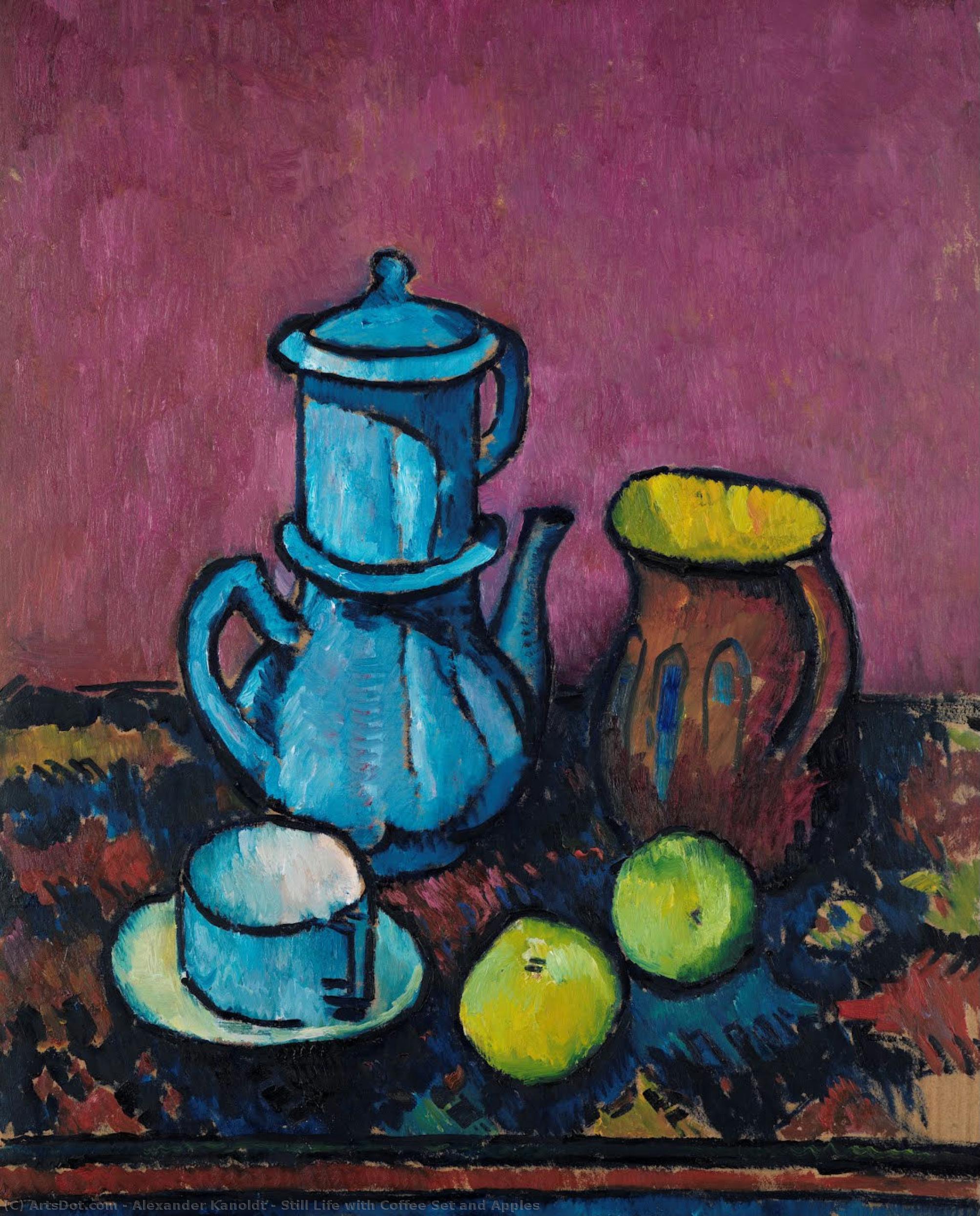
In the serene stillness of Alexander Kanoldt’s Still Life with Coffee Set and Apples, time appears to hold its breath. Created in 1910, this evocative masterpiece invites the viewer into a private, meditative moment, where the mundane objects of daily life are elevated to the realm of the extraordinary. The composition is anchored by a striking blue coffee pot and matching teapot, their smooth, glazed surfaces catching a soft, diffused light that seems to emanated from within the canvas itself. Scattered around these central vessels, bright apples provide rhythmic pops of color, their organic curves contrasting beautifully with the structured elegance of the ceramicware. A delicate vase sits nestled in the mid-ground, adding a layer of depth and architectural stability to the arrangement, while small cups are placed with a deliberate, almost musical precision across the tabletop.
The painting serves as a profound testament to Kanoldt’s mastery of Magic Realism and his connection to the New Objectivity movement. Unlike the frenetic energy of many of his contemporaries in the avant-garde circles of Munich, Kanoldt possessed a unique ability to imbue stillness with a sense of latent energy. His technique is characterized by a meticulous attention to form and a controlled use of color that avoids excessive ornamentation. Every brushstroke serves to define the weight and volume of the objects, creating a tactile reality that feels both hyper-real and dreamlike. The interplay between the cool blues of the porcelain and the warm, earthy tones of the fruit creates a visual harmony that is both soothing and intellectually stimulating, making it an ideal centerpiece for a sophisticated interior.
Historical Resonance and Artistic Legacy
To understand this work is to understand the turbulent yet transformative era of early 20th-century German art. Having moved to Munich in 1908, Kanoldt was immersed in a world of radical experimentation alongside legends like Kandinsky and Jawlensky. Yet, while others sought to dissolve form into pure abstraction, Kanoldt found his voice by refining it. This still life reflects that tension—a commitment to the tangible world even as the boundaries of modern art were being redrawn. The painting captures a sense of order and permanence that would soon be challenged by the shifting political landscapes of Europe, lending the work a poignant, nostalgic quality.
For the discerning collector or interior designer, this reproduction offers more than mere decoration; it offers an atmosphere of contemplative luxury. The piece possesses a timeless quality that allows it to integrate seamlessly into both classical and contemporary settings. Whether placed in a sunlit breakfast nook to evoke morning tranquility or in a formal study to provide a focal point of quiet strength, the artwork commands attention through its subtle complexity. It is a window into a moment of perfect equilibrium, a celebration of the beauty found in the silent, structured elegance of the everyday.