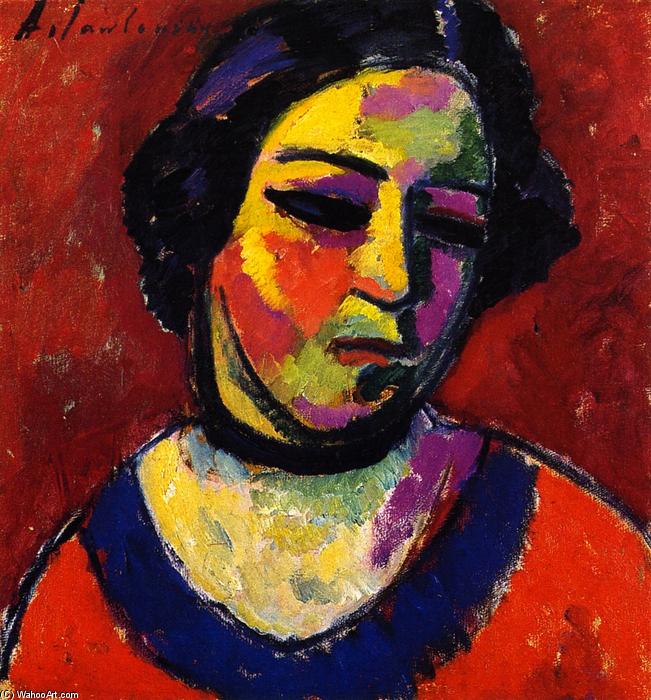
Explore Alexej von Jawlensky's emotive 'Woman's Head' (1912), a vibrant Expressionist masterpiece. Discover bold colors, simplified forms & the artist’s journey within Der Blaue Reiter and beyond.
Otkrijte ekspresivni svet Alekseja von Javlenskog (1864-1941). Istražite njegove ikonične 'Mistične glave', jarke boje i ključnu ulogu u pokretima poput Der Blaue Reiter. Ruski umetnik koji je duboko uticao na modernu umetnost.
Istražite umetnost i istoriju u Muzeju lepih umetnosti Hjustona! Otkrijte drevne artefakte, remek-dela i zapanjujuće skulpture u srcu kulturnog života grada. Tri zgrade, bogata kolekcija i inspirativna iskustva čekaju vas.
A Window into the Soul: Alexej von Jawlensky’s ‘Woman's Head’ (1912)
Alexej von Jawlensky’s 1912 painting, *Woman’s Head*, is not merely a portrait; it’s an intimate encounter with the human spirit. Executed during a pivotal period in the artist’s career and within the burgeoning Expressionist movement, this work transcends representational accuracy to become a powerful exploration of inner life. The face that gazes out from the canvas isn't a specific likeness but rather a universal archetype—a vessel for contemplation, introspection, and perhaps even a touch of melancholy. Painted with oil on panel, the medium itself contributes to the painting’s depth; the texture invites close scrutiny, revealing layers of color and brushwork that hint at the complex emotions beneath the surface. The work resides in the Museum of Fine Arts, Houston, a testament to its enduring artistic significance.
The Birth of Mysticism: Jawlensky's Artistic Journey
Jawlensky’s path to Expressionism was far from conventional. Born into Russian aristocracy in 1864, his early life involved military training before a transformative encounter with art at the Moscow World Exposition ignited a lifelong passion. He settled in Munich, absorbing influences from Fauvism and Cubism but ultimately forging his own unique style. The years leading up to *Woman’s Head* were marked by experimentation—a search for a visual language that could convey not just what he saw, but how he *felt*. This quest led him towards simplification of form and an increasingly bold use of color. His association with Wassily Kandinsky and the Neue Künstlervereinigung München further propelled his artistic evolution, fostering an environment where abstraction and spiritual expression were paramount. The painting emerges from this period as a culmination of these influences—a moment where Jawlensky began to distill the essence of human emotion into its purest form.
Decoding the Palette: Color, Form, and Symbolism
The vibrant color palette of *Woman’s Head* is immediately striking. While seemingly arbitrary at first glance, the hues are carefully chosen to evoke a specific emotional response. The use of intense blues, reds, and yellows—colors often associated with spirituality and inner turmoil—creates a sense of heightened awareness. The distortion of form isn't an attempt to depict reality but rather to reveal it; features are elongated, simplified, and arranged in a way that emphasizes the woman’s psychological state. The necklace adorning her neck is a subtle detail, perhaps representing adornment or societal constraints, while the clock visible in the background introduces a sense of temporality—a reminder of life's fleeting nature. The painting isn’t about *seeing* a woman; it’s about *feeling* her presence and contemplating the mysteries she embodies.
An Echo of Russian Iconography: Spiritual Resonance
Jawlensky’s upbringing in Russia profoundly influenced his artistic vision, particularly his fascination with traditional Orthodox icons. While not directly replicating iconographic imagery, *Woman's Head* shares a similar spiritual resonance—a sense of quiet contemplation and inner peace. The simplified forms and intense colors evoke the otherworldly quality often found in religious art. This connection to his heritage is further evident in his later series of “Mystical Heads” and “Saviour’s Faces,” where he explicitly explored themes of spirituality and redemption. *Woman's Head* can be seen as a precursor to these works—a stepping stone towards a more overtly spiritual aesthetic, hinting at the artist’s deep-seated desire to connect with something beyond the material world.
Inviting Introspection: The Enduring Emotional Impact
More than a century after its creation, *Woman's Head* continues to captivate viewers with its raw emotional power. It is a painting that demands attention—a silent invitation to pause and reflect on the complexities of human existence. Its enduring appeal lies in its ability to transcend cultural boundaries and speak directly to the universal experience of longing, contemplation, and the search for meaning. For collectors seeking a piece that embodies both artistic innovation and emotional depth, *Woman’s Head* offers a compelling addition to any collection. For interior designers, it provides a focal point—a conversation starter that adds a touch of sophistication and intrigue to any space. It is not simply a decorative object but rather a window into the soul, a testament to the power of art to illuminate the human condition.