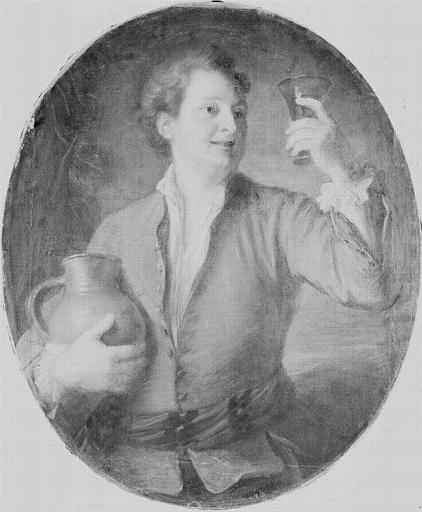
A Glimpse of Parisian Merriment: Un Joyeux Buveur by Alexis Grimou
Alexis Grimou’s “Un Joyeux Buveur” (A Joyful Drinker) is more than just a portrait; it's a vibrant snapshot of 18th-century French life, brimming with convivial energy and an intimate understanding of the human spirit. Painted around 1729, this captivating work, now meticulously reproduced by ArtsDot, transports us to a moment of relaxed indulgence within a bustling Parisian salon. Grimou, often dubbed the “French Rembrandt” for his masterful manipulation of light and shadow—a technique deeply influenced by the Dutch masters—crafted an image that transcends mere representation, capturing a palpable sense of joy and camaraderie.
The subject himself is immediately engaging: a man radiating warmth and good humor. Dressed in the fashionable attire of the period – a rich red coat paired with a crisp white shirt – he holds aloft a generous jug filled with wine, while his other hand cradles a delicate glass. His gaze, directed slightly upwards and to the side, suggests an appreciative enjoyment of the scene unfolding around him, inviting the viewer into his world of pleasure. The oval border framing the figure acts as both a visual anchor and a subtle theatrical device, isolating him within a space that emphasizes his central role in this tableau of merriment.
The Language of Light and Shadow
Grimou’s technical prowess is evident in his masterful use of chalk or charcoal on paper. The image unfolds through a delicate layering of tones—a symphony of grays, whites, and blacks—that creates an astonishingly realistic effect despite the monochrome palette. Soft, blended lines define the contours of the face, clothing, and hands, while subtle gradations of tone sculpt the form and imbue it with depth. The artist skillfully employs chiaroscuro – the dramatic contrast between light and dark – to highlight key features and create a sense of volume, drawing our attention to the man’s expressive eyes and the inviting gesture of his hand.
The lighting itself is remarkably diffused, lending an evenness to the scene that contributes to its overall feeling of warmth and intimacy. There are no harsh highlights or dramatic shadows; instead, a gentle illumination allows us to appreciate the textures of the fabric and the subtle nuances of the subject’s expression. This deliberate restraint enhances the painting's sense of realism and invites us to contemplate the man’s inner life.
Symbolism and Context
“Un Joyeux Buveur” is deeply rooted in the social customs of 18th-century France, a period characterized by elaborate rituals of hospitality and refined entertainment. The act of sharing wine—a symbol of friendship, celebration, and social connection—was central to these gatherings. Grimou’s depiction captures this spirit perfectly, offering us a glimpse into a world where conversation flowed freely alongside the wine, and laughter filled the air.
Furthermore, the painting reflects the artistic trends of the time, particularly the influence of Dutch portraiture. Like Rembrandt, Grimou was fascinated by capturing the psychological depth of his subjects, revealing their inner character through subtle gestures and expressions. The man’s joyful demeanor speaks volumes about his personality—a testament to Grimou's ability to convey emotion with remarkable precision.
A Timeless Appeal
More than three centuries after its creation, “Un Joyeux Buveur” retains a powerful emotional resonance. Its depiction of simple pleasures, genuine camaraderie, and the beauty of human connection continues to captivate viewers today. Reproduced faithfully by ArtsDot, this painting offers an accessible portal into the world of 18th-century France—a world where a good drink, good company, and a touch of merriment were always in season. The artwork’s enduring appeal lies not only in its technical brilliance but also in its ability to evoke a sense of warmth, nostalgia, and the universal desire for connection.