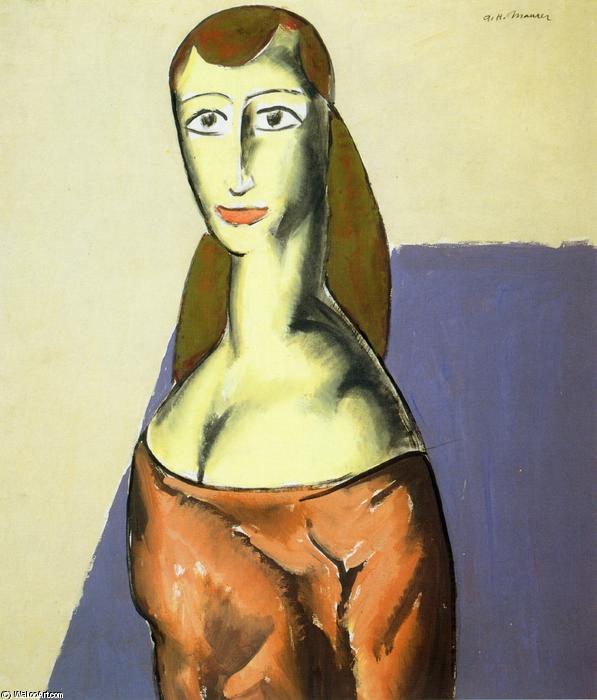
A stylized portrait by Alfred Henry Maurer, 'Girl' (1923) showcases early modernist influences with simplified forms and a striking color palette. Explore this captivating piece of American art.
Alfred Henry Maurer: Istražite rad ovog pionira američkog modernizma! Otkrijte njegova Fauvist i Kubistička dela, most između evropske avangarde i umetnosti SAD. Učestvovao na Armory Show-u 1913. godine.
A Glimpse into Modern Introspection: Alfred Henry Maurer's "Girl"
This striking portrait by Alfred Henry Maurer, painted in 1923, offers a compelling study of early 20th-century modernism. The artwork presents a close-up view of a woman, rendered with a deliberate simplification of form and an emphasis on geometric shapes. Against a deep, resonant blue background, the figure is centrally positioned, drawing immediate attention to her face and upper torso. Maurer eschews realistic representation in favor of a stylized approach, utilizing lines not to mimic detail but to define planes and volumes. The overall effect is one of quiet contemplation and detached observation.
Modernist Influences and Artistic Technique
Maurer’s style demonstrates a clear engagement with the burgeoning modernist movement, exhibiting influences from both Cubism and Expressionism. While not strictly adhering to either aesthetic, "Girl" shares their focus on abstraction, simplification, and emotional expression through form rather than meticulous detail. The color palette—dominated by oranges, yellows, browns, and blues—creates a harmonious yet slightly melancholic atmosphere. Maurer’s technique is characterized by visible brushstrokes, which contribute to the artwork's textural richness and reinforce its handmade quality. Oil paints on canvas were used to create this piece.
The Artist: Alfred Henry Maurer and His Journey
Alfred Henry Maurer (1868-1932) was an American artist whose career unfolded against a backdrop of evolving artistic trends. Born in New York City, his early life was marked by familial tension regarding his pursuit of modern art, ironically fueling his passion. A formative period spent in Paris from 1897 to 1903 exposed him to the vibrant European art scene and profoundly shaped his artistic development. He absorbed new ideas and experimented with various styles, ultimately forging a unique voice that blended American sensibilities with European modernist innovations. His work often explored themes of portraiture and still life, characterized by a distinctive flatness and simplified forms.
Symbolism and Emotional Resonance
Beyond its formal qualities, "Girl" carries a subtle symbolic weight. The stark contrast between the figure and the dark blue background creates a sense of isolation and introspection. The woman’s simplified features—almond-shaped eyes, a small nose, and defined mouth—suggest a quiet strength and an inner world that remains largely unrevealed. The elongated strands of hair flowing down her back add a touch of elegance while also contributing to the overall feeling of stillness and contemplation. The portrait evokes a sense of detached observation, inviting viewers to ponder the subject's thoughts and emotions without offering easy answers. It is a powerful exploration of human presence within an increasingly abstract world.