Alfred Jacob Miller’s “Snake Indians Shooting Elk”: A Window into the American West
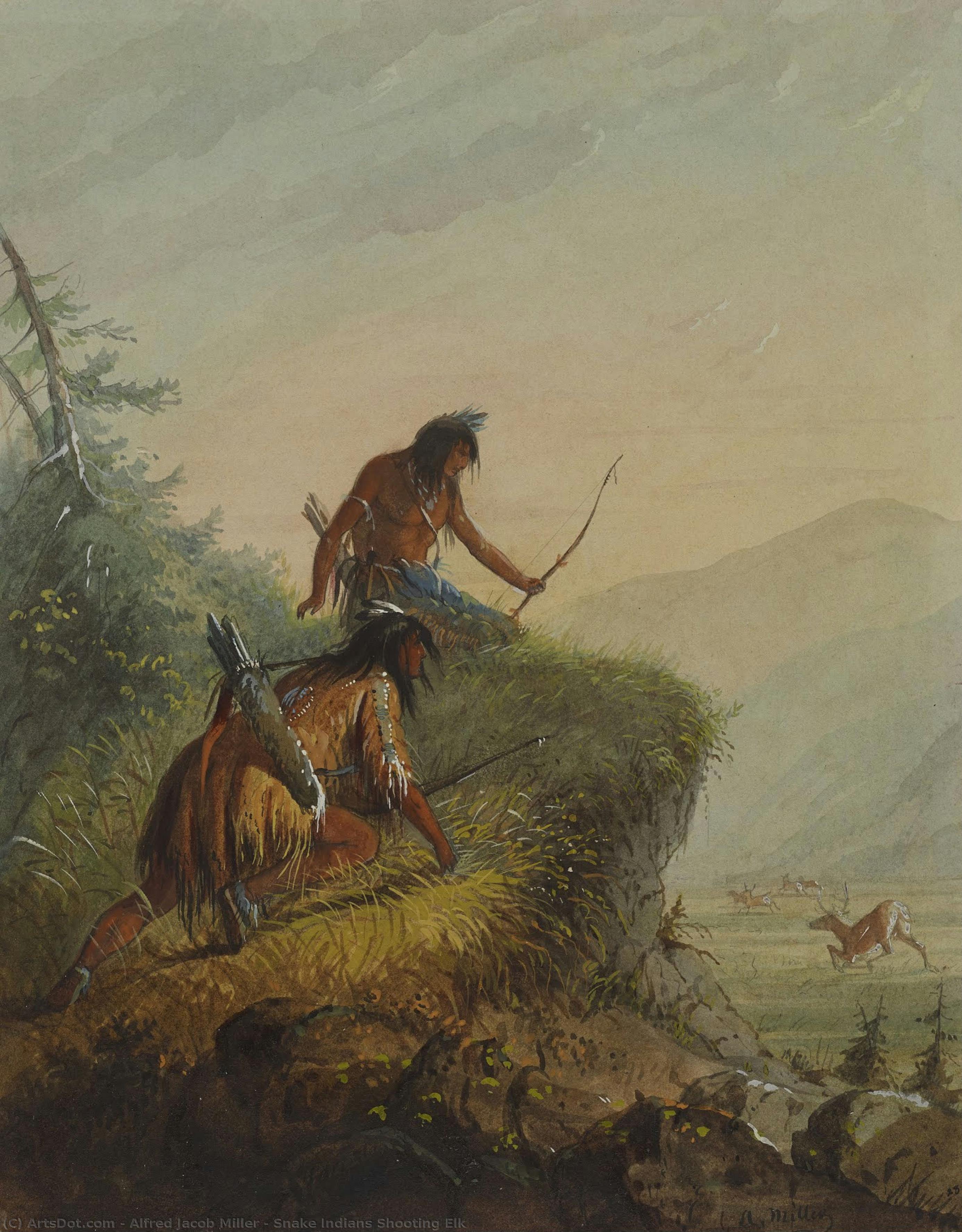
“Snake Indians Shooting Elk,” painted by Alfred Jacob Miller in 1860, is more than just a depiction of Native Americans engaged in a hunt; it's a poignant snapshot of a rapidly changing America and a testament to Miller’s unique position as one of the earliest American artists to authentically portray the lives of the West’s indigenous peoples. Commissioned by William T. Walters, the painting captures two men poised for action – their postures suggesting both focused determination and a deep connection to the land – against the dramatic backdrop of the Rocky Mountains. The inclusion of an elk underscores the vital role of hunting in the survival and cultural practices of these tribes, while the presence of other figures hints at a larger community engaged in this essential activity.
A Pioneer’s Vision: Miller's Artistic Journey
Alfred Jacob Miller (1810-1874), born in Baltimore, carved an extraordinary path for himself as an artist. Unlike many of his contemporaries who relied on formal academic training, Miller’s artistic development was shaped by firsthand experience. His early exposure to artists like Thomas Sully, coupled with a period spent studying life drawing at the École des Beaux-Arts in Paris – a formative experience that instilled meticulous observation and European artistic sensibilities – allowed him to develop a distinctive style. This blend of European technique and genuine engagement with Native American culture resulted in works that are both aesthetically refined and profoundly insightful.
Technique and Composition: A Study in Detail
Miller’s masterful brushwork is immediately apparent in “Snake Indians Shooting Elk.” Executed primarily in oil on canvas, the painting showcases a remarkable level of detail. The artist meticulously rendered the textures of the clothing, the rugged terrain, and the expressions of the figures. His use of light and shadow creates a sense of depth and realism, drawing the viewer into the scene. The composition itself is carefully balanced, with the two central figures dominating the foreground while the mountain range provides a powerful backdrop, emphasizing their scale and connection to the vastness of the American West. The painting’s color palette leans towards earthy tones – browns, ochres, and grays – reflecting the natural environment and lending it a sense of authenticity.
Symbolism and Historical Context
“Snake Indians Shooting Elk” offers a valuable glimpse into the 19th century's complex relationship between European settlers and Native American tribes. The term "Snake Indians" is believed to be a misnomer, potentially reflecting early misunderstandings or derogatory labeling by white observers. The scene represents not just hunting but also the disruption of traditional ways of life as westward expansion intensified. Miller’s work stands as an important record of a culture on the brink of transformation, offering a poignant reminder of a vanishing world. The painting's creation coincided with the peak of the fur trade and the increasing pressure exerted by the U.S. government on Native American territories.