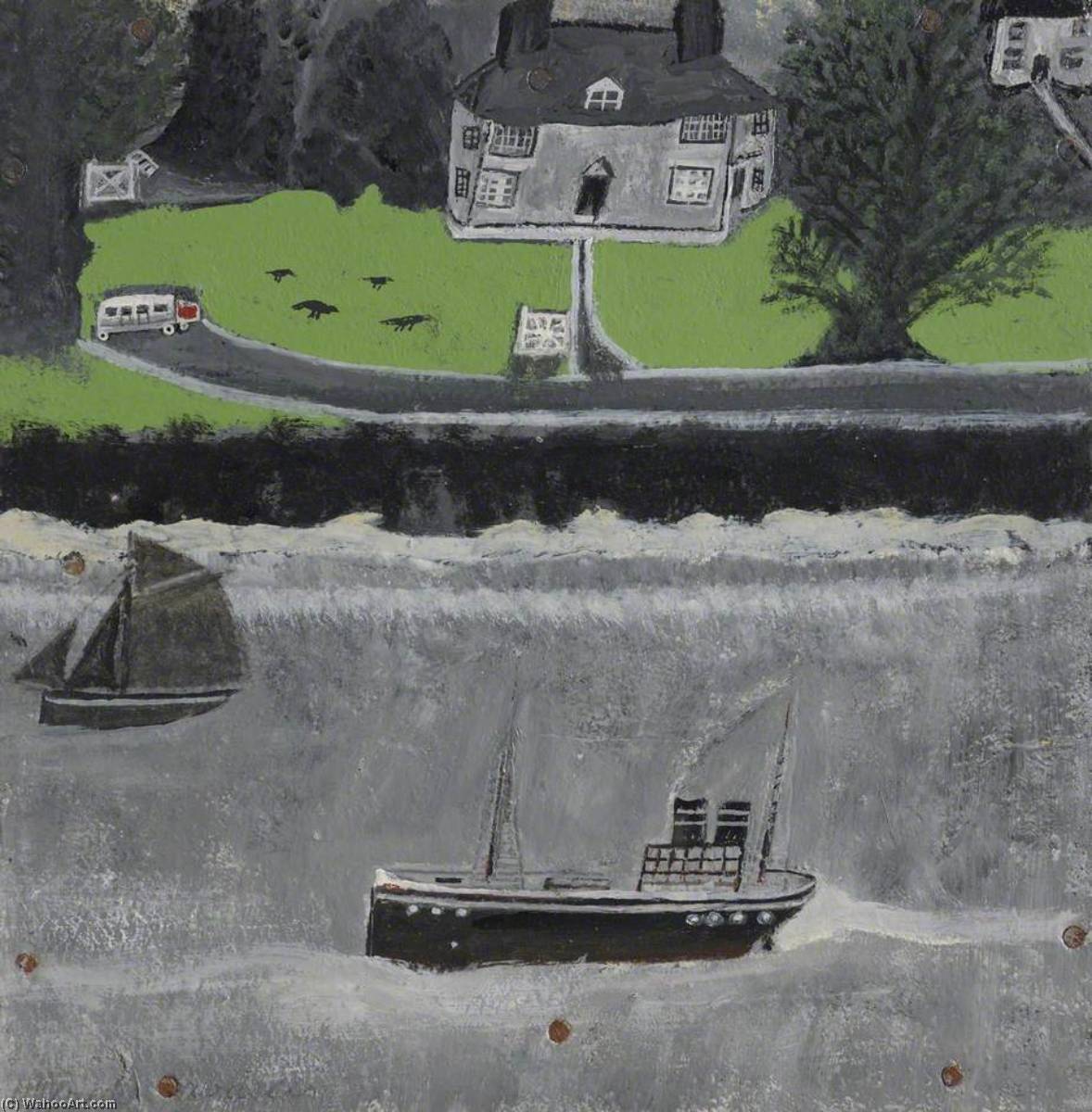
Alfred Wallis: Two Boats Moving Past a Big House – A Cornish Echo of Naive Beauty
Alfred Wallis’ “Two Boats Moving Past a Big House” (1937) stands as a quintessential example of Henry Wallis's distinctive artistic vision—a testament to the enduring power of observation and an unwavering commitment to distilling landscapes into their purest form. Painted during his prolific period in Cornwall, this oil on canvas captures not merely a visual scene but also a palpable sense of place, resonating with the quiet grandeur of the Cornish coast.
Subject Matter & Composition: The artwork depicts a simplified coastal panorama dominated by a substantial house perched atop a grassy hillside overlooking calm waters. Two sailboats navigate the foreground, establishing a harmonious relationship between human presence and natural environment. Wallis’s masterful compositional choices—horizontal layering emphasizing depth while geometric shapes defining forms—reflect a deliberate rejection of academic conventions in favor of clarity and visual impact.
Style & Technique: “Two Boats Moving Past a Big House” embodies Wallis's signature naive style, characterized by flattened perspective, bold outlines, and restrained color palettes. The artist employs thick impasto brushstrokes to imbue the canvas with textural richness, particularly evident in the depiction of the water surface—a subtle ripple effect conveying movement without resorting to photographic realism. This technique prioritizes expressive gesture over meticulous detail, aligning perfectly with Wallis’s belief that art should communicate emotion directly.
Historical Context & Symbolism: Painted in 1937, amidst the burgeoning modernist movement, Wallis's work challenged prevailing artistic trends by embracing a deliberately unpolished aesthetic. The house symbolizes domestic tranquility and shelter—a comforting retreat from the turbulent sea beyond. Simultaneously, the boats represent exploration and aspiration—inviting contemplation on journeys undertaken both physically and intellectually.
Emotional Impact & Aesthetic Appreciation: Viewing “Two Boats Moving Past a Big House” evokes a feeling of serene contemplation—a connection to the timeless beauty of Cornwall’s landscape. Wallis's ability to convey profound emotion through deceptively simple forms underscores the enduring relevance of naive art as a conduit for authentic experience. It is a piece that rewards repeated viewing, revealing subtle nuances of color and texture with each encounter.
Further Research: For more information on Alfred Wallis and Henry Wallis’s artistic legacy, explore Henry Wallis's Pre-Raphaelite paintings—including ‘Death of Chatterton’ & ‘Stonebreaker’. Known for chiaroscuro, symbolic detail, and London life. Discover the captivating world of Alfred Wallis, the self-taught Cornish painter championed by modernists. Explore his unique naive style, maritime scenes & lasting legacy with Alfred Wallis: Rediscovering the Naïve Visionary of Cornish Life.