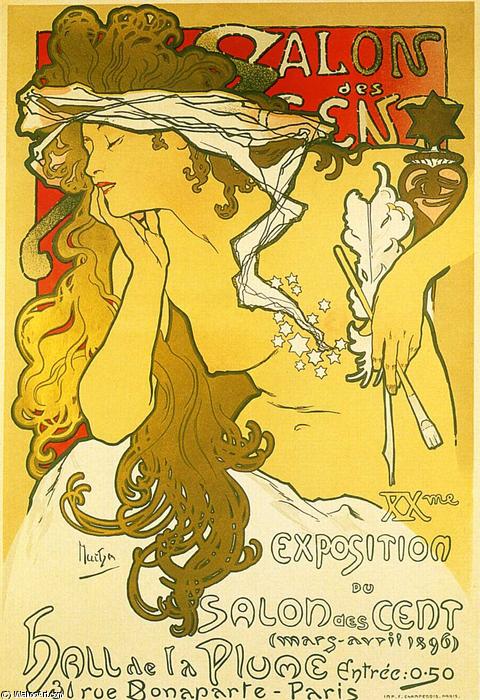
Salon des Cent, 1896: A Vision of Feminine Grace Amidst Art Nouveau Flourishes
The Salon des Cent, held in Paris in 1896, stands as a pivotal moment in the history of art and design—a testament to the burgeoning influence of Art Nouveau and its celebration of beauty, elegance, and organic forms. More than just an exhibition space, it represented a radical departure from the rigid hierarchies of established salons, championed by Société Nouvelle des Beaux-Arts, founded by Eugène Louis Gabriel Ferrier and Henri Renault. This audacious initiative aimed to elevate decorative arts alongside painting and sculpture, recognizing their crucial role in shaping the aesthetic sensibilities of the era.
The centerpiece of this groundbreaking salon was Alphonse Maria Mucha’s monumental canvas, “Salon des Cent,” a breathtaking depiction of a woman draped in flowing robes—a figure instantly recognizable as embodying the quintessential Art Nouveau ideal. Mucha, having arrived in Paris from Brno, Czech Republic, in 1887, swiftly established himself as one of the movement's foremost practitioners, crafting images that captivated audiences with their meticulous detail and mesmerizing fluidity. Unlike the academic conventions prevalent at the time, Mucha rejected traditional perspective and anatomical accuracy, prioritizing instead expressive lines and stylized ornamentation to convey emotion and dynamism.
- Style: Art Nouveau—characterized by curvilinear lines, floral motifs, and asymmetrical compositions.
- Technique: Mucha employed tempera on canvas, a technique favored for its luminosity and ability to achieve vibrant colors. He meticulously layered pigments, utilizing glazing techniques to build up depth and texture, resulting in an image that appears to shimmer with ethereal light.
The painting’s symbolism is rich and multilayered. The woman herself represents femininity, purity, and idealized beauty—themes central to Art Nouveau's fascination with mythological figures and archetypal imagery. Her flowing robe symbolizes grace, movement, and the transformative power of nature. The stylized floral garlands adorning her dress reinforce this connection to organic forms, reflecting the movement’s belief in harmony between artifice and natural splendor. Drawing inspiration from artists like Gustave Moreau and Pierre-Auguste Renoir, Mucha skillfully blended influences from Symbolism and Impressionism to create a visual language that transcended mere representation—aiming instead to evoke profound emotional responses within the viewer.
- Historical Context: The Salon des Cent coincided with a period of significant social and cultural change in France—the Belle Époque—marked by optimism, technological innovation, and a renewed interest in decorative arts.
- Emotional Impact: “Salon des Cent” possesses an undeniable allure, transporting the viewer to a realm of serene beauty and sensual delight. Its meticulous craftsmanship and evocative symbolism continue to inspire artists and designers today, serving as a timeless emblem of Art Nouveau’s enduring legacy.
The Salon des Cent wasn't merely an artistic endeavor; it was a declaration—a bold assertion that beauty could exist beyond the confines of academic dogma. Mucha’s masterpiece solidified Art Nouveau’s position as a dominant force in European culture, shaping the visual vocabulary of subsequent decades and influencing everything from furniture design to fashion trends. Its enduring appeal lies not only in its exquisite aesthetic qualities but also in its profound exploration of human emotion and its celebration of the transformative power of art.