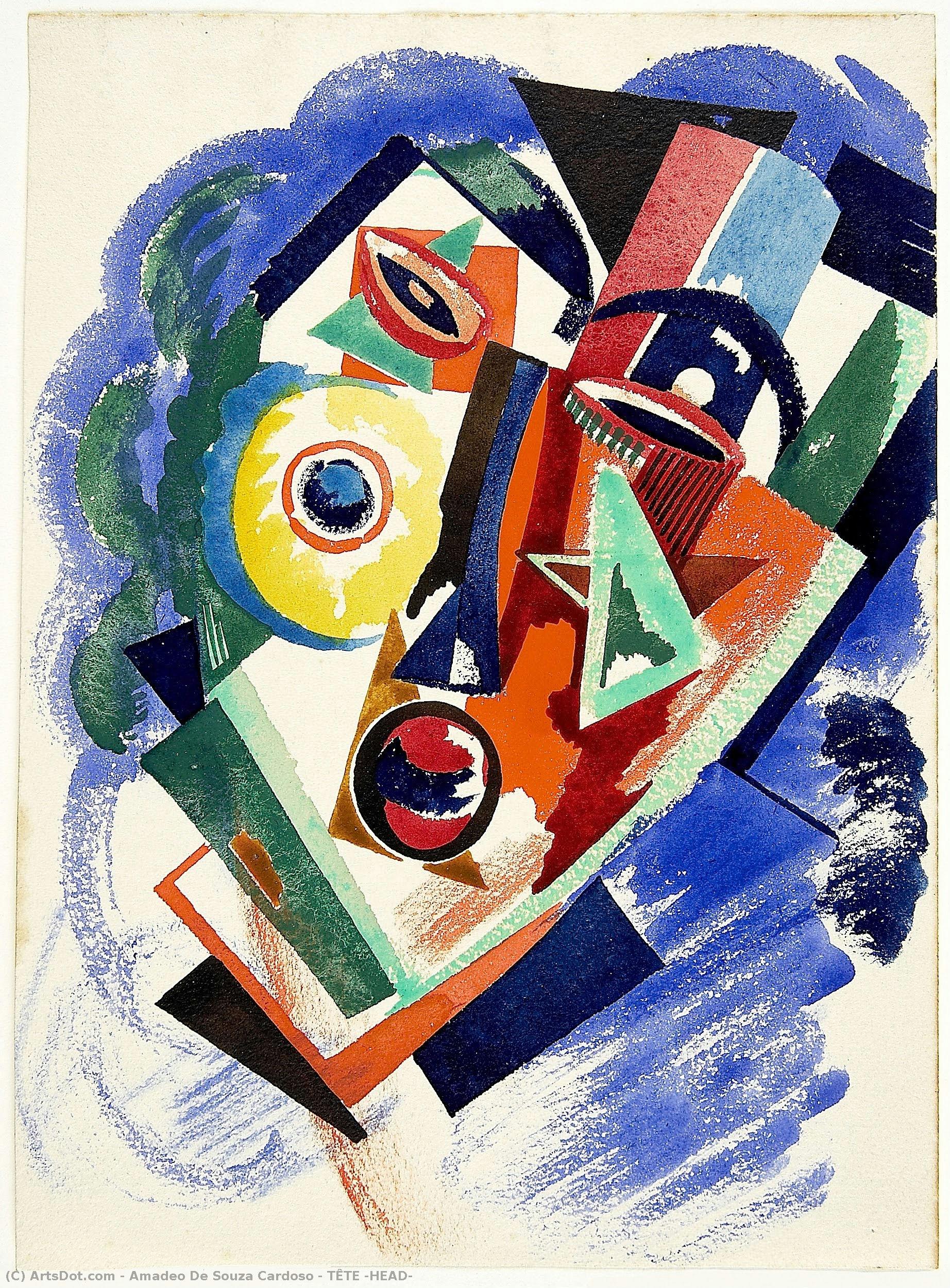
A Distorted Gaze: Amadeo de Souza-Cardoso’s ‘Tête’
Amadeo de Souza-Cardoso's “Tête” (Head), painted in 1915, is not merely a portrait; it’s a distilled essence of early 20th-century modernism, a poignant exploration of identity rendered through the fractured lens of Cubism. Measuring a modest 22 x 16 centimeters on paper, this watercolor captures more than just a likeness—it offers a glimpse into the artist's restless mind and his engagement with the radical artistic currents sweeping across Europe at the time. The painting’s immediate impact is one of unsettling beauty; the head itself appears to be simultaneously present and dissolving, its features fragmented and rearranged as if viewed through a kaleidoscope. This deliberate distortion wasn’t born from mere aesthetic experimentation but reflected Souza-Cardoso's fascination with representing the complexities of perception and the subjective nature of reality – a core tenet of the burgeoning modernist movement.
Cubism and the Fragmentation of Form
Souza-Cardoso’s “Tête” firmly establishes itself within the context of Cubism, an artistic revolution spearheaded by Picasso and Braque. Rejecting traditional representational techniques, Cubists sought to depict objects from multiple viewpoints simultaneously, breaking them down into geometric forms and reassembling them on the canvas. In this work, we see that influence powerfully realized. The head is dissected – the eyes, mouth, and nose are presented as independent planes, overlapping and intersecting in a dynamic interplay of shapes. This fragmentation isn’t chaotic; instead, it creates a sense of movement and depth, inviting the viewer to actively engage with the image and reconstruct its meaning. Souza-Cardoso wasn't simply copying what he saw; he was translating his understanding of the subject into a new visual language.
The Artist’s Biography: A Pioneer of Portuguese Modernism
Understanding “Tête” requires acknowledging Amadeo de Souza-Cardoso’s pivotal role in shaping Portuguese modern art. Born in 1887 in Manhufe, Portugal, he initially studied architecture but quickly gravitated towards painting, drawn to the expressive possibilities of caricature and illustration. His early career was marked by a relentless pursuit of innovation, leading him to Paris in 1908 where he immersed himself in the vibrant artistic scene surrounding Picasso, Braque, and other avant-garde figures. This Parisian experience profoundly influenced his style, introducing him to Cubism, Futurism, and other radical approaches. Souza-Cardoso’s brief but intensely productive life (ending tragically in 1918) saw him establish a unique voice within the Portuguese art world, bridging the gap between European artistic trends and the emerging national identity.
Symbolic Weight and Emotional Resonance
Beyond its formal innovations, “Tête” possesses a subtle yet potent symbolic weight. The distorted features suggest a sense of alienation or introspection—a portrait not just of a face but of an inner state. The single eye, prominently displayed, could be interpreted as a symbol of awareness, observation, or perhaps even vulnerability. The muted color palette – dominated by blues and browns – contributes to the painting’s melancholic atmosphere, evoking a feeling of quiet contemplation. Souza-Cardoso's work often explored themes of identity, memory, and the passage of time, and “Tête” serves as a powerful testament to these concerns. It is a piece that invites repeated viewing, revealing new layers of meaning with each encounter.
A Legacy in Reproduction: Bringing ‘Tête’ Home
Reproductions of “Tête” offer an exceptional opportunity to bring this seminal work into your home or office. Whether you choose a high-quality giclée print on canvas, a meticulously hand-painted replica, or a framed watercolor, the essence of Souza-Cardoso’s vision will be faithfully preserved. Consider framing options that complement the painting's subdued tones – a simple black frame can highlight the artwork's inherent drama, while a warmer wood tone might evoke a sense of nostalgia and introspection. “Tête” is more than just a beautiful image; it’s a window into the heart of modern art—a reminder of the power of abstraction to capture the complexities of human experience.