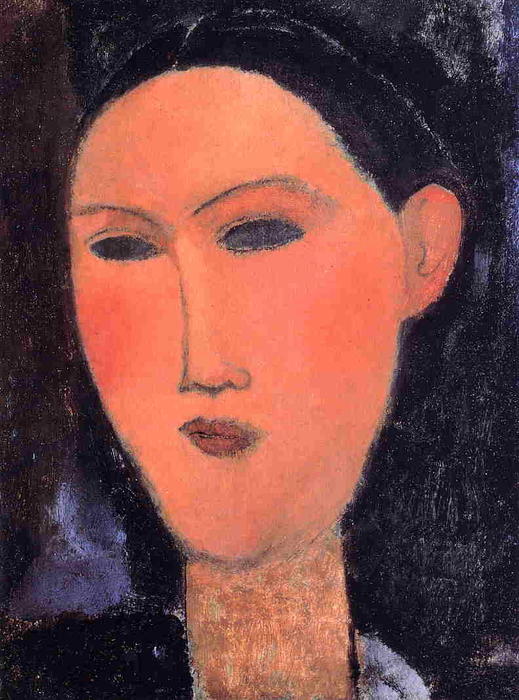
A Striking Portrait in Transition: Modigliani’s 1915 Exploration of Form
This captivating work by Amedo Modigliani, created in 1915, offers a compelling glimpse into the artist's evolving style during a pivotal moment in art history. Measuring 35 x 27 cm, this portrait is not merely a representation of a woman’s head and shoulders; it’s an exploration of form, color, and the very essence of Cubist principles as filtered through Modigliani’s unique artistic sensibility.
Deconstructing the Figure: Style & Technique
The artwork immediately announces itself as belonging to the Cubist movement, yet it doesn't adhere strictly to its more analytical phases. Instead, we see a synthesis of influences.
Geometric shapes – rectangles and triangles primarily – dominate the composition, fragmenting the subject’s face and reducing it to a series of planes. This flattening of perspective rejects traditional notions of depth, creating a distinctly two-dimensional effect. The intense contrast between deep oranges and dark blues/purples is striking, lending an almost theatrical quality to the portrait. Modigliani employs a visible impasto technique –
the paint is applied thickly, adding texture and emphasizing the materiality of the artwork. Bold, angular lines define each facet, contributing to the overall sense of deconstruction and reconstruction.
Modigliani in 1915: A Historical Context
1915 was a crucial year for Modigliani. Having moved to Paris in 1906, he had immersed himself in the avant-garde scene, encountering artists like Picasso and Brâncuși. While initially experimenting with various styles, by this time he was forging his own path – one that acknowledged Cubism’s innovations but ultimately diverged towards a more lyrical and emotionally resonant aesthetic. This period saw him exhibiting alongside Cubists of the Section d'Or group, yet his work retained a distinctly individual character. His health struggles, including bouts of illness throughout his life, also subtly informed his artistic vision – a sense of fragility and introspection often permeates his portraits.
Beyond Representation: Symbolism & Emotional Impact
While the artwork is undeniably abstract, it’s not devoid of emotional resonance. The flattened forms and intense colors create a sense of contained energy. The subject's gaze, though abstracted, feels direct and engaging.
There’s a deliberate detachment in the representation, an analytical quality that prioritizes formal elements over realistic depiction. However, this doesn’t equate to coldness; rather, it invites viewers to contemplate the underlying structure of beauty and the complexities of human perception. Compared to his later, more elongated portraits – like “Head of Red-Haired Woman” or "Woman with Blue Eyes" - this work feels like a transitional piece, a stepping stone towards his signature style.
Interior Design & Collecting Considerations
This artwork’s bold color palette and striking composition make it a powerful statement piece for any interior. Its relatively small size (35 x 27 cm) allows for versatility in placement – it would be equally at home in a modern living room, a sophisticated study, or a curated gallery wall. For collectors, this work represents an important moment in Modigliani’s artistic development, offering insight into his experimentation with Cubist principles and foreshadowing the unique style that would define his legacy. A high-quality reproduction of this piece will bring a touch of early 20th-century modernism and intellectual sophistication to any space.
- Style: Cubism, Early Modernism
- Medium: Oil on Canvas (presumed)
- Dimensions: 35 x 27 cm
- Year: 1915