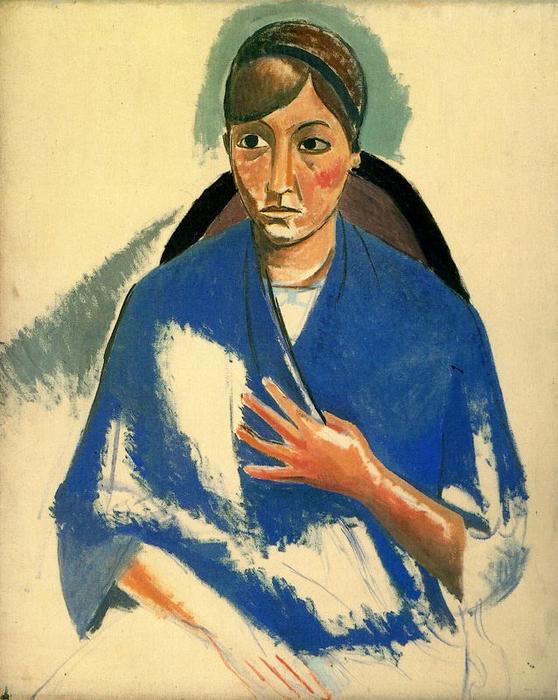
The
Portrait of Woman by
André Derain is a captivating oil on canvas painting that showcases the artist's unique style and technique. Created in 1913, this painting measures 79 x 65 cm and is a prime example of
Cubism. The scene depicts a woman with a blue scarf around her neck, wearing a dress and having a serious expression on her face.
Background and Style
The painting features a chair that is partially visible behind the woman, and a clock present in the scene, located near the top right corner of the image. The use of
geometric shapes and
monochromatic colors gives the painting an abstract appearance, characteristic of Cubist art.
André Derain was a French artist who played a significant role in the development of Fauvism and Cubism. His works can be found in various museums, including the
Kunsthaus Buhler in Stuttgart, Germany.
Influence and Legacy
The
Portrait of Woman is not the only notable work by
André Derain. His painting Deerstalking is another example of his unique style, which can be found on
/art/list/?Filter=8XXN8S-Andre-Derain-Deerstalking. The Cubist movement, pioneered by artists like
Pablo Picasso and
Georges Braque, had a significant impact on modern art. For more information on Cubism, visit
https://en.wikipedia.org/wiki/Cubism.
- Cubism is an early-20th-century avant-garde art movement that revolutionized painting and the visual arts.
- The movement was characterized by the use of geometric shapes and multiple perspectives.
- André Derain's works, including the Portrait of Woman, are examples of Cubist art.
BR The
Portrait of Woman by
André Derain is a significant work of art that showcases the artist's unique style and technique. Its Cubist elements and geometric shapes make it a fascinating piece to study and appreciate. For more information on
André Derain and his works, visit
/art/list/?Filter=andré+derain,andré,derain&.