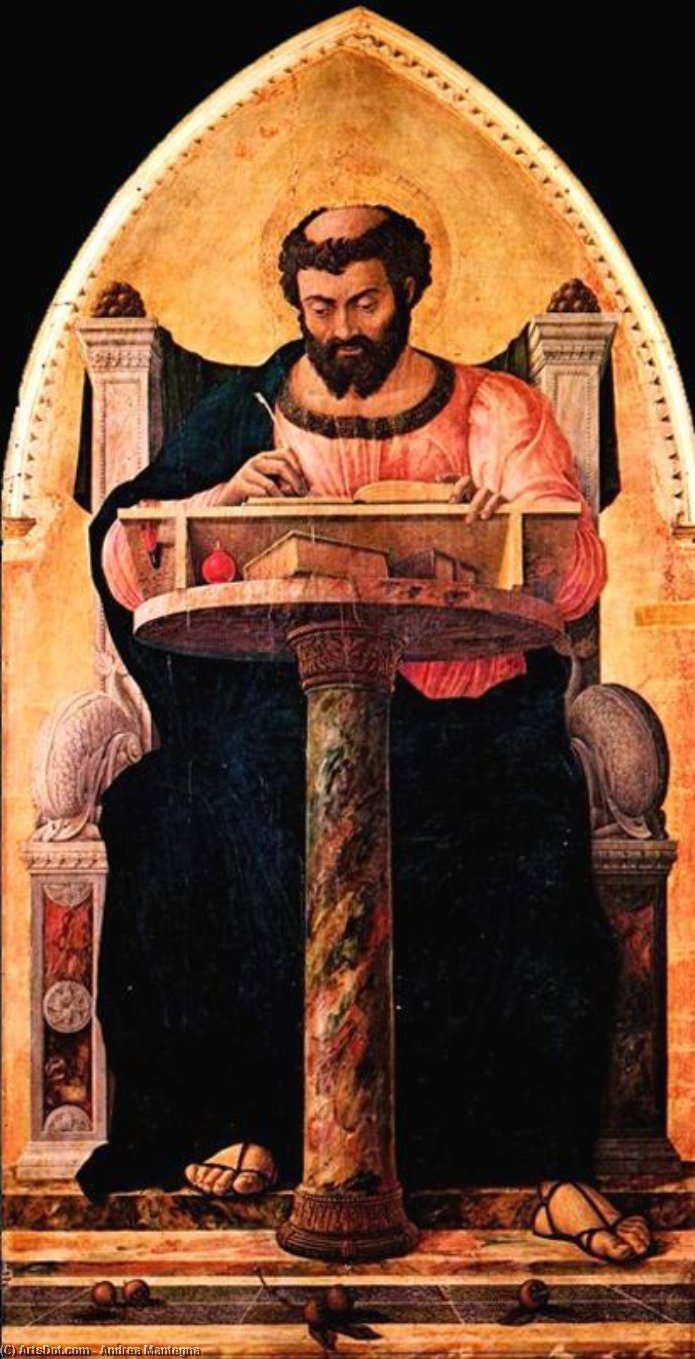
A Window into Augustine’s Soul: Examining Andrea Mantegna's “San Lucas”
Andrea Mantegna’s “San Lucas,” a portrait commissioned for the chapel of St Luke in Padua, transcends mere representation; it embodies Mantegna’s singular artistic philosophy—a profound reverence for antiquity that sought to recapture Rome’s grandeur within the burgeoning Renaissance. Unlike many artists preoccupied with imitating classical forms slavishly, Mantegna approached his craft with an intellectual rigor unparalleled in his time, driven by a conviction that true artistry resided not merely in visual accuracy but in conveying spiritual depth. This dedication is vividly realized in this captivating depiction of Augustine, seated thoughtfully before a building adorned with an arched doorway—a deliberate choice reflecting the chapel’s Gothic origins and highlighting the patron's conservative artistic sensibilities.
- Subject Matter & Composition: The portrait centers on Augustine, portrayed in repose against a backdrop of architectural detail. His gaze is directed inward, suggesting contemplation and intellectual engagement as he engages with his writing materials—a quill pen poised above parchment. This careful positioning underscores the painting’s thematic core: Augustine's pursuit of faith and reason, intertwined within the confines of scholarly endeavor.
- Style & Technique: Mantegna’s masterful technique exemplifies the stylistic hallmarks of Early Renaissance art. He employs meticulous linear perspective—a revolutionary innovation at the time—to create an illusionistic space that convincingly mimics reality. The sculptural quality of Augustine's figure is achieved through subtle modeling and shading, mirroring the influence of Roman sculpture on Mantegna’s artistic sensibilities.
The Echoes of Antiquity: Mantegna’s Archaeological Vision
Mantegna’s formative years under Francesco Squarcione profoundly shaped his artistic worldview. Squarcione's workshop functioned as an incubator for archaeological scholarship, immersing young Mantegna amongst the ruins of Rome—fragments of a civilization revered by humanist thinkers. This exposure instilled in him an unwavering commitment to replicating classical accuracy, surpassing the stylistic conventions prevalent elsewhere. Unlike artists prioritizing decorative splendor, Mantegna prioritized reconstructing the visual language of antiquity, demonstrating a desire to revive Roman ideals and artistic principles.
Symbolism & Emotional Resonance: Beyond Mere Appearance
The arched doorway behind Augustine serves as more than just architectural ornamentation; it symbolizes the gateway to divine contemplation—a deliberate allusion to St Luke’s chapel and its Gothic structure. The bird perched at the bottom-left corner adds a subtle layer of symbolism, representing hope and spiritual ascension. Mantegna's ability to infuse his artwork with emotional nuance elevates “San Lucas” beyond a simple portrait; it invites viewers to contemplate Augustine’s inner life and grapple with fundamental questions concerning faith and intellect.
A Legacy of Innovation: Mantegna’s Enduring Influence
“San Lucas” stands as a testament to Mantegna's pioneering spirit—a beacon of innovation within the Renaissance landscape. His unwavering devotion to classical accuracy, coupled with his mastery of linear perspective and sculptural modeling, established him as one of the foremost artists of his era. Reproductions of this remarkable artwork offer collectors and interior designers alike an opportunity to experience firsthand the profound beauty and intellectual depth that characterize Mantegna’s artistic legacy—a legacy continuing to inspire awe and admiration centuries later.