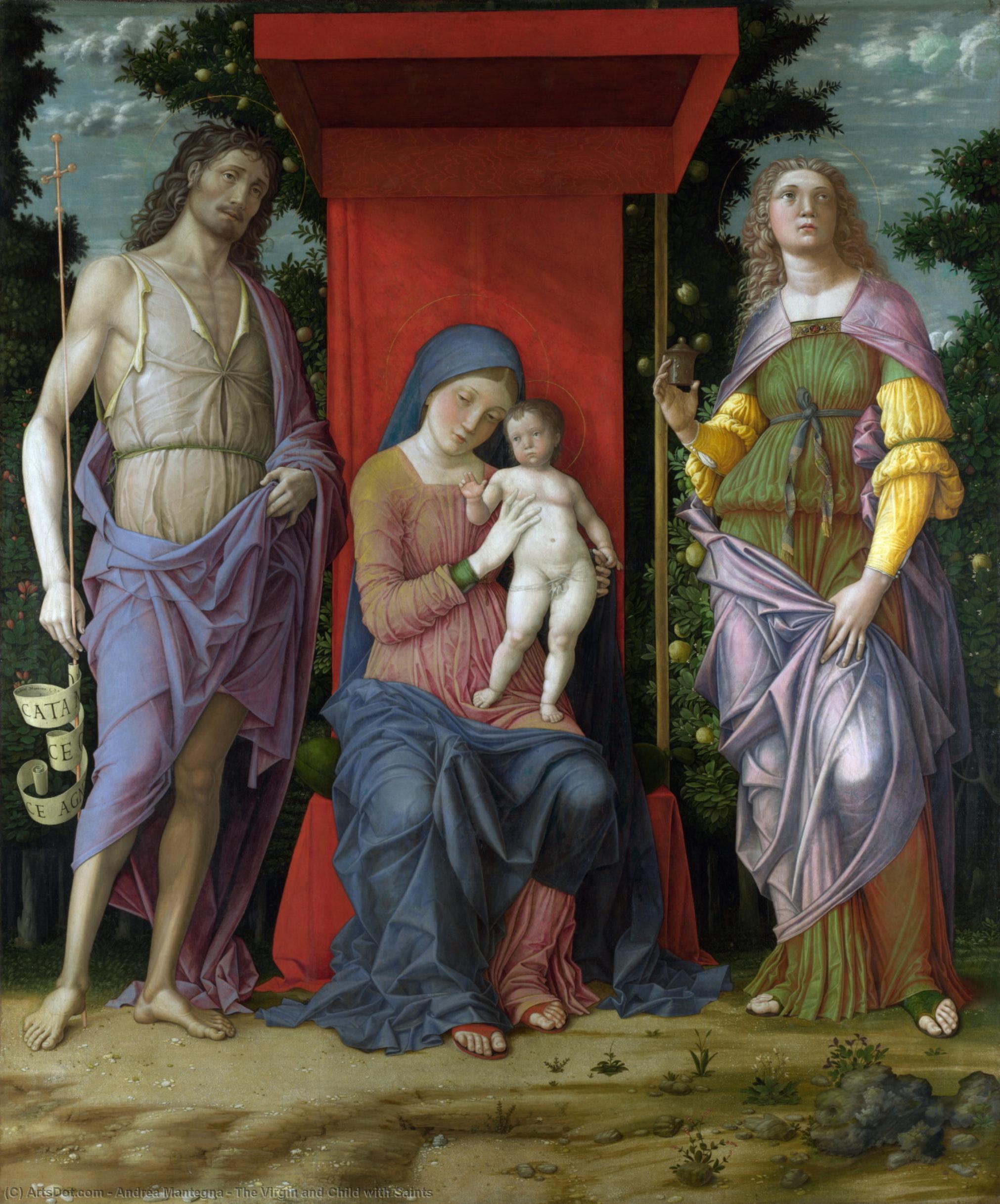
A Renaissance Echo: The Divine Harmony of Mantegna
In the quiet, profound stillness of Andrea Mantegna’s The Virgin and Child with Saints, one finds more than a mere religious tableau; one encounters a meticulously orchestrated vision of the divine. Created during the twilight of the fifteenth century, this masterpiece serves as a breathtaking bridge between the pious traditions of the Early Netherlandish style and the burgeoning intellectual rigor of the Italian Renaissance. Mantegna, an artist whose soul was deeply entwined with the archaeological grandeur of ancient Rome, does not simply paint figures; he carves them into the viewer's consciousness using light, shadow, and an almost obsessive attention to classical form.
The composition is anchored by a masterful pyramidal structure, a hallmark of Renaissance stability. At the apex sits the Virgin Mary, her presence radiating a serene, maternal grace as she cradles the Christ Child. Flanking this central duo are figures that ground the celestial scene in a sense of earthly weight and sanctity—likely Saint Joseph and Saint Anne. This triangular arrangement does more than provide balance; it directs the eye upward, mirroring the architectural soaring of Roman temples and inviting the observer into a state of spiritual ascent. The way the figures are positioned creates a rhythmic flow, leading the gaze through a landscape that feels both intimately human and cosmically significant.
Sculptural Mastery and the Illusion of Space
What truly captivates the discerning eye is Mantegna’s revolutionary command of linear perspective and sculptural illusionism. He possessed a singular ability to transform a flat wooden panel into a window overlooking a three-dimensional world. Through the use of converging lines and subtle, masterful shading, he recreates the tactile reality of stone, fabric, and flesh. The figures possess a certain "stony" or metallic quality—a signature of Mantegna’s style—which lends them a monumental, everlasting presence. This technique does not merely showcase his skill; it serves to heighten the realism of the scene, making the sacred event feel as though it is unfolding within our own reachable space.
The background, a stylized representation of Jerusalem’s Temple Mount, is rendered with an incredible sense of depth. The interplay of light across the distant trees and the architectural elements, such as the striking red pillar, adds layers of chromatic richness and spatial complexity. For the collector or interior designer, this painting offers a profound sense of depth that can transform a room, providing a focal point that is both intellectually stimulating and visually grounding. It is a work that demands slow looking, rewarding the viewer with new discoveries of texture and light upon every encounter.
A Timeless Legacy for the Modern Collector
Beyond its technical brilliance, The Virgin and Child with Saints resonates with an emotional depth that transcends the centuries. There is a palpable sense of peace, a "divine serenity" that emanates from the tender gestures of the saints and the soft gaze of the Madonna. In an era of modern chaos, the painting offers a sanctuary of order, beauty, and contemplative silence. It embodies the Renaissance ideal of humanitas—the marriage of human emotion with divine truth.
For those seeking to adorn a space with art that speaks of history, permanence, and elegance, a high-quality reproduction of this Mantegna masterpiece is an incomparable choice. Whether placed in a grand library, a formal dining room, or a curated gallery space, the painting brings with it the weight of antiquity and the light of the Renaissance. It is not merely a decoration; it is an invitation to contemplate the eternal, making it a cornerstone piece for any serious collection of fine art reproductions.