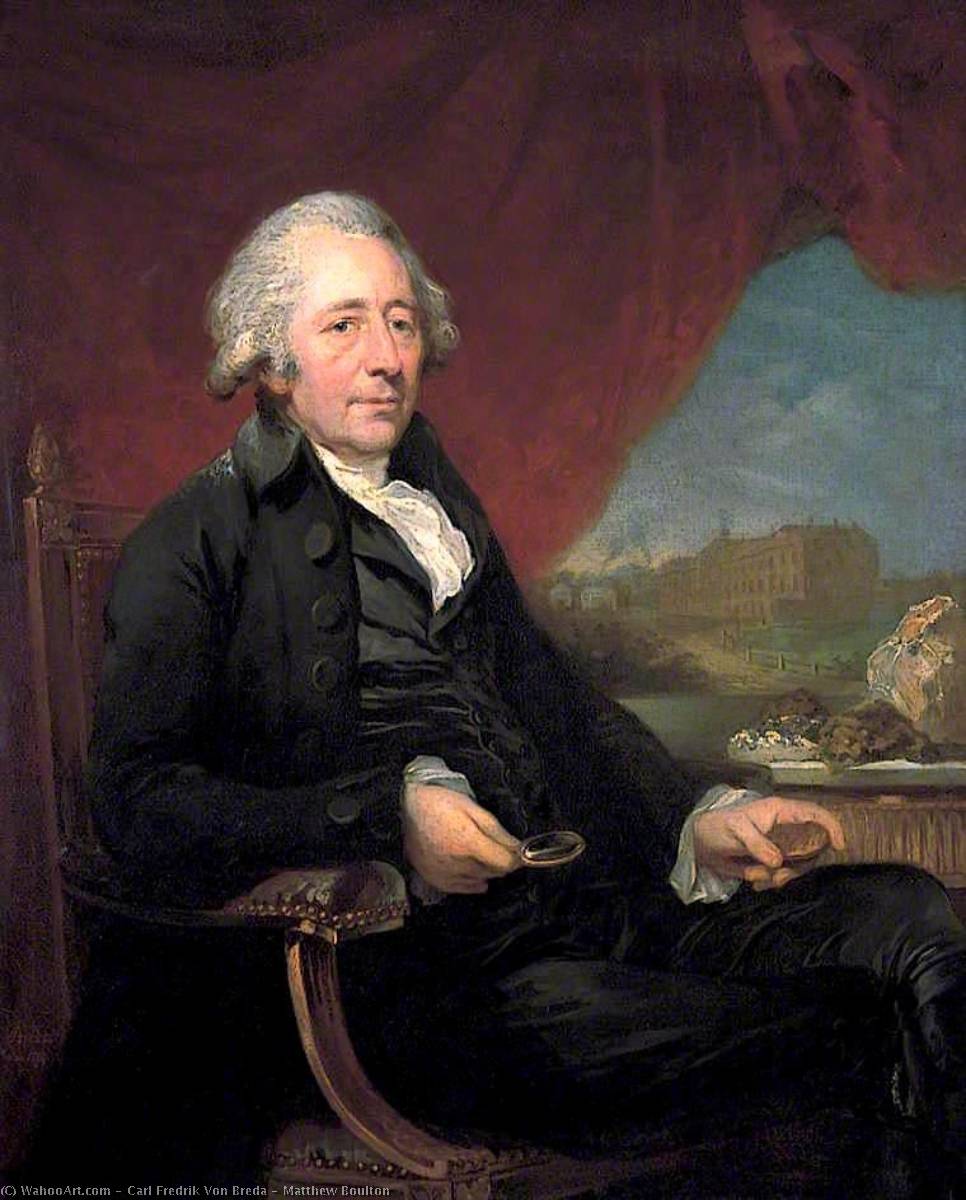
The Subject – Matthew Boulton, Architect of Industry
Carl Fredrik von Breda’s 1772 portrait of Matthew Boulton is more than a simple likeness; it's a carefully constructed tableau of ambition, industry, and the burgeoning spirit of the Industrial Revolution. Boulton himself was a pivotal figure in this transformative era – a Birmingham manufacturer who revolutionized iron production, coin minting, and ultimately, the very fabric of British commerce. The painting captures him not merely as a businessman, but as a man deeply invested in shaping his world, radiating an aura of shrewdness and determined innovation. His seated posture, hands deliberately placed, speaks to a mind constantly engaged in calculation and strategic planning – a visual representation of his relentless drive.

A Neoclassical Composition – Echoes of Reynolds and the Age of Reason
Von Breda, trained under the influence of Joshua Reynolds, a leading figure in the British Royal Academy, skillfully employs the principles of neoclassical portraiture. The composition is meticulously balanced, reflecting the order and rationality that defined the era. The dark red curtain serves as a dramatic backdrop, framing Boulton against a subtle suggestion of an outdoor scene – perhaps a glimpse of Birmingham’s developing cityscape through a window. This carefully orchestrated space isn't merely decorative; it subtly elevates Boulton’s status, associating him with both the stability of tradition and the promise of progress. The lighting is directional, highlighting his face and hands, drawing the viewer’s attention to his intellect and authority.
- The use of chiaroscuro (strong contrasts between light and dark) creates a sense of depth and drama.
- Boulton's attire – the dark coat, white shirt, and waistcoat – adheres to the formal dress codes of the period, signifying his wealth and social standing.
- The composition’s symmetry reinforces Boulton’s position as a central figure in the narrative.
Symbolism and Context – The Lunar Society and Birmingham's Rise
To fully appreciate this portrait, it’s crucial to understand the context of 18th-century Birmingham. The city was undergoing an unprecedented transformation, fueled by coal mining, iron production, and the rise of a vibrant merchant class. Matthew Boulton was at the heart of this revolution, alongside James Watt, forming the core of the Lunar Society – a group of intellectuals, scientists, and industrialists who met regularly to exchange ideas and push the boundaries of knowledge. Von Breda’s painting subtly reflects this intellectual ferment; Boulton's thoughtful gaze suggests a man deeply engaged in philosophical inquiry as well as practical innovation. The small object he holds—likely a tool or instrument related to his work – hints at the constant activity of his mind.
Further Research:
A Legacy in Oil – The Artist’s Hand and the Enduring Image
Von Breda's masterful brushwork, evident in the rich textures of Boulton’s clothing and the subtle modeling of his face, speaks to a deep understanding of oil painting techniques. The portrait is not merely a representation; it’s an embodiment of Boulton’s character – a man of intellect, determination, and entrepreneurial spirit. The enduring appeal of this image lies in its ability to capture a pivotal moment in British history, portraying a figure who fundamentally reshaped the nation's economy and technological landscape. Reproductions of this work offer a tangible connection to this remarkable era, inviting viewers to contemplate the legacy of Matthew Boulton and the transformative power of innovation.