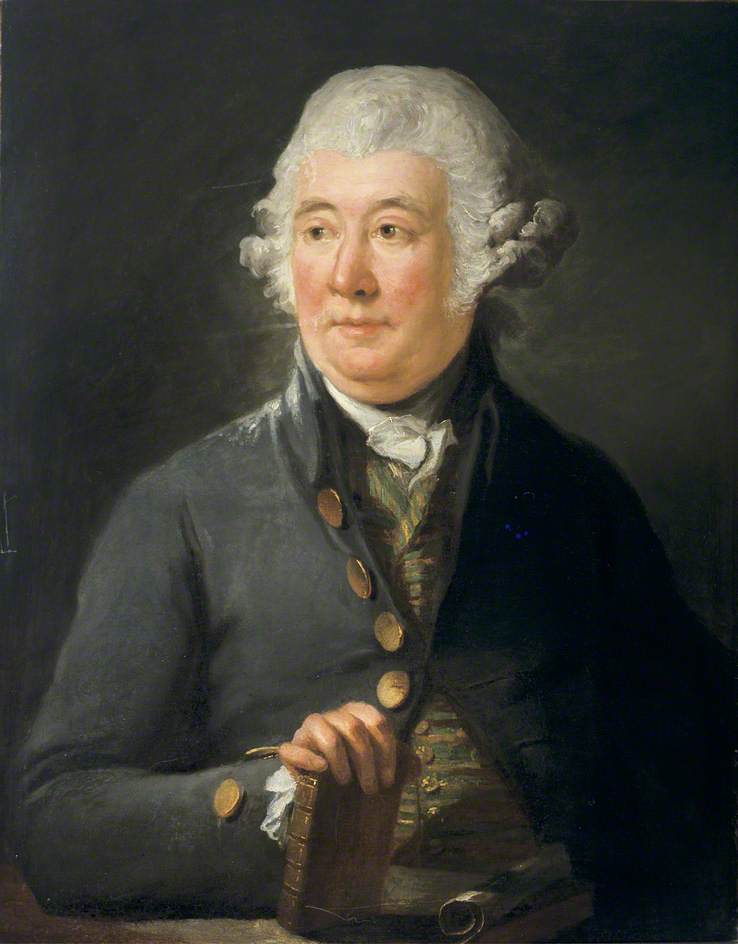
A Portrait of Power and Refinement: Sir William Chambers by Carl Fredrik von Breda
Carl Fredrik von Breda’s 1790 portrait of Sir William Chambers is more than a simple likeness; it's a carefully constructed tableau of power, intellect, and the understated elegance that defined the Georgian era. The painting immediately commands attention with its rich palette – deep blues and golds dominating the composition, punctuated by the crisp white of Chambers’ wig and the subtle grey of his background. It’s a work steeped in the Rococo tradition, yet imbued with a distinctly British sensibility, reflecting Breda's time spent honing his craft amidst the artistic currents of London.
Chambers himself was a pivotal figure in 18th-century England. A brilliant architect and surveyor, he served as the principal designer for Carlton House, one of the grandest private residences of its time, and played a crucial role in the rebuilding of St Paul’s Cathedral after the Great Fire. The portrait captures him not merely as a public servant but as a man of considerable social standing and intellectual prowess. His posture is dignified yet approachable, his gaze direct and assured – qualities that speak to both his professional success and personal character.
The Language of Rococo: Technique and Detail
Breda’s mastery lies in his ability to translate the principles of Rococo into a powerfully evocative image. The painting is executed in oil on canvas, utilizing a layering technique that creates an astonishingly tactile surface. Notice the meticulous rendering of fabric – the heavy folds of the coat, the delicate sheen of the buttons, and the subtle texture of the wig. Breda’s brushwork is remarkably fluid, creating a sense of movement and life within the static portrait. The use of chiaroscuro—the dramatic contrast between light and shadow—further enhances the three-dimensionality of the figure, drawing the viewer's eye to Chambers’ face and emphasizing his features.
- Color Palette: Deep blues, golds, and subtle greys create a sense of wealth and sophistication.
- Brushwork: Fluid and layered, contributing to the painting’s tactile quality.
- Chiaroscuro: Dramatic lighting emphasizes form and creates depth.
Symbolism and Context
Beyond its technical brilliance, the portrait is laden with symbolic meaning. The dark blue coat, a color associated with nobility and authority, immediately establishes Chambers’ status. The gold buttons are not merely decorative; they represent wealth, power, and recognition of his achievements. The wig, a fashionable accessory during the 18th century, speaks to Chambers' adherence to social norms while simultaneously hinting at the artificiality of appearances. The restrained background—a simple grey wall—serves to highlight the subject, reinforcing his importance within the composition.
Furthermore, the portrait reflects the broader cultural context of its time – a period marked by both aristocratic privilege and burgeoning Enlightenment ideals. Chambers’ role as an architect and surveyor embodies this duality, representing the intersection of tradition and innovation. The painting serves as a testament to his influence on Georgian society and a window into the world of 18th-century England.
A Legacy of Elegance: Reproduction and Appreciation
Reproductions of “Sir William Chambers” by Carl Fredrik von Breda offer an exceptional opportunity to bring this captivating portrait into your home or office. The intricate details, rich colors, and masterful composition are faithfully captured in high-quality prints, allowing you to appreciate the artistry of this remarkable work for years to come. Whether displayed as a statement piece in a grand salon or as a subtle accent in a more intimate setting, this portrait embodies the elegance, sophistication, and enduring legacy of Georgian England.