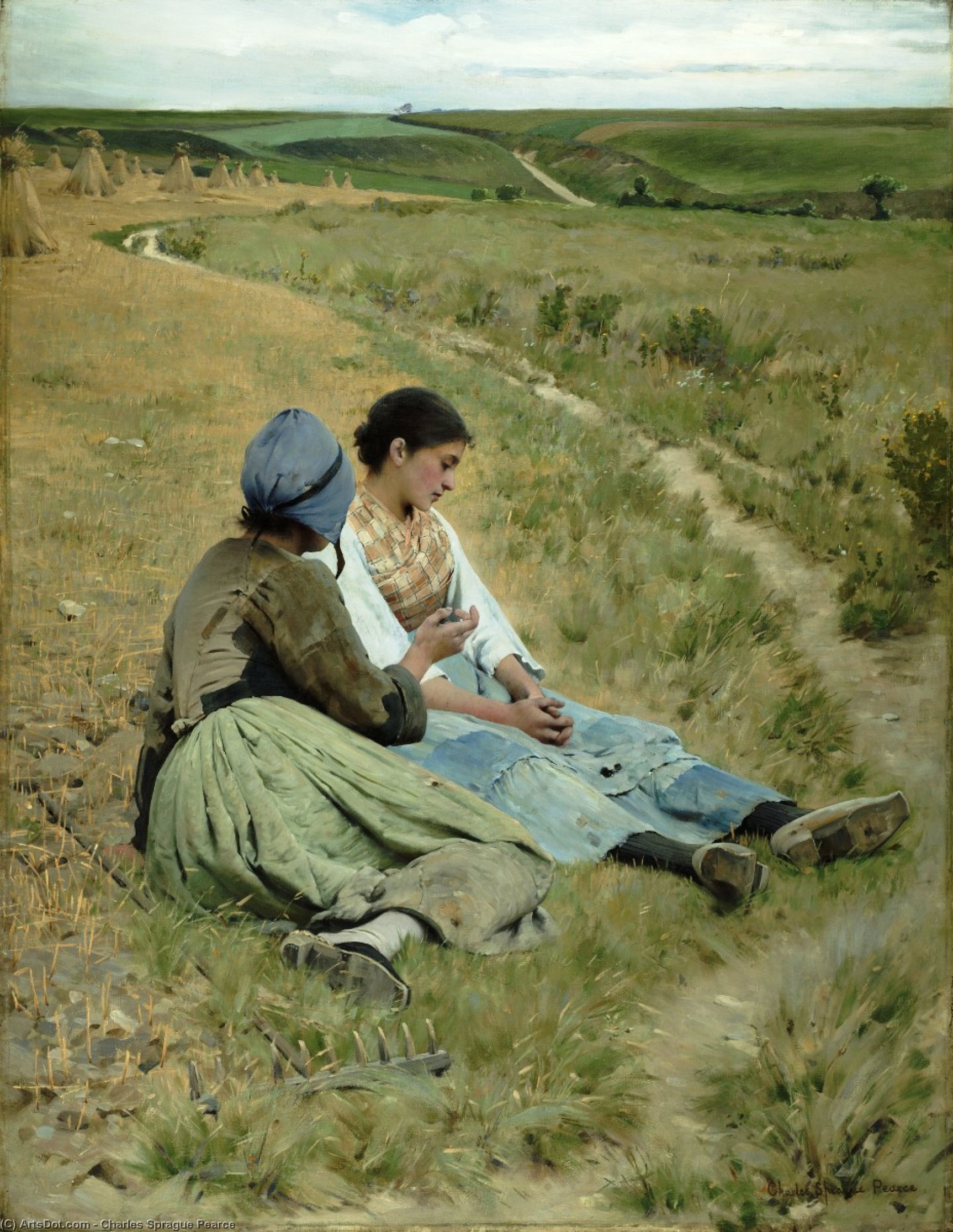
Discover "Heartbreak" by Charles Sprague Pearce (1884). This serene oil painting captures rural life & companionship in a detailed, impressionistic style. Explore this captivating artwork!
Istražite slikarstvo Čarlsa Sprega Pirsа (1851-1914), američkog umetnika poznatog po akademskoj preciznosti, žanr scenama, orijentalnim temama i portretima. Otkrijte remek dela kao što je 'Povratak stada'.
Istražite vrhunsku umetnost u Muzeju lepih umetnosti Virdžinije u Ričmondu! Otkrijte drevne artefakte, Fabergé jaja i raznovrsne kolekcije – besplatan ulaz vas očekuje!
Heartbreak (also known as Peines de Coeur) – A Portrait of Rural Tranquility
The painting Heartbreak, also known as Peines de Coeur, is a beautiful and captivating oil on canvas work created by the American artist Charles Sprague Pearce in 1884. This masterpiece currently resides at the Virginia Museum of Fine Arts in Richmond, United States. It’s more than just a depiction of two women; it's an embodiment of Impressionistic serenity—a moment frozen in time against a backdrop of verdant fields and hazy hills.
Composition & Perspective: Capturing Light and Atmosphere
Pearce skillfully employs a balanced composition, placing the women slightly off-center to draw the viewer’s eye across the expansive grassy expanse. The perspective is subtly flattened, enhancing the sense of depth without resorting to dramatic foreshortening—a technique favored by artists like Vincent Van Gogh who sought to convey emotion through landscape vistas. Horizontal lines dominate the scene, mirroring the stillness of the land and anchoring the gaze towards the distant horizon. Vertical lines emerge from the figures themselves, grounding them within this tranquil environment. The artist’s meticulous attention to detail is evident in the depiction of wheat stalks swaying gently in the breeze and the subtle shading that creates a palpable feeling of warmth emanating from the sunlit day.
Technique & Style: Impressionistic Brushstrokes
Pearce's mastery of oil paint is undeniable, characterized by smooth, delicate brushstrokes that contribute to the overall softness of the image. Unlike academic painting’s emphasis on precise realism, Pearce leans towards Impressionism—a movement prioritizing capturing fleeting impressions of light and color rather than meticulous representation. The artist utilizes a muted palette dominated by greens and browns, punctuated by touches of blue in the women's clothing and sky – colors that harmonize beautifully to evoke a mood of peaceful contemplation. These brushstrokes aren’t merely decorative; they convey texture—the roughness of the grass, the smoothness of the wheat—bringing the scene to life with remarkable vibrancy.
Historical Context & Artistic Influences
The painting was conceived in 1884, coinciding with the establishment of The Snite Museum of Art near South Bend, Indiana, a testament to the burgeoning interest in art during that era. Pearce’s style resonates with Impressionist contemporaries like Claude Monet and Vincent Van Gogh, artists who similarly explored capturing the ephemeral beauty of nature and conveying emotion through color and light. Monet's Lemon-Trees. Bordighera /art/list/?Filter=5ZKBW8-Claude-Monet-Lemon-Trees-Bordighera) shares a similar focus on landscape tranquility, while Van Gogh’s Parsonage Garden at Nuenen with Pond and Figures /art/list/?Filter=5ZKGLH-Vincent-Van-Gogh-Parsonage-Garden-at-Nuenen-with-Pond-and-Figures-The) similarly captures a serene outdoor scene.
Symbolism & Emotional Resonance
Heartbreak transcends mere visual representation; it speaks to themes of companionship, quiet reflection, and the profound connection between humanity and the natural world. The two women seated together symbolize intimacy and shared experience—a celebration of simple pleasures amidst the beauty of rural life. Pearce’s artwork invites viewers to pause, appreciate the subtleties of light and color, and contemplate the enduring power of tranquility. It's a piece that lingers in the mind long after viewing, reminding us of the importance of finding solace and inspiration in moments of quiet contemplation.