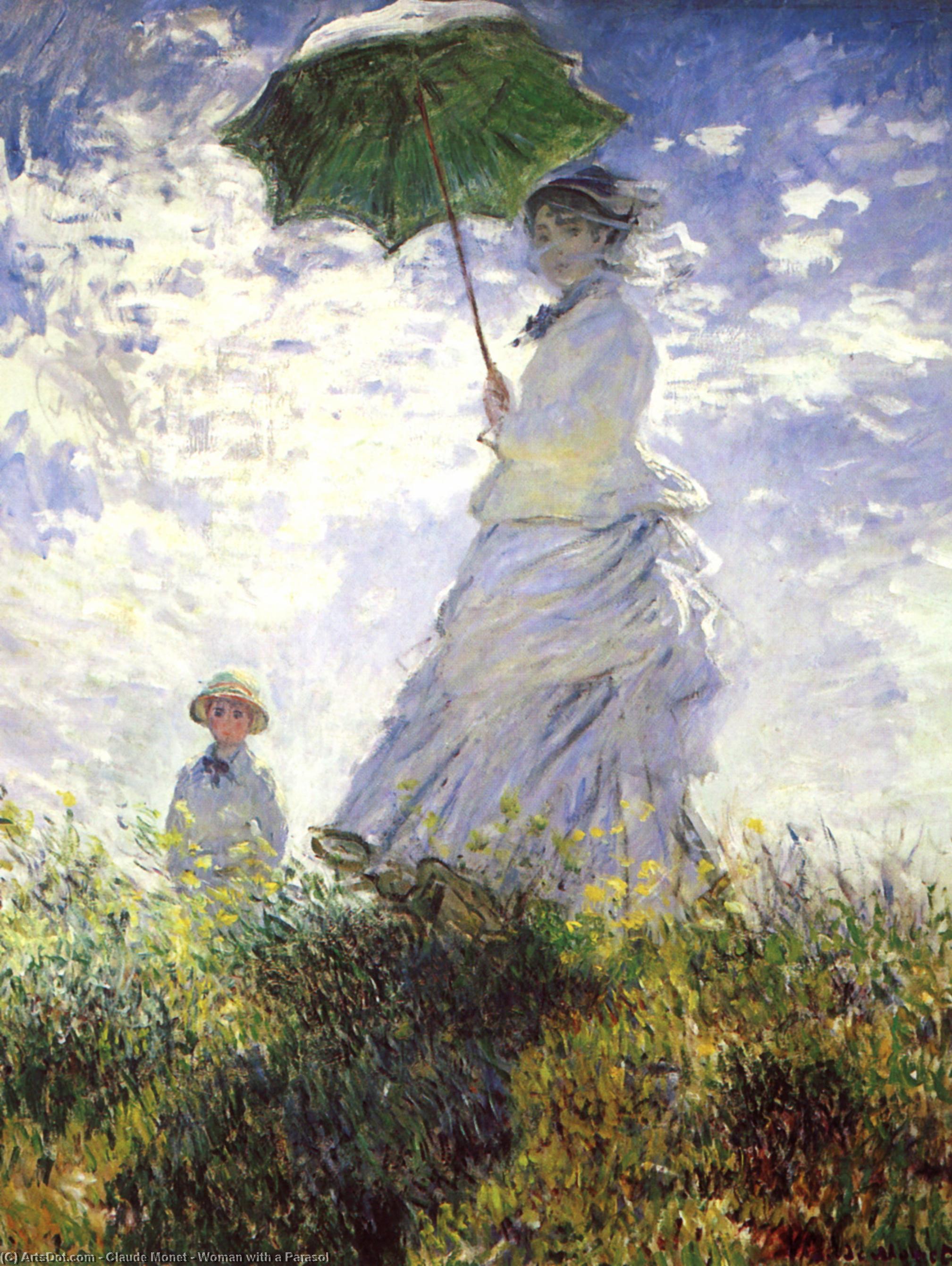
A Moment Captured in Light: Exploring Monet’s “Woman with a Parasol”
Claude Monet, a name instantly recognizable within the annals of Impressionism, wasn't simply concerned with depicting landscapes; he possessed an extraordinary ability to distill the essence of fleeting moments into visual poetry. Born in Paris on November 14, 1840, his formative years unfolded amidst familial relocation to Le Havre, Normandy – a move that inadvertently nurtured his artistic sensibilities. While initially steered toward mercantile pursuits by his father, Monet’s inherent talent for drawing quickly surfaced, evidenced by caricatures he sold locally, demonstrating both considerable skill and an early entrepreneurial spirit. Yet, it was his mentorship under Eugène Boudin that truly cemented his artistic trajectory. Boudin championed the revolutionary concept of *plein air* painting – capturing scenes directly from nature – a practice that would become synonymous with Monet’s oeuvre and profoundly influence the movement itself.
- Subject Matter: The painting portrays Madame Monet Albéniz, Claude Monet's wife, strolling through a sunlit meadow in Argenteuil, France. This seemingly simple depiction holds considerable significance beyond its surface appearance.
- Style & Technique: Monet’s masterful application of Impressionistic technique is immediately apparent. He eschewed meticulous detail and instead prioritized capturing the ephemeral qualities of light and color—a hallmark of Impressionism. The brushstrokes are loose, broken, and blended to create an atmospheric haze that conveys a sense of movement and immediacy.
Historical Context: Impressionism’s Embrace of Nature
Impressionism emerged in France during the late 1860s and early 1870s as a reaction against the academic conventions prevalent at the time. Artists like Monet, Pierre-Auguste Renoir, and Camille Pissarro rejected the rigid rules imposed by the Salon—the official art exhibition of the Académie Royale de Peinture et de Sculpture—favoring instead subjective perception and capturing the sensory experience of the present moment. The Impressionists sought to depict not what they *saw*, but how light transformed the appearance of objects, prioritizing color harmonies over precise representation.
- Symbolism: Beyond its visual beauty, “Woman with a Parasol” carries subtle symbolic resonance. The parasol serves as a protective shield against the sun’s glare, representing not only physical comfort but also perhaps shielding Madame Monet Albéniz from societal pressures and expectations – a common theme in Impressionist art exploring domestic life.
- Color Palette: Monet employed a vibrant palette dominated by greens, yellows, and blues—colors characteristic of the Normandy landscape. These hues are blended seamlessly to create an illusion of depth and luminosity, immersing the viewer in the tranquil beauty of the meadow.
Emotional Impact & Artistic Legacy
“Woman with a Parasol” transcends mere visual depiction; it evokes a profound sense of serenity and nostalgia. Monet’s ability to convey emotion through color and brushwork is remarkable, capturing the fleeting joy of a summer afternoon. This painting exemplifies the Impressionist ideal—to transport the viewer into the artist's experience, allowing them to feel the warmth of the sun, the gentle breeze rustling through the grass, and the quiet contemplation of a woman enjoying the simple pleasures of life. Its enduring popularity testifies to Monet’s genius in capturing not just what he saw but also what he *felt*, establishing “Woman with a Parasol” as one of Impressionism's most beloved masterpieces and cementing Monet’s place as an icon of artistic innovation.