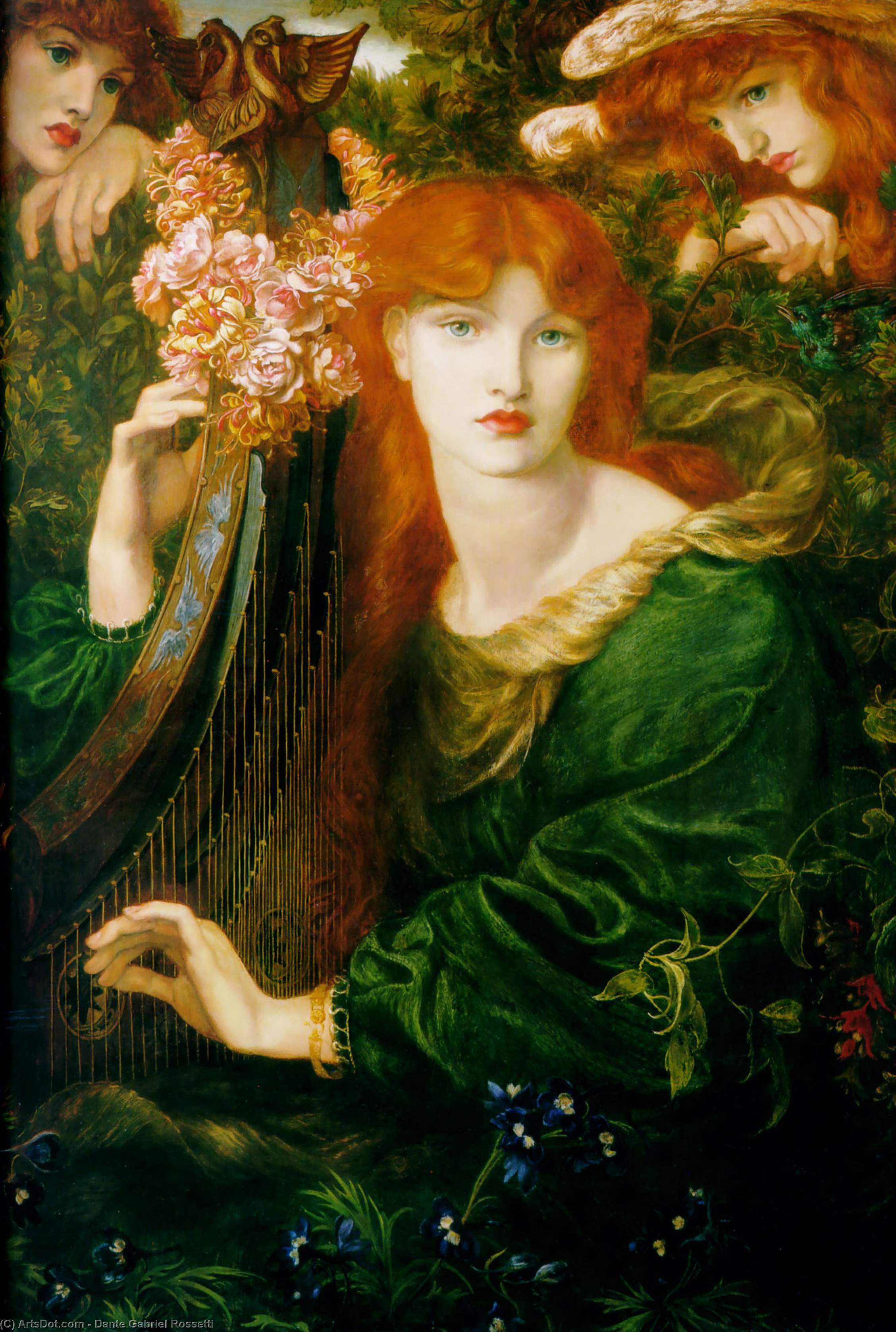
This lush portrait captures the beauty of three women with striking red hair, dressed in emerald green gowns and adorned with flowers. Set against a verdant forest backdrop featuring birds, Rossetti’s ‘The Garland’ exemplifies Romantic ideals within Victorian sensibilities.
A Portrait of Mythic Beauty: Exploring Dante Gabriel Rossetti’s “The Garland”
“The Garland,” painted in 1874 by Dante Gabriel Rossetti, stands as a cornerstone of Victorian Romanticism and an enduring testament to the artist's fascination with mythology and feminine allure. More than just a depiction of three women adorned with flowers—a motif recurrent throughout Rossetti’s oeuvre—the painting delves into profound symbolic layers that resonate with themes of immortality, remembrance, and the cyclical nature of life.
Style and Technique: Impressionistic Hints Within Romantic Form
Rossetti skillfully blends elements of Impressionism with the established conventions of Romantic painting. While retaining a formal composition reminiscent of earlier masters like Ingres, he employs looser brushstrokes and subtle tonal variations that capture the diffused light filtering through the forest backdrop—a characteristic technique championed by artists experimenting with new approaches to color and texture. The meticulous rendering of individual flowers – lilies, roses, violets – contributes to an overall sense of realism tempered by artistic interpretation.
Historical Context: Victorian Sensibility and Literary Influence
Painted during a period marked by anxieties surrounding mortality and fueled by the resurgence of interest in classical mythology—particularly Greek myths concerning Persephone and Hades— “The Garland” reflects the broader intellectual climate of its time. Rossetti’s artistic vision was profoundly influenced by writers such as Tennyson and Browning, whose poetry explored similar themes of beauty, loss, and spiritual yearning. The painting embodies the Victorian preoccupation with idealized femininity and celebrates the power of remembrance as a means of overcoming death.
Symbolism: Flowers as Vessels of Memory and Eternal Life
The garland itself—a symbol of victory and honor—represents not merely outward adornment but also an inner state of spiritual perfection. Each flower meticulously placed in the women’s hands carries specific symbolic significance; lilies symbolize purity and resurrection, roses represent love and beauty, while violets signify modesty and remembrance. These floral emblems serve as visual metaphors for the enduring spirit of those depicted—a testament to Rossetti's belief that beauty transcends temporal limitations.
Emotional Impact: Capturing a Moment of Sublime Tranquility
"The Garland" evokes a feeling of serene contemplation, inviting viewers into a space where earthly concerns dissolve amidst the grandeur of nature and the timeless elegance of feminine grace. The artist’s masterful use of color—particularly greens and reds—creates an atmosphere of lush vibrancy that contrasts subtly with the melancholic undertones inherent in the subject matter. Ultimately, Rossetti's masterpiece succeeds in conveying not merely a visual representation but also an emotional experience—a glimpse into a realm where beauty persists beyond death itself.