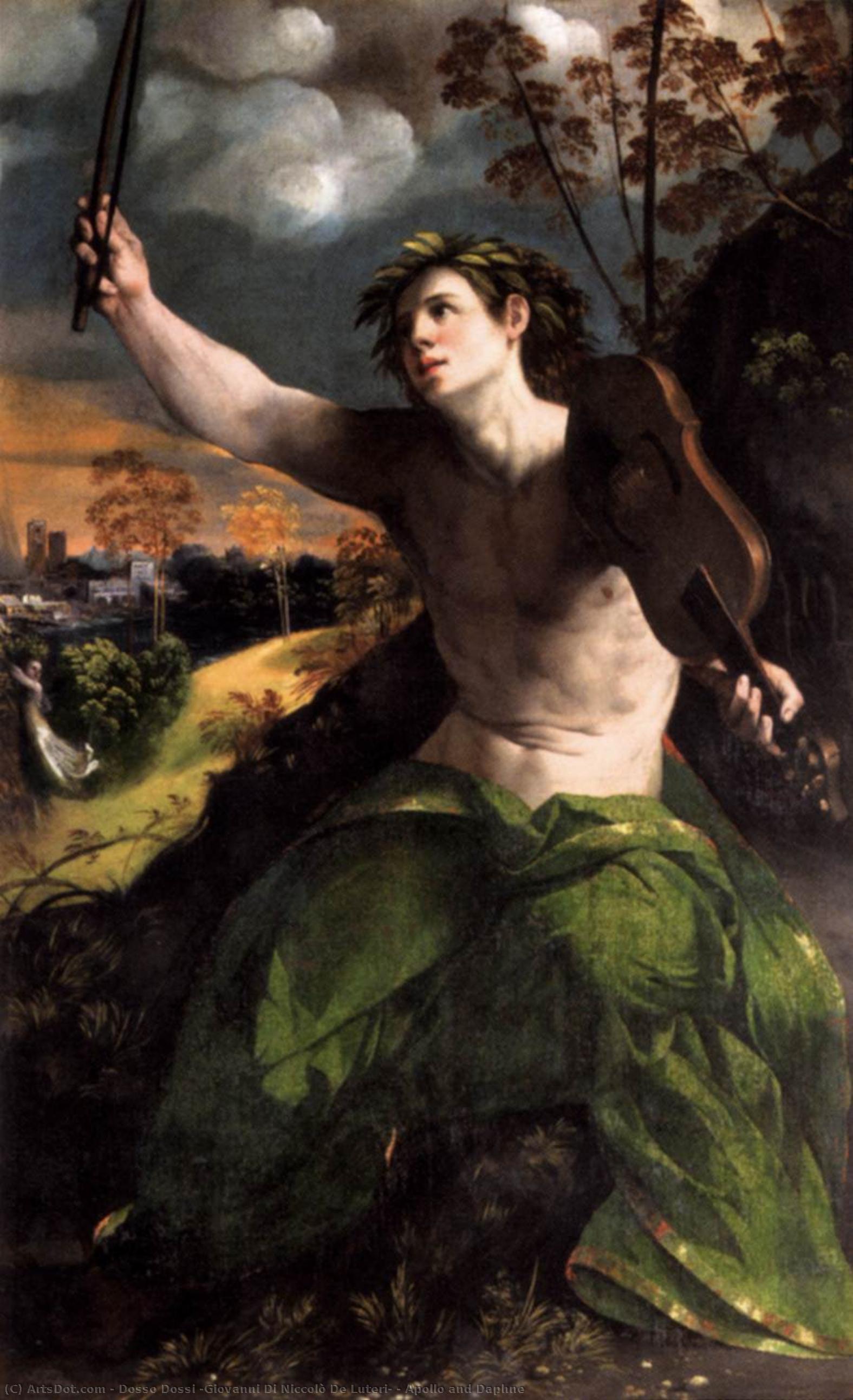
Commissioned by Alfonso I dEste, Duke of Ferrara. Influenced by Raphael and Michelangelo.
Doso Disi (oko 1489–1542) bio je ključni slikar italijanske renesanse Ferarske škole, poznat po mitološkim scenama, sanjivim pejzažima i venecijanskim uticajima. Istražite njegova alegorijska dela i jedinstveni stil!
Otkrijte galeriju Borghese u Rimu! Upoznajte se sa remek-delima Berninija, Rafaela i Karavađa u prelepom baroknom okruženju vile Borgese. Rezervišite svoje karte na vreme!
Dosso Dossi’s Apollo and Daphne: A Renaissance Dreamscape
The artwork depicts a scene from Greek mythology: Apollo and Daphne. It's a Renaissance-style painting with a focus on dramatic lighting and detailed figures, embodying the spirit of Ferrara’s artistic flourishing under Alfonso I dEste. More than just a depiction of legend, it represents a masterful synthesis of humanist ideals and Venetian influences—a testament to Dosso Dossi’s singular vision.
Composition & Narrative Depth
Apollo dominates the foreground, positioned slightly off-center to create visual interest. He’s depicted mid-stride, reaching out as if attempting to grasp Daphne, who is partially visible in the background transforming into a laurel tree. This dynamic arrangement isn't merely aesthetically pleasing; it meticulously conveys the narrative core of Ovid’s Metamorphoses—Apollo’s relentless pursuit of Daphne and her desperate transformation to escape his unwanted affections. The landscape recedes into the distance, establishing depth and perspective, reinforcing the drama unfolding before our eyes.
Color Palette & Atmospheric Illusion
The color palette is dominated by greens and browns, punctuated by splashes of gold and orange in the sky—a deliberate choice that reflects the lush Tuscan countryside surrounding Ferrara during Dosso Dossi’s time. The green hues range from deep forest to lighter shades, creating texture and volume in Apollo’s drapery and the surrounding foliage. Skin tones are rendered with remarkable realism, subtly shaded to convey muscle definition. Crucially, Dosso Dossi employs sfumato—a technique perfected by Leonardo da Vinci—to create a hazy atmospheric effect, blurring the edges of forms and lending an ethereal quality to the scene. This stylistic element elevates the painting beyond mere representation, immersing the viewer in a dreamlike realm evocative of Venetian art.
Technique & Artistic Mastery
Dosso Dossi demonstrates exceptional skill with brushstrokes, generally subtle yet purposeful, contributing to the overall smoothness of the surface. The artist’s meticulous attention to detail—evident in the rendering of Apollo's musculature and Daphne’s delicate transformation—underscores his dedication to capturing the essence of classical sculpture, particularly the Belvedere Torso, which profoundly influenced Renaissance artists. Linear perspective is skillfully employed in the background, creating a convincing illusion of depth and enhancing the dramatic impact of the composition. The use of oil on canvas ensures rich colors and luminous textures, guaranteeing that Dosso Dossi’s masterpiece retains its beauty and grandeur for centuries to come.
Symbolism & Mythological Resonance
The subject matter—the mythological story of Apollo's pursuit of Daphne—holds profound symbolic significance. Daphne embodies purity and resistance to unwanted desire, while Apollo represents divine power and artistic ambition. The laurel wreath, associated with Apollo as god of music and poetry, serves as a visual emblem of this theme, reinforcing the painting’s intellectual depth. Ultimately, Dosso Dossi's *Apollo and Daphne* transcends mere storytelling; it explores universal themes of love, loss, and transformation—a timeless reflection on human experience captured in breathtaking artistic form.