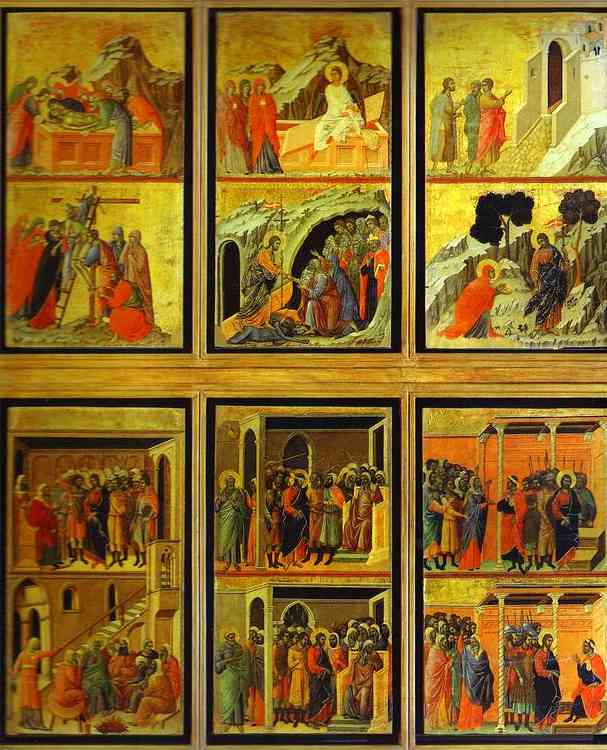
The Maestà by Duccio Di Buoninsegna is a cornerstone of Gothic art from Siena Cathedral, showcasing Mary enthroned with Christ Child and 26 biblical scenes. Admire Duccio’s groundbreaking techniques & explore high-resolution reproductions at ArtsDot.com. Learn about his legacy as a pioneer of Italian painting and its influence on Western visual culture.
The Maestà: A Gothic Vision of Divine Majesty
Duccio di Buoninsegna’s *Maestà*, completed around 1305, stands as an unparalleled achievement in Gothic art—a monumental altarpiece that irrevocably altered the course of Italian painting and cemented Siena Cathedral's place as a beacon of artistic innovation. More than just a depiction of Mary enthroned with Christ Child, it’s a profound meditation on faith, hierarchy, and the sublime beauty attainable through divine grace. Commissioned for the cathedral’s crossing during a turbulent period marked by papal schism and civic strife—a time when Siena wrestled for dominance amongst its rivals—the Maestà wasn't merely intended to adorn a sacred space; it was conceived as an instrument of spiritual upliftment.
A Revolutionary Approach to Composition and Color
What distinguishes Duccio’s masterpiece from its Byzantine predecessors is his daring embrace of naturalism. Unlike the stylized figures of earlier Gothic art, Duccio’s saints and angels possess palpable flesh tones—a revolutionary departure that reflects a burgeoning humanist sensibility. This subtle realism is bolstered by an astonishing mastery of color—particularly gold leaf—which dominates the background and radiates outwards from the throne, symbolizing divine illumination and conveying an overwhelming sense of grandeur. The artist skillfully employed atmospheric perspective, creating depth and luminosity that would inspire generations of painters to come.
Narrative Depth: Scenes From Christ’s Life
The Maestà's reverse panel is equally remarkable for its intricate narrative program—a series of 26 scenes recounting pivotal moments in Jesus’ life. These images, arranged in three horizontal bands, demonstrate Duccio’s exceptional skill at conveying complex theological concepts through visual storytelling. Consider “Jesus Accused by the Pharisees,” a scene brimming with tension and dramatic lighting; or “The Wedding at Cana,” where Duccio captures the joyous celebration of divine providence. Each panel is meticulously crafted, imbued with symbolic detail—from gestures to drapery—that reinforces the overarching narrative and invites contemplation.
Symbolism: Gold Leaf and Heavenly Light
Beyond its compositional innovations and narrative richness, *Maestà* is saturated with symbolism that speaks to the core tenets of Christian faith. The pervasive use of gold leaf isn’t merely decorative; it represents divine glory—the radiant light emanating from God—and underscores Mary's role as Queen of Heaven. Duccio’s meticulous attention to detail extends to every aspect of the painting, from the drapery folds that ripple with movement to the expressions on the faces of the saints and angels—each conveying a profound sense of piety and reverence. These elements coalesce into an unforgettable visual experience that transcends time.
Legacy: An Inspiration for Future Artists
Duccio di Buoninsegna’s *Maestà* irrevocably transformed Italian Gothic art, establishing new standards for naturalism, color palette, and narrative complexity. Its influence can be traced throughout the subsequent centuries—inspiring artists like Simone Martini and Giotto—and continues to resonate today as a testament to human creativity and spiritual aspiration. To experience the majesty of Duccio’s vision firsthand, explore high-resolution reproductions at ArtsDot.com – where you can immerse yourself in the beauty and depth of this enduring masterpiece.