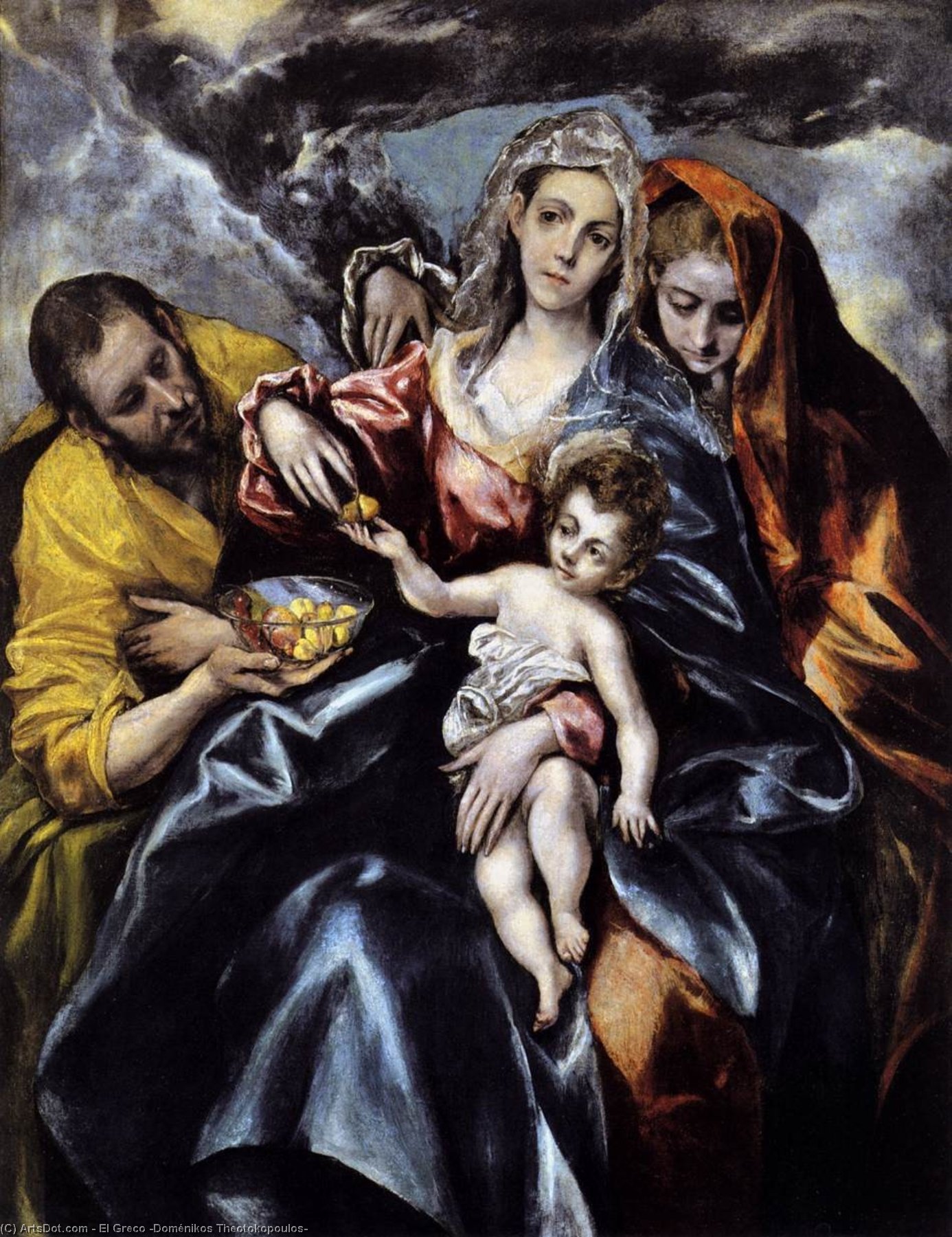
The Holy Family with St Mary Magdalen: A Window into El Greco’s Soul
Doménikos Theotokópoulos, universally known as El Greco, remains one of the most singularly captivating figures in Western art history. His work transcends mere representation; it plunges directly into the emotional core of faith and humanity. “The Holy Family with St Mary Magdalen,” painted in 1595 and currently residing within the Museum of Art in Cleveland, Ohio, is a prime example of this profound artistic vision. Measuring just over a meter by eighty centimeters, this oil-on-canvas painting isn’t imposing in scale, yet it possesses an astonishing intensity that draws the viewer into its world – a world where Byzantine spirituality intertwines with Renaissance sensibilities and a distinctly personal style emerges.
The scene depicted is deceptively simple: the Holy Family—Saint Joseph, the Virgin Mary, and the Christ Child—are joined by St. Mary Magdalen. However, El Greco’s genius lies not in replicating a conventional religious tableau but in imbuing it with an almost palpable sense of drama and intimacy. The composition immediately arrests the eye; figures are elongated, their forms subtly distorted, creating a dynamic tension that speaks to both earthly vulnerability and spiritual aspiration. Notice how Joseph, rendered with a robust physicality, offers Mary a bowl overflowing with fruit – apples, cherries, pears, and peaches—each carefully chosen for its symbolic weight. The inclusion of these still-life elements is crucial; they ground the scene in everyday life, suggesting that faith isn’t confined to sacred rituals but permeates every aspect of human existence.
A Masterclass in Mannerist Technique
El Greco's distinctive style—often categorized as Mannerism—is immediately apparent. He abandons the smooth, polished surfaces favored by earlier Renaissance artists in favor of a textured, almost impastoed application of paint. Bold colors – deep reds, vibrant blues, and luminous yellows – are juxtaposed with areas of shadow, creating a dramatic chiaroscuro effect that intensifies the emotional impact of the scene. The use of oil on canvas allows for incredible depth and luminosity; El Greco masterfully manipulates light and color to create an atmosphere of both serenity and underlying tension. Observe how he employs swirling brushstrokes, particularly in the drapery and the figures’ hair, adding a sense of movement and dynamism that is rarely found in religious paintings of this period.
The elongated forms are not merely stylistic flourishes; they serve to heighten the emotional intensity of the scene. The figures seem almost suspended in time, caught between earthly concerns and divine grace. St. Mary Magdalen, positioned slightly apart from the central family group, gazes outwards with a contemplative expression—a subtle suggestion that she is both present within this domestic setting and aware of the larger narrative of redemption. Her posture and gaze invite the viewer to share in her silent reflection.
Symbolism and Spiritual Depth
Beyond its formal qualities, “The Holy Family” is rich in symbolism. The fruit offered by St. Joseph represents not only earthly abundance but also the fruits of salvation—the apple symbolizing original sin, the cherries representing Christ’s blood, the peaches signifying divine grace, and the pears embodying purity. Mary's selection of these specific fruits underscores her role as a mediator between humanity and God, offering both earthly sustenance and spiritual nourishment to her son. The painting is not simply a depiction of a family; it’s an allegory for the human condition—a testament to faith, hope, and love in the face of adversity.
Reproductions: Preserving El Greco's Legacy
El Greco’s work was widely copied during his lifetime, and many workshop followers continued to produce paintings in his style after his death. “The Holy Family with St Mary Magdalen” is one such composition that has been repeated by his workshop and imitators. For art enthusiasts and collectors seeking an authentic representation of this masterpiece, ArtsDot offers meticulously crafted oil painting reproductions that capture the essence of El Greco’s unique vision. These reproductions are created by skilled artisans who painstakingly replicate every detail, from the artist's distinctive brushstrokes to the rich color palette, ensuring that the emotional power and spiritual depth of the original work are faithfully preserved. To explore more of El Greco’s captivating oeuvre, visit ArtsDot.
For further reading and exploration of El Greco’s works, refer to the following resources: