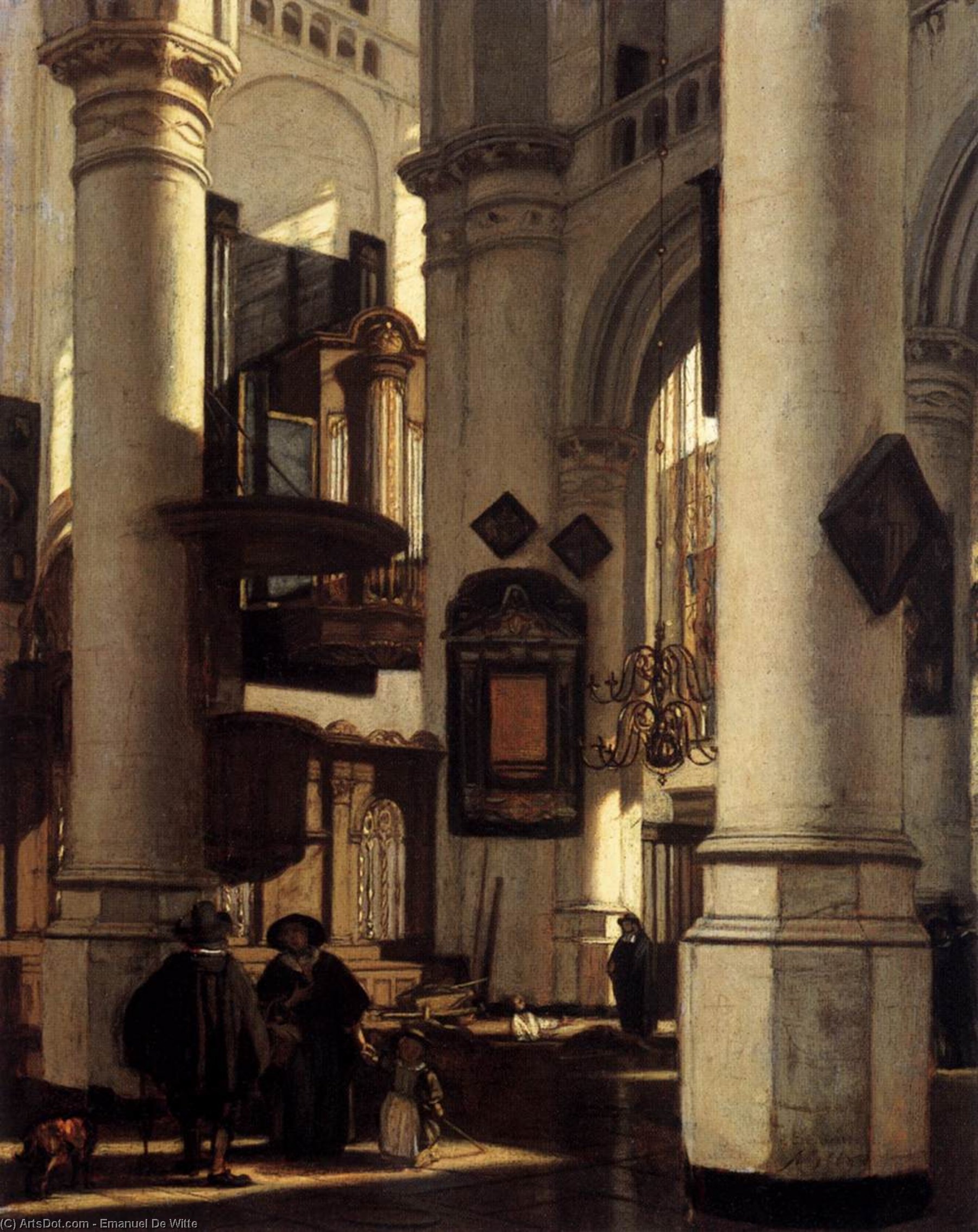
A Sanctuary of Light and Shadow: Exploring Emanuel de Witte’s “Interior of a Protestant Gothic Church”
Emanuel de Witte's "Interior of a Protestant Gothic Church," painted in 1669, isn’t merely a depiction of a sacred space; it’s an immersive experience. This remarkable work transcends the simple act of recording architecture, instead capturing the very *feeling* of being within a grand, dimly lit cathedral – a testament to de Witte's unique artistic vision. Unlike his contemporary Pieter Saenredam, who meticulously documented architectural details with photographic precision, de Witte sought to evoke atmosphere and spiritual resonance. He wasn’t interested in precise measurements or structural accuracy; rather, he aimed to translate the intangible qualities of light, space, and contemplation onto canvas.
The Dance of Light and Form: Technique and Composition
The painting's power lies largely in de Witte’s masterful manipulation of chiaroscuro – the dramatic contrast between light and dark. Strong shafts of illumination, streaming through arched windows on the right, carve deep shadows across the walls and floor, creating a profound sense of depth and volume. This isn’t simply an artistic effect; it's a deliberate strategy to draw the viewer’s eye upwards towards the soaring ceiling and the distant, hazy light beyond. The composition itself is carefully constructed, utilizing vertical columns that act as visual anchors, guiding the gaze skyward. The flattened perspective, while slightly unconventional for the period, contributes to the overall feeling of vastness and reverence. Notice how the brushstrokes themselves subtly reveal the layering of paint – a technique indicative of an oil-on-canvas medium, meticulously applied to build up both texture and luminosity.
- Color Palette: Predominantly warm browns, ochres, and creams create a sense of age and solemnity.
- Lines: Primarily straight and geometric, reflecting the architectural elements but softened by the artist’s hand.
- Texture: Smooth in areas (walls, columns), with slightly rougher textures where light falls, suggesting the physicality of paint application.
Symbolism and Spiritual Resonance: A Window into Faith
Beyond its technical brilliance, “Interior of a Protestant Gothic Church” is rich in symbolic meaning. The darkened figures of worshippers, clad in somber attire, represent faith, contemplation, and the collective experience of worship. The organ, a central element within the space, symbolizes both musical devotion and the power of the church. The architecture itself – the towering columns, arched windows, and vaulted ceiling – speaks to notions of grandeur, stability, and divine authority. De Witte’s choice to depict a Protestant Gothic church is significant; it reflects the religious landscape of 17th-century Netherlands, where various denominations coexisted alongside the dominant Catholic Church. The painting isn't simply a record of a building; it’s an invitation to consider the spiritual significance of this space and the role it plays in the lives of its worshippers.
A Legacy of Atmospheric Realism: De Witte’s Enduring Influence
Emanuel de Witte's work stands apart within the Dutch Golden Age, offering a compelling alternative to the more strictly architectural approaches of artists like Saenredam. His focus on capturing atmosphere and emotional resonance has secured his place as a master of interior space, whose paintings continue to resonate with viewers today. Reproductions of “Interior of a Protestant Gothic Church” offer a remarkable opportunity to experience this evocative work firsthand, bringing the quiet solemnity and spiritual depth of de Witte’s vision into your own home or studio. Consider how his masterful use of light and shadow can transform any room, creating an atmosphere of contemplation and reverence – a true reflection of the sanctuary he so beautifully portrays.