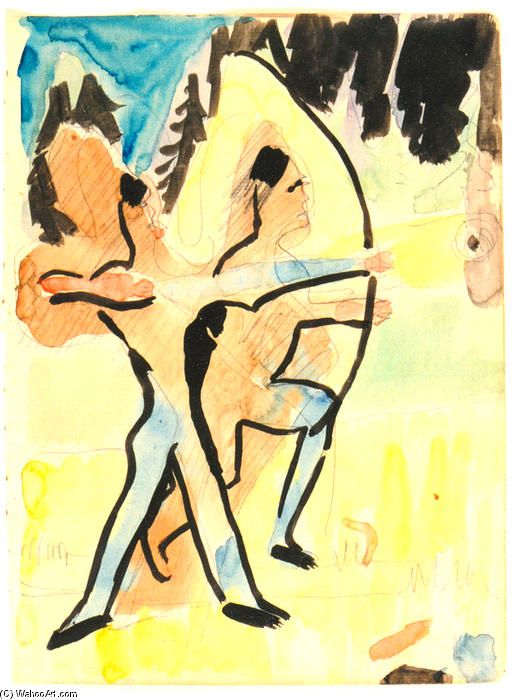
Experience the visceral energy of Ernst Ludwig Kirchner’s ‘Archer at Wildboden,’ a striking pencil drawing embodying German Expressionism's emotive intensity. Bold lines and vibrant hues depict a dynamic hunting scene, capturing a moment of primal action against a textured yellow backdrop.
Ernst Ludwig Kirchner (1880-1938): Ključni umetnik ekspresionizma i osnivač Die Brücke grupe. Istražite snažne emocije u njegovim slikama grada, golih tela i pejzaža – izraz umetnosti početka 20. veka koji vas uvlači u svet umetnosti i umetničkog dela.
A Moment Frozen in Expressionist Intensity
The Archer at Wildboden, created by Ernst Ludwig Kirchner in 1937, isn’t merely a depiction of hunting; it's a visceral embodiment of the anxieties and uncertainties characterizing German Expressionism during its formative years. Painted on canvas measuring 28 x 21 cm, this drawing transcends simple representation to communicate profound emotional states—a hallmark of Kirchner’s distinctive artistic vision.
Style and Technique: Primitivism Meets Bold Impressionism
Kirchner's approach distinguishes itself through a masterful fusion of primitivist influences and bold impressionistic techniques. Rejecting the polished surfaces and idealized forms favored by academic art, he embraced a deliberately rough aesthetic—evident in the textured brushstrokes that dominate the composition. The artist’s use of color is equally striking: a dominant yellow hue pulsates with energy against a backdrop punctuated by assertive blue accents. This chromatic contrast isn't accidental; it serves to heighten the drama and underscore the psychological tension inherent in the scene. Kirchner skillfully employs linear perspective, albeit distorted, to create a sense of immediacy and dynamism—drawing viewers into the action as if they were witnessing it firsthand.
Historical Context: The Crucible of Expressionism
Kirchner’s creation sits firmly within the context of Die Brücke – “The Bridge” – a group of artists who sought to break free from artistic conventions and express their innermost feelings about the social and political realities of Weimar Germany. Following World War I, the movement confronted disillusionment and fear—themes powerfully conveyed in artworks like The Archer at Wildboden. The backdrop of dense trees symbolizes both isolation and resilience, mirroring the struggles faced by artists attempting to forge a new path amidst societal upheaval. The inclusion of a clock subtly reinforces the idea that time itself is passing swiftly, adding another layer of complexity to the narrative.
Symbolism: Tension and Uncertainty Embodied
The central figures—one holding a bow and arrow, the other grasping an unseen object—represent not just hunters but also individuals grappling with internal conflicts and striving for action amidst paralyzing apprehension. The gesture of reaching out embodies desperation and perhaps even futile effort—a poignant reflection of the anxieties prevalent during Kirchner’s time. The yellow background symbolizes optimism or hope battling against darker hues, highlighting the precarious balance between aspiration and despair.
Emotional Impact: Capturing Raw Feeling
Ultimately, The Archer at Wildboden succeeds in conveying a palpable sense of emotional intensity. It's a painting that compels contemplation—provoking viewers to confront their own vulnerabilities and anxieties. Kirchner’s uncompromising style invites us to experience the scene as if we were present within its turbulent atmosphere. Like all reproductions from ArtsDot.com, this artwork offers an opportunity to appreciate the enduring legacy of Expressionism and immerse oneself in a masterpiece of artistic innovation. Explore more at ArtsDot.com.