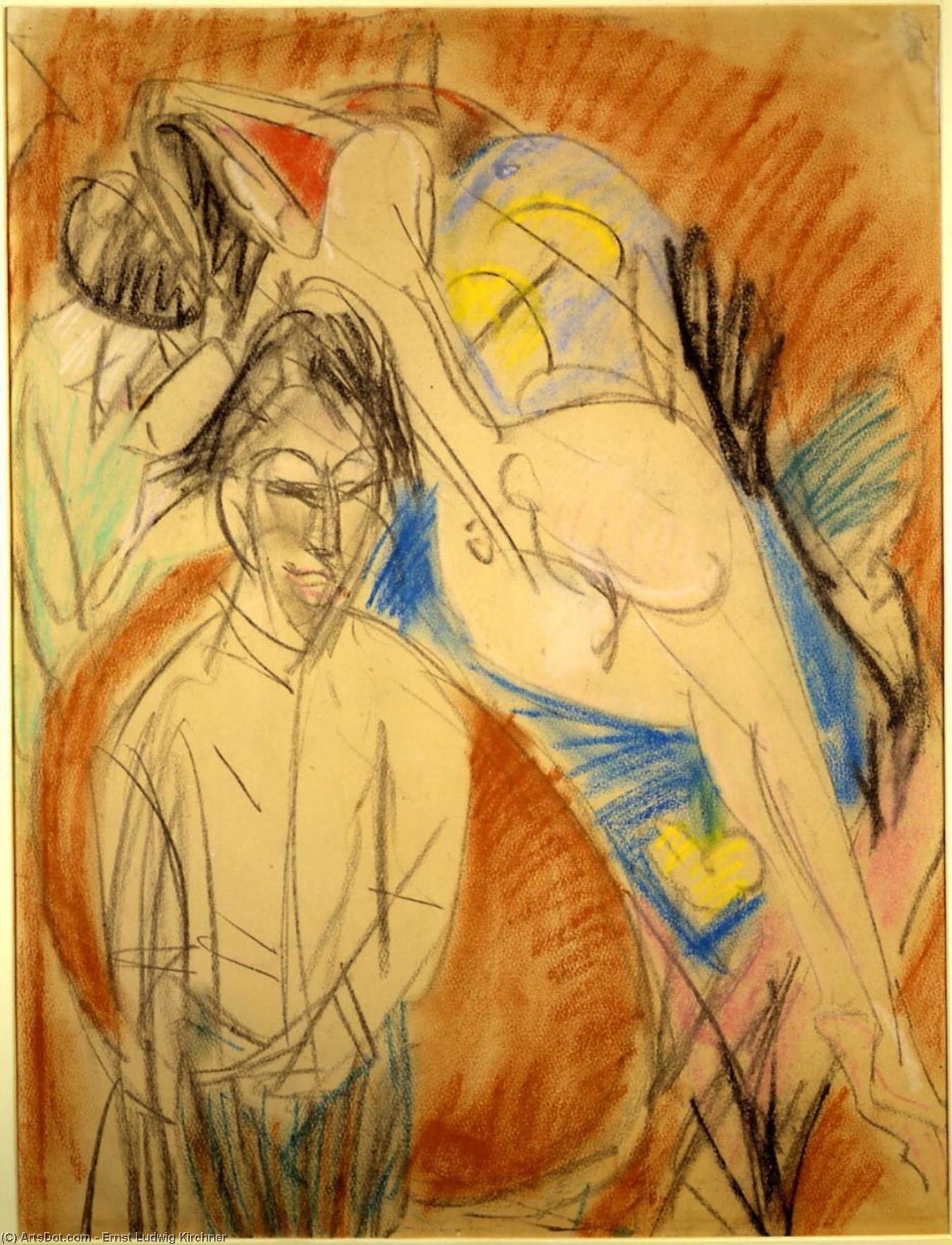
Man and Naked Woman: An Expressionist Exploration of Intimacy
Ernst Ludwig Kirchner's "Man and Naked Woman," created in 1915, stands as a powerful example of Expressionism, a movement that prioritized the artist’s subjective emotional experience over realistic representation. This pastel drawing captures a moment of intimacy between two figures, rendered with bold colors and distorted forms characteristic of Kirchner’s unique style. The artwork is housed within the Bayerische Staatsgemaldesammlungen in Munich, Germany, and offers a glimpse into the anxieties and complexities of early 20th-century life.
Composition and Artistic Style
The composition centers around a man standing on the left side of the frame, his posture suggesting a quiet observation. A naked woman sits to his right, her gaze locked with his, creating an immediate sense of connection. The surrounding space is not empty; other figures and what appears to be an animal—possibly a horse or bird—populate the background, contributing to a dynamic and energetic atmosphere. Kirchner’s use of pastel allows for vibrant color blending and layering, evident in the warm oranges and reds that dominate the palette. The lack of traditional perspective further enhances the feeling of immediacy and emotional intensity. The loose, expressive lines and visible strokes contribute to the artwork's raw energy.
Historical Context: Expressionism and Die Brücke
"Man and Naked Woman" emerged during a period of significant social and political upheaval in Germany. Kirchner was a key figure within the "Die Brücke" (The Bridge) group, founded in 1905 by artists seeking to break away from traditional artistic conventions. This movement aimed to create a bridge between established art forms and the emerging modern world, reflecting the anxieties and uncertainties of the time. Expressionism, as a broader movement, sought to convey subjective emotions and experiences through distorted forms and exaggerated colors. Kirchner’s work reflects these influences, drawing inspiration from artists like Edvard Munch while forging his own distinct style.
Symbolism and Emotional Impact
While not overtly symbolic, "Man and Naked Woman" evokes a range of emotions related to intimacy, vulnerability, and perhaps the fleeting nature of human connection. The figures' gazes suggest a shared moment, yet their isolation within the bustling environment hints at underlying anxieties. The vibrant colors, while visually striking, also contribute to a sense of unease or heightened emotionality. Kirchner’s masterful use of pastel creates a textured surface that amplifies the artwork's expressive power, inviting viewers to contemplate the complexities of human relationships and the psychological landscape of early 20th-century Germany.
Kirchner: A Legacy of Expression
Ernst Ludwig Kirchner (1880-1938) was a German expressionist painter and printmaker. His work, initially celebrated for its innovative approach to color and form, later faced persecution under the Nazi regime, with many of his pieces deemed "degenerate." Despite this adversity, Kirchner's legacy as a pioneering figure in Expressionism remains secure. His exploration of urban life, human relationships, and psychological states continues to resonate with audiences today, making works like “Man and Naked Woman” enduring testaments to the power of artistic expression.
- View more of Kirchner's artwork on ArtsDot.com
- Learn about the Expressionist movement and its key figures on Wikipedia