A Dance of Light and Shadow: The Pulse of Expressionism
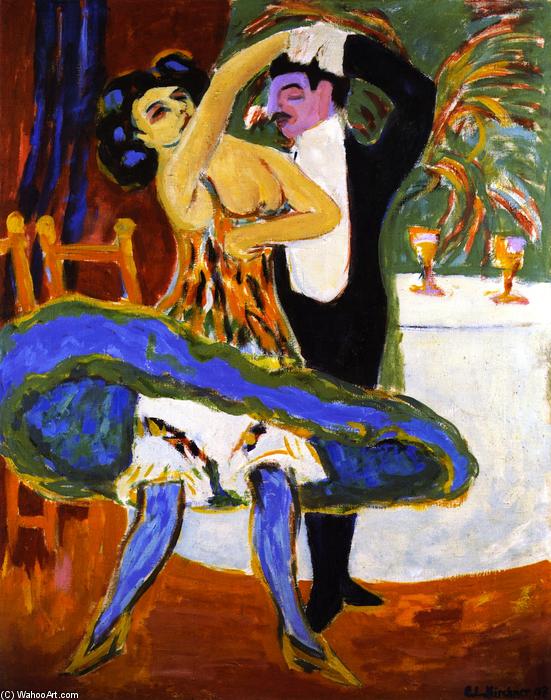
In the heart of the early twentieth century, amidst the burgeoning energy of urban modernity, Ernst Ludwig Kirchner captured a moment of electric vitality in Varieté, Englisches Tanzpaar. This 1910 masterpiece serves as a breathtaking window into the soul of German Expressionism, inviting the viewer to step onto a dance floor vibrating with life. The painting depicts an intimate yet public spectacle: a man and a woman locked in the rhythmic embrace of a dance, their forms partially obscured by the swirling atmosphere of a crowded room. As one gazes upon the canvas, the sense of movement is almost tactile; the figures do not merely exist within the space, they animate it, pulling the observer into a world where the boundaries between individual emotion and collective celebration begin to blur.
Kirchner, a founding member of the radical Die Brücke group, utilized a visual language designed to bypass the intellect and strike directly at the heart. In this work, we see his signature mastery of distorted forms and a palette that refuses to be ignored. The colors are not merely descriptive but emotional; vibrant, clashing hues dance across the canvas just as the subjects do, creating a sense of psychological tension and exhilaration. By eschewing realistic proportions in favor of exaggerated features and jagged, energetic brushstrokes, Kirchner captures the essence of the experience—the heat of the room, the dizzying spin of the dancers, and the underlying pulse of a society on the brink of profound transformation.
The Urban Symphony: Context and Composition
Beyond the central couple, the composition breathes with the presence of others. Figures linger at the periphery, their silhouettes contributing to a dense, layered atmosphere that mirrors the sensory overload of modern city life. A solitary chair sits near the edge of the frame, a quiet anchor amidst the kinetic energy, perhaps suggesting the fleeting nature of these social encounters. This careful arrangement of space creates a dynamic tension, guiding the eye from the focal point of the dancers outward into the hazy, crowded depths of the venue. It is a composition that celebrates the vaudeville spirit—a theatrical, slightly chaotic, and deeply human spectacle.
For the discerning collector or interior designer, Varieté, Englisches Tanzpaar offers more than just aesthetic beauty; it provides a profound emotional resonance. The painting embodies the tension between the individual and the crowd, a theme that remains strikingly relevant in our contemporary era. When rendered as a high-quality oil reproduction, the texture of the brushwork and the depth of the pigments can transform a room, acting as a sophisticated centerpiece that sparks conversation and evokes a sense of historical grandeur. It is an investment in a piece of art history that brings the raw, unbridled spirit of the avant-garde into the modern living space, offering a timeless window into the beautiful turbulence of the human experience.